

4 Impedance and Collective Effects
129
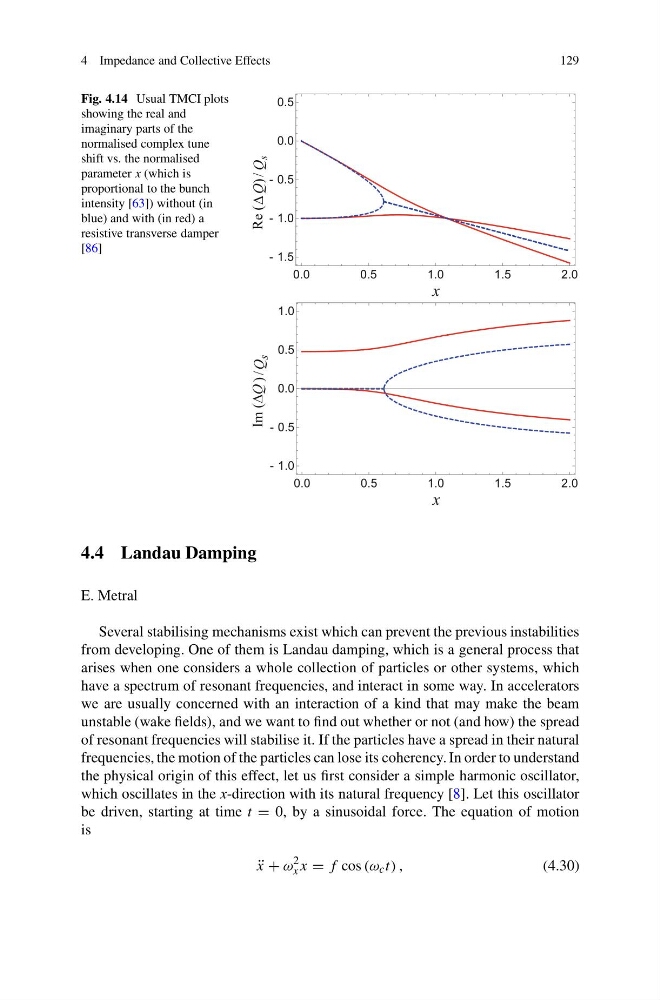
Fig. 4.14 Usual TMCI plots
showing the real and
imaginary parts of the
normalised complex tune
shift vs. the normalised
parameter x (which is
proportional to the bunch
intensity [63]) without (in
blue) and with (in red) a
resistive transverse damper
[86]
0.0
0.5
1.0
1.5
2.0
- 1.5
- 1.0
- 0.5
0.0
0.5
x
0.0
0.5
1.0
1.5
2.0
- 1.0
- 0.5
0.0
0.5
1.0
x
Im (∆Q
)
Q
s
Re (∆
Q)
Q
s
/
/
4.4 Landau Damping
E. Metral
Several stabilising mechanisms exist which can prevent the previous instabilities
from developing. One of them is Landau damping, which is a general process that
arises when one considers a whole collection of particles or other systems, which
have a spectrum of resonant frequencies, and interact in some way. In accelerators
we are usually concerned with an interaction of a kind that may make the beam
unstable (wake fields), and we want to find out whether or not (and how) the spread
of resonant frequencies will stabilise it. If the particles have a spread in their natural
frequencies, the motion of the particles can lose its coherency. In order to understand
the physical origin of this effect, let us first consider a simple harmonic oscillator,
which oscillates in the x-direction with its natural frequency [8]. Let this oscillator
be driven, starting at time t = 0, by a sinusoidal force. The equation of motion
is
¨
x + ω
2
x x = f cos (ω c t) ,
(4.30)
129
Fig. 4.14 Usual TMCI plots
showing the real and
imaginary parts of the
normalised complex tune
shift vs. the normalised
parameter x (which is
proportional to the bunch
intensity [63]) without (in
blue) and with (in red) a
resistive transverse damper
[86]
0.0
0.5
1.0
1.5
2.0
- 1.5
- 1.0
- 0.5
0.0
0.5
x
0.0
0.5
1.0
1.5
2.0
- 1.0
- 0.5
0.0
0.5
1.0
x
Im (∆Q
)
Q
s
Re (∆
Q)
Q
s
/
/
4.4 Landau Damping
E. Metral
Several stabilising mechanisms exist which can prevent the previous instabilities
from developing. One of them is Landau damping, which is a general process that
arises when one considers a whole collection of particles or other systems, which
have a spectrum of resonant frequencies, and interact in some way. In accelerators
we are usually concerned with an interaction of a kind that may make the beam
unstable (wake fields), and we want to find out whether or not (and how) the spread
of resonant frequencies will stabilise it. If the particles have a spread in their natural
frequencies, the motion of the particles can lose its coherency. In order to understand
the physical origin of this effect, let us first consider a simple harmonic oscillator,
which oscillates in the x-direction with its natural frequency [8]. Let this oscillator
be driven, starting at time t = 0, by a sinusoidal force. The equation of motion
is
¨
x + ω
2
x x = f cos (ω c t) ,
(4.30)