

128
E. Metral et al.
0.0
0.5
1.0
1.5
2.0
-1.0
-0.5
0.0
0.5
1.0
0.0
0.5
1.0
1.5
2.0
-2.0
-1.5
-1.0
-0.5
0.0
0.5
1.0
0.0
0.5
1.0
1.5
2.0
-1.0
-0.5
0.0
0.5
1.0
0.0
0.5
1.0
1.5
2.0
-2.0
-1.5
-1.0
-0.5
0.0
0.5
1.0
x
x
x
x
Im (∆Q)
Q
s
Re (∆Q)
Q
s
/
Re (∆Q)
Q
s
/
/
Im (∆Q)
Q
s
/
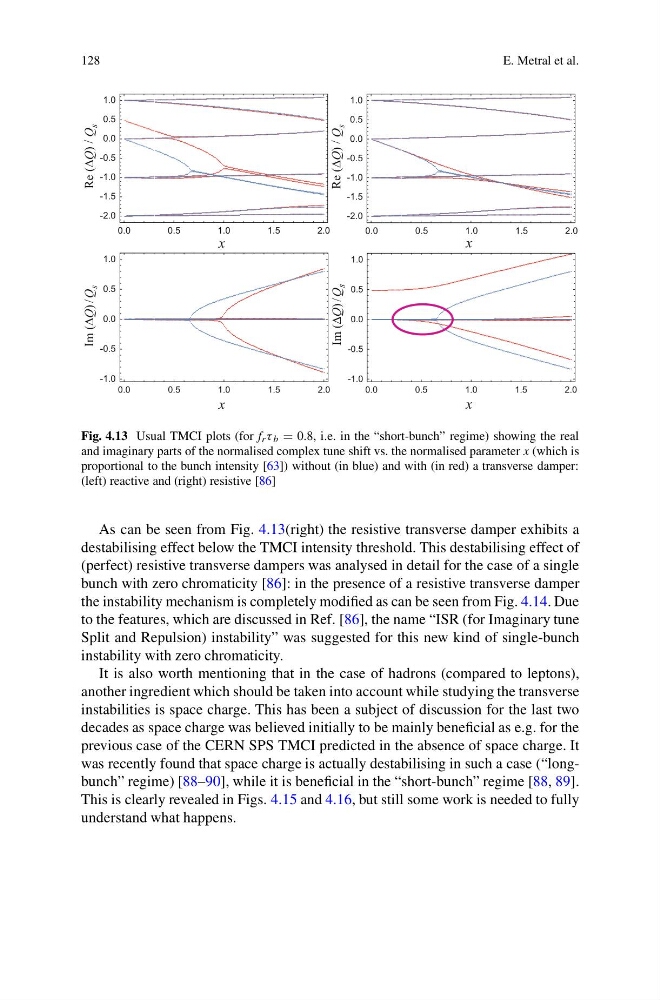
Fig. 4.13 Usual TMCI plots (for f r τ b = 0.8, i.e. in the “short-bunch” regime) showing the real
and imaginary parts of the normalised complex tune shift vs. the normalised parameter x (which is
proportional to the bunch intensity [63]) without (in blue) and with (in red) a transverse damper:
(left) reactive and (right) resistive [86]
As can be seen from Fig. 4.13(right) the resistive transverse damper exhibits a
destabilising effect below the TMCI intensity threshold. This destabilising effect of
(perfect) resistive transverse dampers was analysed in detail for the case of a single
bunch with zero chromaticity [86]: in the presence of a resistive transverse damper
the instability mechanism is completely modified as can be seen from Fig. 4.14. Due
to the features, which are discussed in Ref. [86], the name “ISR (for Imaginary tune
Split and Repulsion) instability” was suggested for this new kind of single-bunch
instability with zero chromaticity.
It is also worth mentioning that in the case of hadrons (compared to leptons),
another ingredient which should be taken into account while studying the transverse
instabilities is space charge. This has been a subject of discussion for the last two
decades as space charge was believed initially to be mainly beneficial as e.g. for the
previous case of the CERN SPS TMCI predicted in the absence of space charge. It
was recently found that space charge is actually destabilising in such a case (“longbunch” regime) [88–90], while it is beneficial in the “short-bunch” regime [88, 89].
This is clearly revealed in Figs. 4.15 and 4.16, but still some work is needed to fully
understand what happens.
E. Metral et al.
0.0
0.5
1.0
1.5
2.0
-1.0
-0.5
0.0
0.5
1.0
0.0
0.5
1.0
1.5
2.0
-2.0
-1.5
-1.0
-0.5
0.0
0.5
1.0
0.0
0.5
1.0
1.5
2.0
-1.0
-0.5
0.0
0.5
1.0
0.0
0.5
1.0
1.5
2.0
-2.0
-1.5
-1.0
-0.5
0.0
0.5
1.0
x
x
x
x
Im (∆Q)
Q
s
Re (∆Q)
Q
s
/
Re (∆Q)
Q
s
/
/
Im (∆Q)
Q
s
/
Fig. 4.13 Usual TMCI plots (for f r τ b = 0.8, i.e. in the “short-bunch” regime) showing the real
and imaginary parts of the normalised complex tune shift vs. the normalised parameter x (which is
proportional to the bunch intensity [63]) without (in blue) and with (in red) a transverse damper:
(left) reactive and (right) resistive [86]
As can be seen from Fig. 4.13(right) the resistive transverse damper exhibits a
destabilising effect below the TMCI intensity threshold. This destabilising effect of
(perfect) resistive transverse dampers was analysed in detail for the case of a single
bunch with zero chromaticity [86]: in the presence of a resistive transverse damper
the instability mechanism is completely modified as can be seen from Fig. 4.14. Due
to the features, which are discussed in Ref. [86], the name “ISR (for Imaginary tune
Split and Repulsion) instability” was suggested for this new kind of single-bunch
instability with zero chromaticity.
It is also worth mentioning that in the case of hadrons (compared to leptons),
another ingredient which should be taken into account while studying the transverse
instabilities is space charge. This has been a subject of discussion for the last two
decades as space charge was believed initially to be mainly beneficial as e.g. for the
previous case of the CERN SPS TMCI predicted in the absence of space charge. It
was recently found that space charge is actually destabilising in such a case (“longbunch” regime) [88–90], while it is beneficial in the “short-bunch” regime [88, 89].
This is clearly revealed in Figs. 4.15 and 4.16, but still some work is needed to fully
understand what happens.