

4 Impedance and Collective Effects
131
0
2
4
6
8
10
12
14
0.0
0.2
0.4
0.6
0.8
1.0
q sc / q
Reduction factor from SC
Head
Tail
Head
Tail
0.4
0.2
0.0
–0.2
2
1
0
–1
–2
–3
Vertical signal [arb, units]
Vertical signal [arb, units]
–0.6 –0.4 –0.2 0.0 0.2 0.4 0.6
Position [m]
–0.6 –0.4 –0.2 0.0 0.2 0.4 0.6
Position [m]
Vertical pick-up signal
Vertical pick-up signal
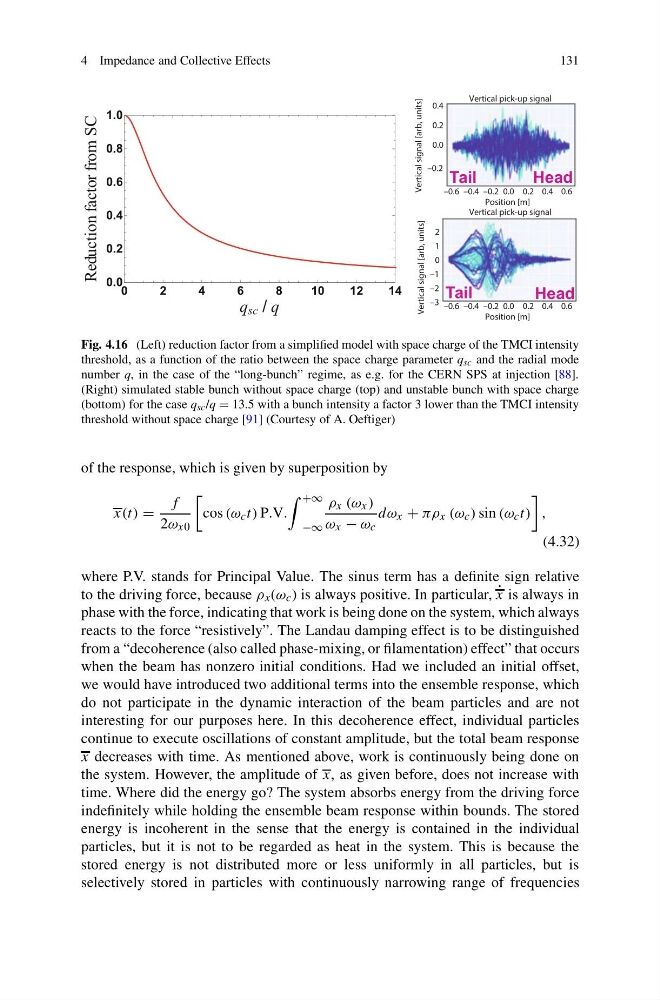
Fig. 4.16 (Left) reduction factor from a simplified model with space charge of the TMCI intensity
threshold, as a function of the ratio between the space charge parameter q sc and the radial mode
number q, in the case of the “long-bunch” regime, as e.g. for the CERN SPS at injection [88].
(Right) simulated stable bunch without space charge (top) and unstable bunch with space charge
(bottom) for the case q sc /q = 13.5 with a bunch intensity a factor 3 lower than the TMCI intensity
threshold without space charge [91] (Courtesy of A. Oeftiger)
of the response, which is given by superposition by
x(t) =
f
2ω x0
cos (ω c t) P.V.
+∞
−∞
ρ x (ω x )
ω x − ω c
dω x + πρ x (ω c ) sin (ω c t)
,
(4.32)
where P.V. stands for Principal Value. The sinus term has a definite sign relative
to the driving force, because ρ x (ω c ) is always positive. In particular, ˙
x is always in
phase with the force, indicating that work is being done on the system, which always
reacts to the force “resistively”. The Landau damping effect is to be distinguished
from a “decoherence (also called phase-mixing, or filamentation) effect” that occurs
when the beam has nonzero initial conditions. Had we included an initial offset,
we would have introduced two additional terms into the ensemble response, which
do not participate in the dynamic interaction of the beam particles and are not
interesting for our purposes here. In this decoherence effect, individual particles
continue to execute oscillations of constant amplitude, but the total beam response
x decreases with time. As mentioned above, work is continuously being done on
the system. However, the amplitude of x, as given before, does not increase with
time. Where did the energy go? The system absorbs energy from the driving force
indefinitely while holding the ensemble beam response within bounds. The stored
energy is incoherent in the sense that the energy is contained in the individual
particles, but it is not to be regarded as heat in the system. This is because the
stored energy is not distributed more or less uniformly in all particles, but is
selectively stored in particles with continuously narrowing range of frequencies
131
0
2
4
6
8
10
12
14
0.0
0.2
0.4
0.6
0.8
1.0
q sc / q
Reduction factor from SC
Head
Tail
Head
Tail
0.4
0.2
0.0
–0.2
2
1
0
–1
–2
–3
Vertical signal [arb, units]
Vertical signal [arb, units]
–0.6 –0.4 –0.2 0.0 0.2 0.4 0.6
Position [m]
–0.6 –0.4 –0.2 0.0 0.2 0.4 0.6
Position [m]
Vertical pick-up signal
Vertical pick-up signal
Fig. 4.16 (Left) reduction factor from a simplified model with space charge of the TMCI intensity
threshold, as a function of the ratio between the space charge parameter q sc and the radial mode
number q, in the case of the “long-bunch” regime, as e.g. for the CERN SPS at injection [88].
(Right) simulated stable bunch without space charge (top) and unstable bunch with space charge
(bottom) for the case q sc /q = 13.5 with a bunch intensity a factor 3 lower than the TMCI intensity
threshold without space charge [91] (Courtesy of A. Oeftiger)
of the response, which is given by superposition by
x(t) =
f
2ω x0
cos (ω c t) P.V.
+∞
−∞
ρ x (ω x )
ω x − ω c
dω x + πρ x (ω c ) sin (ω c t)
,
(4.32)
where P.V. stands for Principal Value. The sinus term has a definite sign relative
to the driving force, because ρ x (ω c ) is always positive. In particular, ˙
x is always in
phase with the force, indicating that work is being done on the system, which always
reacts to the force “resistively”. The Landau damping effect is to be distinguished
from a “decoherence (also called phase-mixing, or filamentation) effect” that occurs
when the beam has nonzero initial conditions. Had we included an initial offset,
we would have introduced two additional terms into the ensemble response, which
do not participate in the dynamic interaction of the beam particles and are not
interesting for our purposes here. In this decoherence effect, individual particles
continue to execute oscillations of constant amplitude, but the total beam response
x decreases with time. As mentioned above, work is continuously being done on
the system. However, the amplitude of x, as given before, does not increase with
time. Where did the energy go? The system absorbs energy from the driving force
indefinitely while holding the ensemble beam response within bounds. The stored
energy is incoherent in the sense that the energy is contained in the individual
particles, but it is not to be regarded as heat in the system. This is because the
stored energy is not distributed more or less uniformly in all particles, but is
selectively stored in particles with continuously narrowing range of frequencies