

126
E. Metral et al.
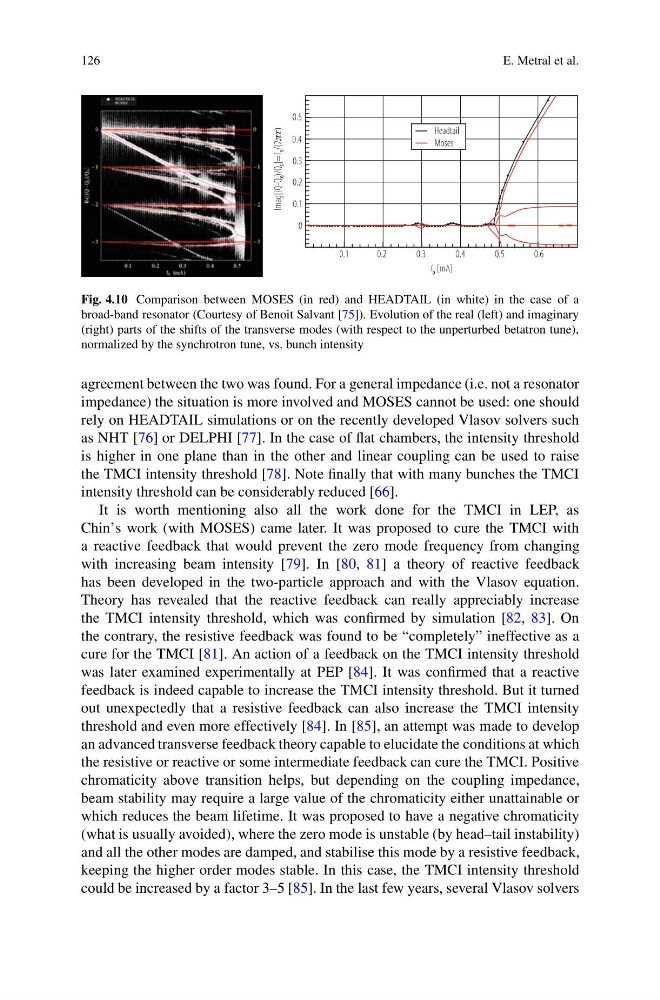
Fig. 4.10 Comparison between MOSES (in red) and HEADTAIL (in white) in the case of a
broad-band resonator (Courtesy of Benoit Salvant [75]). Evolution of the real (left) and imaginary
(right) parts of the shifts of the transverse modes (with respect to the unperturbed betatron tune),
normalized by the synchrotron tune, vs. bunch intensity
agreement between the two was found. For a general impedance (i.e. not a resonator
impedance) the situation is more involved and MOSES cannot be used: one should
rely on HEADTAIL simulations or on the recently developed Vlasov solvers such
as NHT [76] or DELPHI [77]. In the case of flat chambers, the intensity threshold
is higher in one plane than in the other and linear coupling can be used to raise
the TMCI intensity threshold [78]. Note finally that with many bunches the TMCI
intensity threshold can be considerably reduced [66].
It is worth mentioning also all the work done for the TMCI in LEP, as
Chin’s work (with MOSES) came later. It was proposed to cure the TMCI with
a reactive feedback that would prevent the zero mode frequency from changing
with increasing beam intensity [79]. In [80, 81] a theory of reactive feedback
has been developed in the two-particle approach and with the Vlasov equation.
Theory has revealed that the reactive feedback can really appreciably increase
the TMCI intensity threshold, which was confirmed by simulation [82, 83]. On
the contrary, the resistive feedback was found to be “completely” ineffective as a
cure for the TMCI [81]. An action of a feedback on the TMCI intensity threshold
was later examined experimentally at PEP [84]. It was confirmed that a reactive
feedback is indeed capable to increase the TMCI intensity threshold. But it turned
out unexpectedly that a resistive feedback can also increase the TMCI intensity
threshold and even more effectively [84]. In [85], an attempt was made to develop
an advanced transverse feedback theory capable to elucidate the conditions at which
the resistive or reactive or some intermediate feedback can cure the TMCI. Positive
chromaticity above transition helps, but depending on the coupling impedance,
beam stability may require a large value of the chromaticity either unattainable or
which reduces the beam lifetime. It was proposed to have a negative chromaticity
(what is usually avoided), where the zero mode is unstable (by head–tail instability)
and all the other modes are damped, and stabilise this mode by a resistive feedback,
keeping the higher order modes stable. In this case, the TMCI intensity threshold
could be increased by a factor 3–5 [85]. In the last few years, several Vlasov solvers
E. Metral et al.
Fig. 4.10 Comparison between MOSES (in red) and HEADTAIL (in white) in the case of a
broad-band resonator (Courtesy of Benoit Salvant [75]). Evolution of the real (left) and imaginary
(right) parts of the shifts of the transverse modes (with respect to the unperturbed betatron tune),
normalized by the synchrotron tune, vs. bunch intensity
agreement between the two was found. For a general impedance (i.e. not a resonator
impedance) the situation is more involved and MOSES cannot be used: one should
rely on HEADTAIL simulations or on the recently developed Vlasov solvers such
as NHT [76] or DELPHI [77]. In the case of flat chambers, the intensity threshold
is higher in one plane than in the other and linear coupling can be used to raise
the TMCI intensity threshold [78]. Note finally that with many bunches the TMCI
intensity threshold can be considerably reduced [66].
It is worth mentioning also all the work done for the TMCI in LEP, as
Chin’s work (with MOSES) came later. It was proposed to cure the TMCI with
a reactive feedback that would prevent the zero mode frequency from changing
with increasing beam intensity [79]. In [80, 81] a theory of reactive feedback
has been developed in the two-particle approach and with the Vlasov equation.
Theory has revealed that the reactive feedback can really appreciably increase
the TMCI intensity threshold, which was confirmed by simulation [82, 83]. On
the contrary, the resistive feedback was found to be “completely” ineffective as a
cure for the TMCI [81]. An action of a feedback on the TMCI intensity threshold
was later examined experimentally at PEP [84]. It was confirmed that a reactive
feedback is indeed capable to increase the TMCI intensity threshold. But it turned
out unexpectedly that a resistive feedback can also increase the TMCI intensity
threshold and even more effectively [84]. In [85], an attempt was made to develop
an advanced transverse feedback theory capable to elucidate the conditions at which
the resistive or reactive or some intermediate feedback can cure the TMCI. Positive
chromaticity above transition helps, but depending on the coupling impedance,
beam stability may require a large value of the chromaticity either unattainable or
which reduces the beam lifetime. It was proposed to have a negative chromaticity
(what is usually avoided), where the zero mode is unstable (by head–tail instability)
and all the other modes are damped, and stabilise this mode by a resistive feedback,
keeping the higher order modes stable. In this case, the TMCI intensity threshold
could be increased by a factor 3–5 [85]. In the last few years, several Vlasov solvers