

4.1 Numerical Results
To test the developed integer programming model for the vehicle dispatching
problem, we used the P&G Switzerland historical sales order data to construct a
case study.
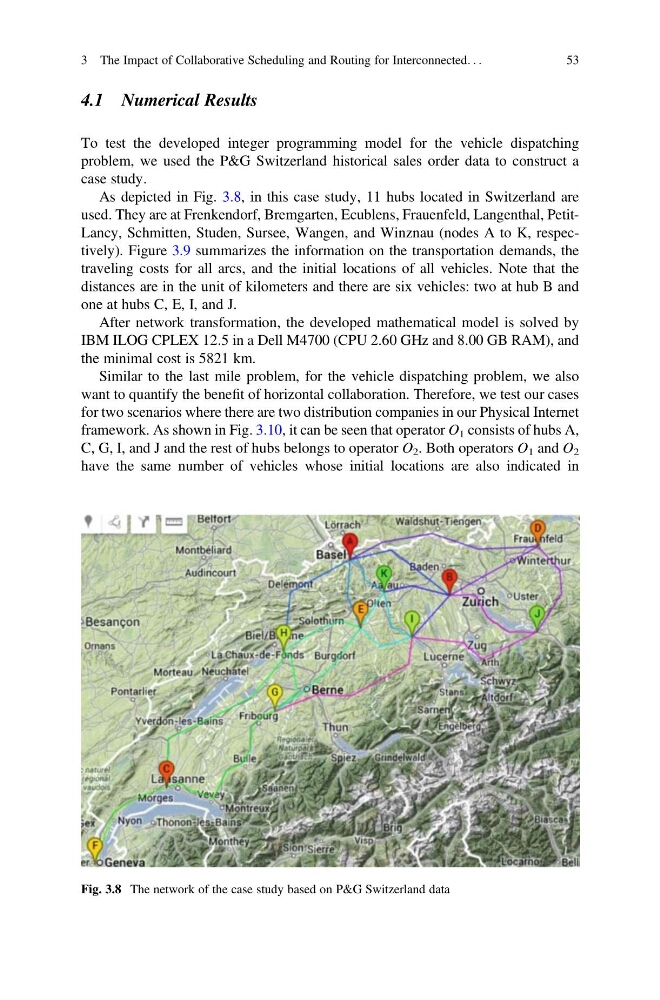
As depicted in Fig. 3.8, in this case study, 11 hubs located in Switzerland are
used. They are at Frenkendorf, Bremgarten, Ecublens, Frauenfeld, Langenthal, PetitLancy, Schmitten, Studen, Sursee, Wangen, and Winznau (nodes A to K, respectively). Figure 3.9 summarizes the information on the transportation demands, the
traveling costs for all arcs, and the initial locations of all vehicles. Note that the
distances are in the unit of kilometers and there are six vehicles: two at hub B and
one at hubs C, E, I, and J.
After network transformation, the developed mathematical model is solved by
IBM ILOG CPLEX 12.5 in a Dell M4700 (CPU 2.60 GHz and 8.00 GB RAM), and
the minimal cost is 5821 km.
Similar to the last mile problem, for the vehicle dispatching problem, we also
want to quantify the benefit of horizontal collaboration. Therefore, we test our cases
for two scenarios where there are two distribution companies in our Physical Internet
framework. As shown in Fig. 3.10, it can be seen that operator O 1 consists of hubs A,
C, G, I, and J and the rest of hubs belongs to operator O 2 . Both operators O 1 and O 2
have the same number of vehicles whose initial locations are also indicated in
Fig. 3.8 The network of the case study based on P&G Switzerland data
3 The Impact of Collaborative Scheduling and Routing for Interconnected. . .
53
To test the developed integer programming model for the vehicle dispatching
problem, we used the P&G Switzerland historical sales order data to construct a
case study.
As depicted in Fig. 3.8, in this case study, 11 hubs located in Switzerland are
used. They are at Frenkendorf, Bremgarten, Ecublens, Frauenfeld, Langenthal, PetitLancy, Schmitten, Studen, Sursee, Wangen, and Winznau (nodes A to K, respectively). Figure 3.9 summarizes the information on the transportation demands, the
traveling costs for all arcs, and the initial locations of all vehicles. Note that the
distances are in the unit of kilometers and there are six vehicles: two at hub B and
one at hubs C, E, I, and J.
After network transformation, the developed mathematical model is solved by
IBM ILOG CPLEX 12.5 in a Dell M4700 (CPU 2.60 GHz and 8.00 GB RAM), and
the minimal cost is 5821 km.
Similar to the last mile problem, for the vehicle dispatching problem, we also
want to quantify the benefit of horizontal collaboration. Therefore, we test our cases
for two scenarios where there are two distribution companies in our Physical Internet
framework. As shown in Fig. 3.10, it can be seen that operator O 1 consists of hubs A,
C, G, I, and J and the rest of hubs belongs to operator O 2 . Both operators O 1 and O 2
have the same number of vehicles whose initial locations are also indicated in
Fig. 3.8 The network of the case study based on P&G Switzerland data
3 The Impact of Collaborative Scheduling and Routing for Interconnected. . .
53