

loaded. Oppositely, the arcs with symbol ! represent the empty moves of a vehicle.
Therefore, it can be observed that in the solution shown in Fig. 3.2, all the transportation demands can be fulfilled and the total traveling cost for such a dispatching plan
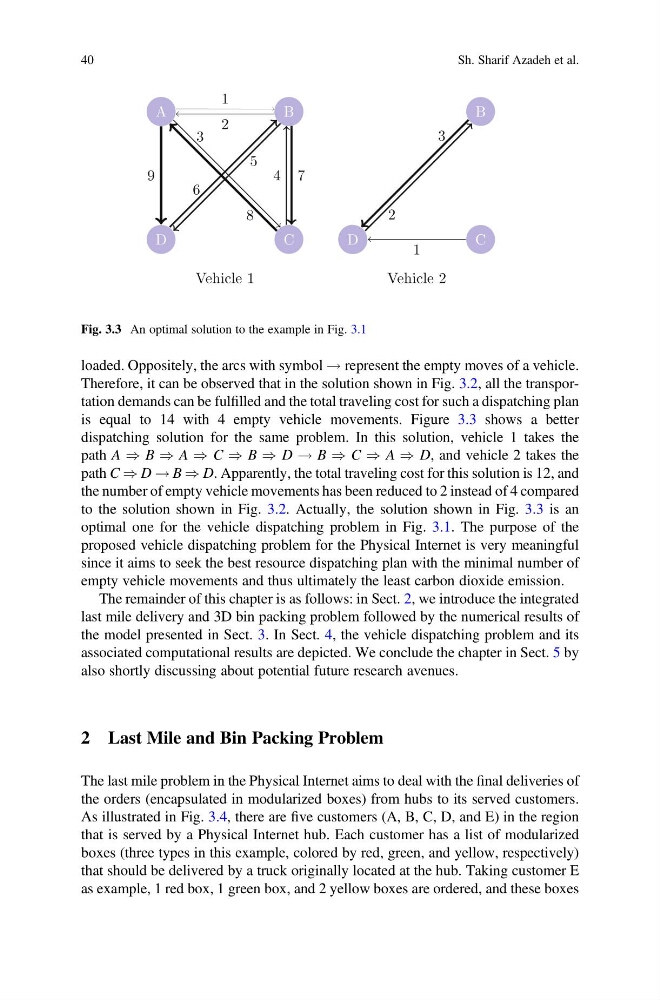
is equal to 14 with 4 empty vehicle movements. Figure 3.3 shows a better
dispatching solution for the same problem. In this solution, vehicle 1 takes the
path A ) B ) A ) C ) B ) D ! B ) C ) A ) D, and vehicle 2 takes the
path C ) D ! B ) D. Apparently, the total traveling cost for this solution is 12, and
the number of empty vehicle movements has been reduced to 2 instead of 4 compared
to the solution shown in Fig. 3.2. Actually, the solution shown in Fig. 3.3 is an
optimal one for the vehicle dispatching problem in Fig. 3.1. The purpose of the
proposed vehicle dispatching problem for the Physical Internet is very meaningful
since it aims to seek the best resource dispatching plan with the minimal number of
empty vehicle movements and thus ultimately the least carbon dioxide emission.
The remainder of this chapter is as follows: in Sect. 2, we introduce the integrated
last mile delivery and 3D bin packing problem followed by the numerical results of
the model presented in Sect. 3. In Sect. 4, the vehicle dispatching problem and its
associated computational results are depicted. We conclude the chapter in Sect. 5 by
also shortly discussing about potential future research avenues.
2 Last Mile and Bin Packing Problem
The last mile problem in the Physical Internet aims to deal with the final deliveries of
the orders (encapsulated in modularized boxes) from hubs to its served customers.
As illustrated in Fig. 3.4, there are five customers (A, B, C, D, and E) in the region
that is served by a Physical Internet hub. Each customer has a list of modularized
boxes (three types in this example, colored by red, green, and yellow, respectively)
that should be delivered by a truck originally located at the hub. Taking customer E
as example, 1 red box, 1 green box, and 2 yellow boxes are ordered, and these boxes
Fig. 3.3 An optimal solution to the example in Fig. 3.1
40
Sh. Sharif Azadeh et al.
Therefore, it can be observed that in the solution shown in Fig. 3.2, all the transportation demands can be fulfilled and the total traveling cost for such a dispatching plan
is equal to 14 with 4 empty vehicle movements. Figure 3.3 shows a better
dispatching solution for the same problem. In this solution, vehicle 1 takes the
path A ) B ) A ) C ) B ) D ! B ) C ) A ) D, and vehicle 2 takes the
path C ) D ! B ) D. Apparently, the total traveling cost for this solution is 12, and
the number of empty vehicle movements has been reduced to 2 instead of 4 compared
to the solution shown in Fig. 3.2. Actually, the solution shown in Fig. 3.3 is an
optimal one for the vehicle dispatching problem in Fig. 3.1. The purpose of the
proposed vehicle dispatching problem for the Physical Internet is very meaningful
since it aims to seek the best resource dispatching plan with the minimal number of
empty vehicle movements and thus ultimately the least carbon dioxide emission.
The remainder of this chapter is as follows: in Sect. 2, we introduce the integrated
last mile delivery and 3D bin packing problem followed by the numerical results of
the model presented in Sect. 3. In Sect. 4, the vehicle dispatching problem and its
associated computational results are depicted. We conclude the chapter in Sect. 5 by
also shortly discussing about potential future research avenues.
2 Last Mile and Bin Packing Problem
The last mile problem in the Physical Internet aims to deal with the final deliveries of
the orders (encapsulated in modularized boxes) from hubs to its served customers.
As illustrated in Fig. 3.4, there are five customers (A, B, C, D, and E) in the region
that is served by a Physical Internet hub. Each customer has a list of modularized
boxes (three types in this example, colored by red, green, and yellow, respectively)
that should be delivered by a truck originally located at the hub. Taking customer E
as example, 1 red box, 1 green box, and 2 yellow boxes are ordered, and these boxes
Fig. 3.3 An optimal solution to the example in Fig. 3.1
40
Sh. Sharif Azadeh et al.