

should be delivered in batch. Thus, the major decisions for the operator of the PI hub
are as follows:
1. How many vehicles should be used to fulfill the delivery task?
2. For each vehicle, which customers should be served?
3. For each vehicle, after assigning the served customers, which visiting sequence
should be adopted by the driver in order to minimize the total traveling distance?
In this vehicle routing problem (VRP), each vehicle has a weight and volume
capacity for its trailer. However, compared to the traditional capacitated VRP, here,
the dimensions of the modularized boxes should also be taken into account when
checking the feasibility of a routing plan for a vehicle. Figure 3.5 shows the necessity
of the consideration in two-dimensional space. For example, let the internal size of a
trailer be rectangle ABCD, and the hatched area is the occupied space by other
modularized boxes. Box FKGH is the next container to be packed into the trailer
which has the volume exactly equal to the current available space (i.e., the rectangle
FECD). Although the overall sum of volume does not exceed the trailer’s capacity,
the box FKGH could not be packed into the trailer even when we allow the rotation
of the box.
Secondly, the visiting sequence of clients for a vehicle poses the constraints on
the packing sequence of the corresponding modularized boxes ordered by the
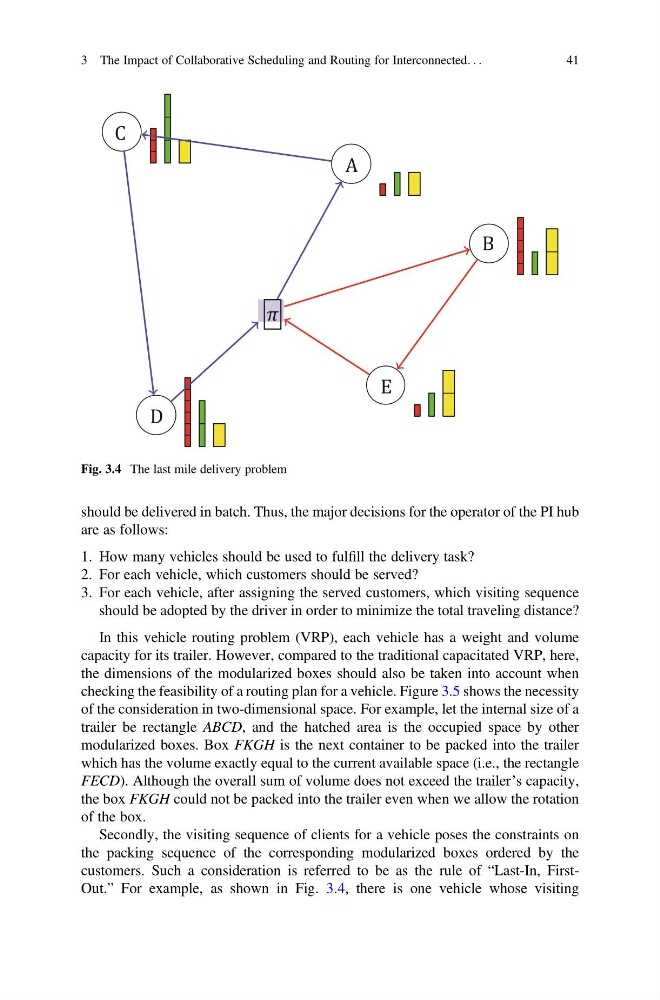
customers. Such a consideration is referred to be as the rule of “Last-In, FirstOut.” For example, as shown in Fig. 3.4, there is one vehicle whose visiting
Fig. 3.4 The last mile delivery problem
3 The Impact of Collaborative Scheduling and Routing for Interconnected. . .
41
are as follows:
1. How many vehicles should be used to fulfill the delivery task?
2. For each vehicle, which customers should be served?
3. For each vehicle, after assigning the served customers, which visiting sequence
should be adopted by the driver in order to minimize the total traveling distance?
In this vehicle routing problem (VRP), each vehicle has a weight and volume
capacity for its trailer. However, compared to the traditional capacitated VRP, here,
the dimensions of the modularized boxes should also be taken into account when
checking the feasibility of a routing plan for a vehicle. Figure 3.5 shows the necessity
of the consideration in two-dimensional space. For example, let the internal size of a
trailer be rectangle ABCD, and the hatched area is the occupied space by other
modularized boxes. Box FKGH is the next container to be packed into the trailer
which has the volume exactly equal to the current available space (i.e., the rectangle
FECD). Although the overall sum of volume does not exceed the trailer’s capacity,
the box FKGH could not be packed into the trailer even when we allow the rotation
of the box.
Secondly, the visiting sequence of clients for a vehicle poses the constraints on
the packing sequence of the corresponding modularized boxes ordered by the
customers. Such a consideration is referred to be as the rule of “Last-In, FirstOut.” For example, as shown in Fig. 3.4, there is one vehicle whose visiting
Fig. 3.4 The last mile delivery problem
3 The Impact of Collaborative Scheduling and Routing for Interconnected. . .
41