

maximize the overall social benefit of truck drivers so that they are able to come back
home after their daily jobs. In this section, we will introduce an optimization
problem called the vehicle dispatching problem inside the PI context. Here, in
transportation demands between any two linked hubs (in terms of how many trailers
of modularized boxes to ship) and the current locations of all the available vehicles
designated for the network (assuming all vehicles are homogeneous with the transportation capacity equal to 1 trailer), the decision-makers need to design a vehicle
dispatching plan for each vehicle such that all the transportation demands are
satisfied and the entire vehicle traveling cost is minimized. For example, in
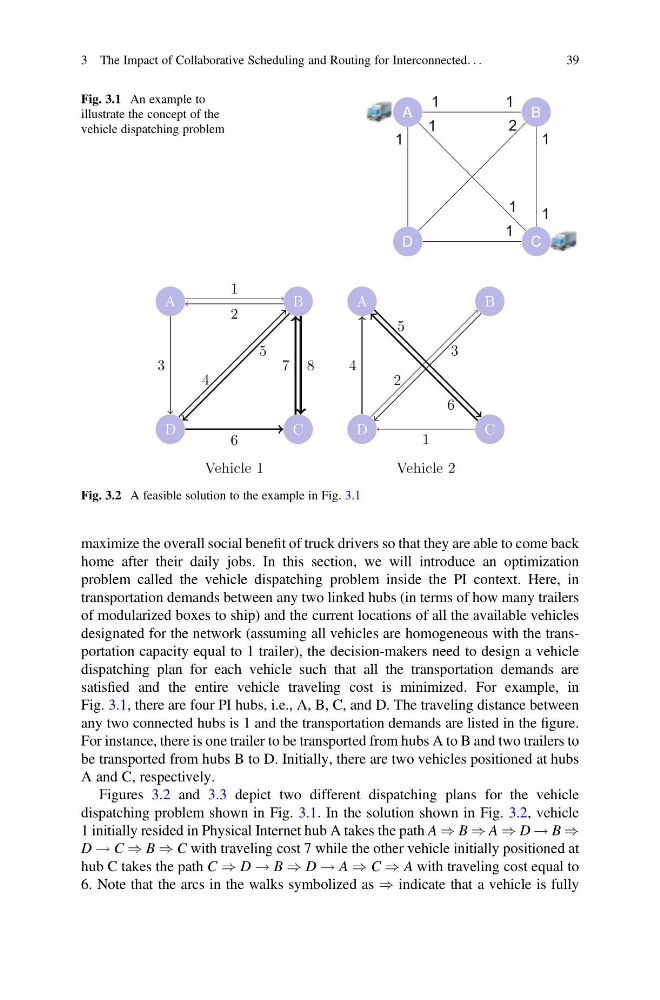
Fig. 3.1, there are four PI hubs, i.e., A, B, C, and D. The traveling distance between
any two connected hubs is 1 and the transportation demands are listed in the figure.
For instance, there is one trailer to be transported from hubs A to B and two trailers to
be transported from hubs B to D. Initially, there are two vehicles positioned at hubs
A and C, respectively.
Figures 3.2 and 3.3 depict two different dispatching plans for the vehicle
dispatching problem shown in Fig. 3.1. In the solution shown in Fig. 3.2, vehicle
1 initially resided in Physical Internet hub A takes the path A ) B ) A ) D ! B )
D ! C ) B ) C with traveling cost 7 while the other vehicle initially positioned at
hub C takes the path C ) D ! B ) D ! A ) C ) A with traveling cost equal to
6. Note that the arcs in the walks symbolized as ) indicate that a vehicle is fully
A
B
C
D
1
1
1
1
1
1
2
1
1
Fig. 3.1 An example to
illustrate the concept of the
vehicle dispatching problem
Fig. 3.2 A feasible solution to the example in Fig. 3.1
3 The Impact of Collaborative Scheduling and Routing for Interconnected. . .
39
home after their daily jobs. In this section, we will introduce an optimization
problem called the vehicle dispatching problem inside the PI context. Here, in
transportation demands between any two linked hubs (in terms of how many trailers
of modularized boxes to ship) and the current locations of all the available vehicles
designated for the network (assuming all vehicles are homogeneous with the transportation capacity equal to 1 trailer), the decision-makers need to design a vehicle
dispatching plan for each vehicle such that all the transportation demands are
satisfied and the entire vehicle traveling cost is minimized. For example, in
Fig. 3.1, there are four PI hubs, i.e., A, B, C, and D. The traveling distance between
any two connected hubs is 1 and the transportation demands are listed in the figure.
For instance, there is one trailer to be transported from hubs A to B and two trailers to
be transported from hubs B to D. Initially, there are two vehicles positioned at hubs
A and C, respectively.
Figures 3.2 and 3.3 depict two different dispatching plans for the vehicle
dispatching problem shown in Fig. 3.1. In the solution shown in Fig. 3.2, vehicle
1 initially resided in Physical Internet hub A takes the path A ) B ) A ) D ! B )
D ! C ) B ) C with traveling cost 7 while the other vehicle initially positioned at
hub C takes the path C ) D ! B ) D ! A ) C ) A with traveling cost equal to
6. Note that the arcs in the walks symbolized as ) indicate that a vehicle is fully
A
B
C
D
1
1
1
1
1
1
2
1
1
Fig. 3.1 An example to
illustrate the concept of the
vehicle dispatching problem
Fig. 3.2 A feasible solution to the example in Fig. 3.1
3 The Impact of Collaborative Scheduling and Routing for Interconnected. . .
39