

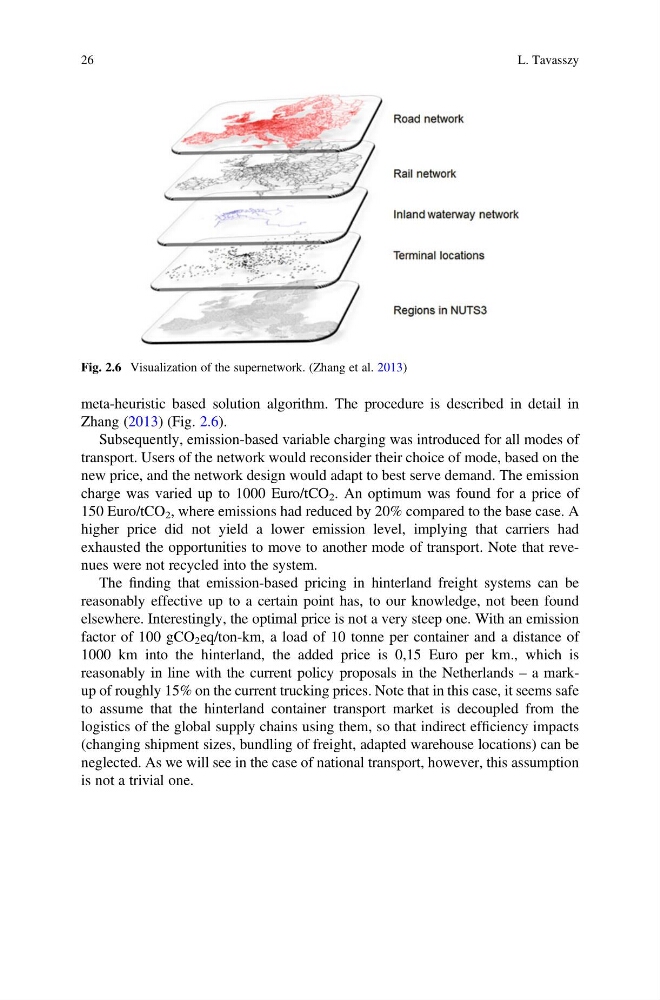
meta-heuristic based solution algorithm. The procedure is described in detail in
Zhang (2013) (Fig. 2.6).
Subsequently, emission-based variable charging was introduced for all modes of
transport. Users of the network would reconsider their choice of mode, based on the
new price, and the network design would adapt to best serve demand. The emission
charge was varied up to 1000 Euro/tCO 2 . An optimum was found for a price of
150 Euro/tCO 2 , where emissions had reduced by 20% compared to the base case. A
higher price did not yield a lower emission level, implying that carriers had
exhausted the opportunities to move to another mode of transport. Note that revenues were not recycled into the system.
The finding that emission-based pricing in hinterland freight systems can be
reasonably effective up to a certain point has, to our knowledge, not been found
elsewhere. Interestingly, the optimal price is not a very steep one. With an emission
factor of 100 gCO 2 eq/ton-km, a load of 10 tonne per container and a distance of
1000 km into the hinterland, the added price is 0,15 Euro per km., which is
reasonably in line with the current policy proposals in the Netherlands – a markup of roughly 15% on the current trucking prices. Note that in this case, it seems safe
to assume that the hinterland container transport market is decoupled from the
logistics of the global supply chains using them, so that indirect efficiency impacts
(changing shipment sizes, bundling of freight, adapted warehouse locations) can be
neglected. As we will see in the case of national transport, however, this assumption
is not a trivial one.
Fig. 2.6 Visualization of the supernetwork. (Zhang et al. 2013)
26
L. Tavasszy
Zhang (2013) (Fig. 2.6).
Subsequently, emission-based variable charging was introduced for all modes of
transport. Users of the network would reconsider their choice of mode, based on the
new price, and the network design would adapt to best serve demand. The emission
charge was varied up to 1000 Euro/tCO 2 . An optimum was found for a price of
150 Euro/tCO 2 , where emissions had reduced by 20% compared to the base case. A
higher price did not yield a lower emission level, implying that carriers had
exhausted the opportunities to move to another mode of transport. Note that revenues were not recycled into the system.
The finding that emission-based pricing in hinterland freight systems can be
reasonably effective up to a certain point has, to our knowledge, not been found
elsewhere. Interestingly, the optimal price is not a very steep one. With an emission
factor of 100 gCO 2 eq/ton-km, a load of 10 tonne per container and a distance of
1000 km into the hinterland, the added price is 0,15 Euro per km., which is
reasonably in line with the current policy proposals in the Netherlands – a markup of roughly 15% on the current trucking prices. Note that in this case, it seems safe
to assume that the hinterland container transport market is decoupled from the
logistics of the global supply chains using them, so that indirect efficiency impacts
(changing shipment sizes, bundling of freight, adapted warehouse locations) can be
neglected. As we will see in the case of national transport, however, this assumption
is not a trivial one.
Fig. 2.6 Visualization of the supernetwork. (Zhang et al. 2013)
26
L. Tavasszy