

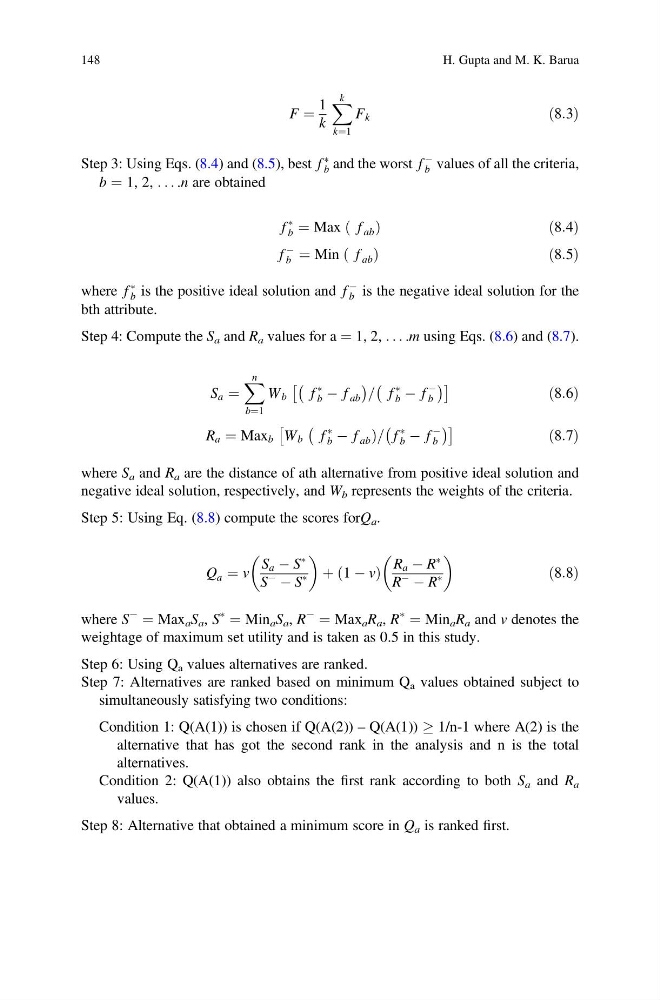
F ¼
1
k
X k
k¼1
F k
ð8:3Þ
Step 3: Using Eqs. (8.4) and (8.5), best f
Ã
b and the worst f
À
b values of all the criteria,
b ¼ 1, 2, . . . .n are obtained
f
Ã
b ¼ Max f ab
ð
Þ
ð8:4Þ
f
À
b ¼ Min f ab
ð
Þ
ð8:5Þ
where f
Ã
b is the positive ideal solution and f
À
b is the negative ideal solution for the
bth attribute.
Step 4: Compute the S a and R a values for a ¼ 1, 2, . . . .m using Eqs. (8.6) and (8.7).
S a ¼
X n
b¼1
W b
f
Ã
b À f ab
À
Á = f
Ã
b À f
À
b
À
Á
Â
Ã
ð8:6Þ
R a ¼ Max b W b f
Ã
b À f ab Þ= f
Ã
b À f
À
b
À
Á
À
Ã
Â
ð8:7Þ
where S a and R a are the distance of ath alternative from positive ideal solution and
negative ideal solution, respectively, and W b represents the weights of the criteria.
Step 5: Using Eq. (8.8) compute the scores forQ a .
Q a ¼ v
S a À S
Ã
S
À
À S
Ã
þ 1 À v
ð
Þ
R a À R
Ã
R
À
À R
Ã
ð8:8Þ
where S
À
¼ Max a S a , S
Ã
¼ Min a S a , R
À
¼ Max a R a , R
Ã
¼ Min a R a and v denotes the
weightage of maximum set utility and is taken as 0.5 in this study.
Step 6: Using Q a values alternatives are ranked.
Step 7: Alternatives are ranked based on minimum Q a values obtained subject to
simultaneously satisfying two conditions:
Condition 1: Q(A(1)) is chosen if Q(A(2)) – Q(A(1)) ! 1/n-1 where A(2) is the
alternative that has got the second rank in the analysis and n is the total
alternatives.
Condition 2: Q(A(1)) also obtains the first rank according to both S a and R a
values.
Step 8: Alternative that obtained a minimum score in Q a is ranked first.
148
H. Gupta and M. K. Barua
1
k
X k
k¼1
F k
ð8:3Þ
Step 3: Using Eqs. (8.4) and (8.5), best f
Ã
b and the worst f
À
b values of all the criteria,
b ¼ 1, 2, . . . .n are obtained
f
Ã
b ¼ Max f ab
ð
Þ
ð8:4Þ
f
À
b ¼ Min f ab
ð
Þ
ð8:5Þ
where f
Ã
b is the positive ideal solution and f
À
b is the negative ideal solution for the
bth attribute.
Step 4: Compute the S a and R a values for a ¼ 1, 2, . . . .m using Eqs. (8.6) and (8.7).
S a ¼
X n
b¼1
W b
f
Ã
b À f ab
À
Á = f
Ã
b À f
À
b
À
Á
Â
Ã
ð8:6Þ
R a ¼ Max b W b f
Ã
b À f ab Þ= f
Ã
b À f
À
b
À
Á
À
Ã
Â
ð8:7Þ
where S a and R a are the distance of ath alternative from positive ideal solution and
negative ideal solution, respectively, and W b represents the weights of the criteria.
Step 5: Using Eq. (8.8) compute the scores forQ a .
Q a ¼ v
S a À S
Ã
S
À
À S
Ã
þ 1 À v
ð
Þ
R a À R
Ã
R
À
À R
Ã
ð8:8Þ
where S
À
¼ Max a S a , S
Ã
¼ Min a S a , R
À
¼ Max a R a , R
Ã
¼ Min a R a and v denotes the
weightage of maximum set utility and is taken as 0.5 in this study.
Step 6: Using Q a values alternatives are ranked.
Step 7: Alternatives are ranked based on minimum Q a values obtained subject to
simultaneously satisfying two conditions:
Condition 1: Q(A(1)) is chosen if Q(A(2)) – Q(A(1)) ! 1/n-1 where A(2) is the
alternative that has got the second rank in the analysis and n is the total
alternatives.
Condition 2: Q(A(1)) also obtains the first rank according to both S a and R a
values.
Step 8: Alternative that obtained a minimum score in Q a is ranked first.
148
H. Gupta and M. K. Barua