

min ξ
L
s.t.
w B À a Bj w j
ξ
L , for all j
w j À a jW w W
ξ
L , for all j
X
j
w j ¼ 1
w j ! 0, for all j
ð8:2Þ
Model (8.2) can be solved to obtain optimal weights (w 1
* , w 2
* , . . .. . . ., w n
* ) and
optimal valueξ
L .
Consistency (ξ
L ) of attribute comparisons close to 0 is desired (Rezaei 2016).
3.3 Evaluating Organizations Using VIKOR
VIKOR method as introduced by Opricovic (1998) has the advantage to provide
optimized solutions in case of complex and conflicting situations and also in cases
where criteria have different units of measurement; it provides an optimized solution
that is closest to an ideal solution using compromise priority approach. The steps of
VIKOR methodology are presented below:
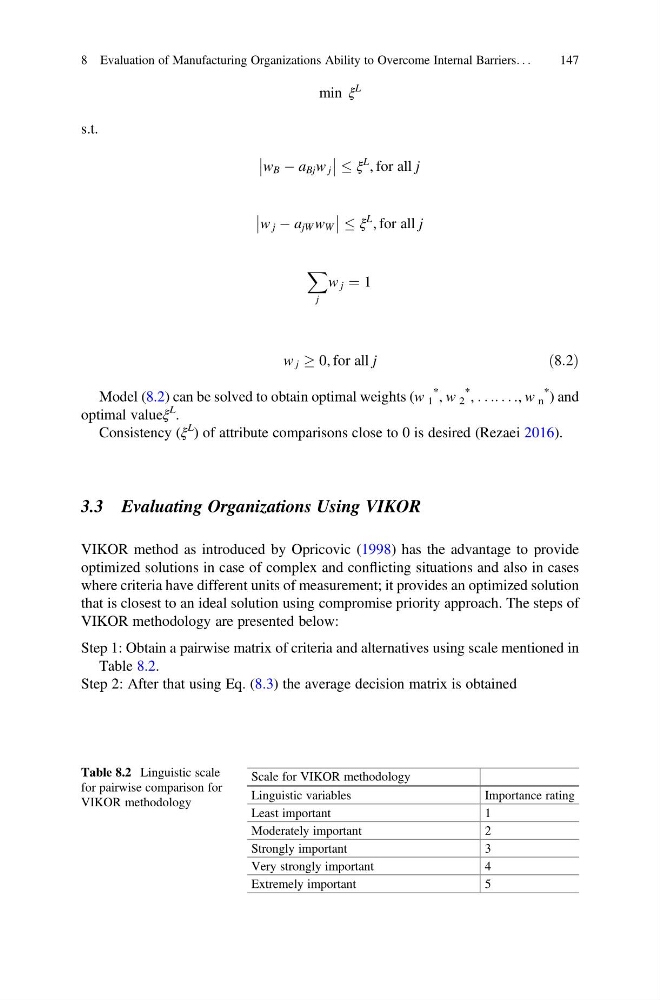
Step 1: Obtain a pairwise matrix of criteria and alternatives using scale mentioned in
Table 8.2.
Step 2: After that using Eq. (8.3) the average decision matrix is obtained
Table 8.2 Linguistic scale
for pairwise comparison for
VIKOR methodology
Scale for VIKOR methodology
Linguistic variables
Importance rating
Least important
1
Moderately important
2
Strongly important
3
Very strongly important
4
Extremely important
5
8 Evaluation of Manufacturing Organizations Ability to Overcome Internal Barriers. . .
147
L
s.t.
w B À a Bj w j
ξ
L , for all j
w j À a jW w W
ξ
L , for all j
X
j
w j ¼ 1
w j ! 0, for all j
ð8:2Þ
Model (8.2) can be solved to obtain optimal weights (w 1
* , w 2
* , . . .. . . ., w n
* ) and
optimal valueξ
L .
Consistency (ξ
L ) of attribute comparisons close to 0 is desired (Rezaei 2016).
3.3 Evaluating Organizations Using VIKOR
VIKOR method as introduced by Opricovic (1998) has the advantage to provide
optimized solutions in case of complex and conflicting situations and also in cases
where criteria have different units of measurement; it provides an optimized solution
that is closest to an ideal solution using compromise priority approach. The steps of
VIKOR methodology are presented below:
Step 1: Obtain a pairwise matrix of criteria and alternatives using scale mentioned in
Table 8.2.
Step 2: After that using Eq. (8.3) the average decision matrix is obtained
Table 8.2 Linguistic scale
for pairwise comparison for
VIKOR methodology
Scale for VIKOR methodology
Linguistic variables
Importance rating
Least important
1
Moderately important
2
Strongly important
3
Very strongly important
4
Extremely important
5
8 Evaluation of Manufacturing Organizations Ability to Overcome Internal Barriers. . .
147