

30
2 Biphenyl Moiety for a Solvent Responsive Aryl Gold(I) …
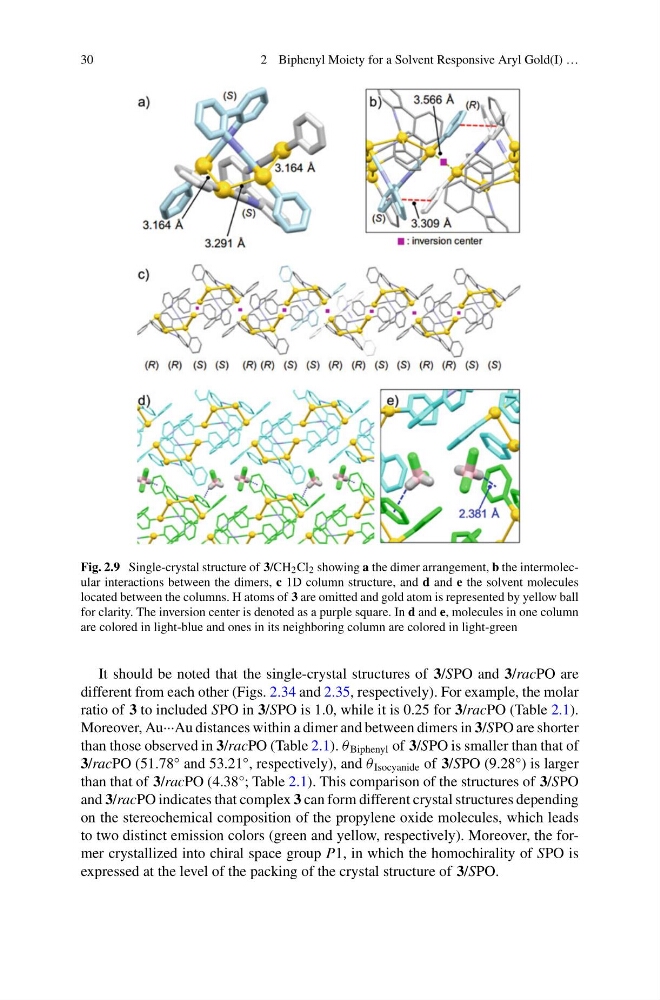
Fig. 2.9 Single-crystal structure of 3/CH 2 Cl 2 showing a the dimer arrangement, b the intermolecular interactions between the dimers, c 1D column structure, and d and e the solvent molecules
located between the columns. H atoms of 3 are omitted and gold atom is represented by yellow ball
for clarity. The inversion center is denoted as a purple square. In d and e, molecules in one column
are colored in light-blue and ones in its neighboring column are colored in light-green
It should be noted that the single-crystal structures of 3/SPO and 3/racPO are
different from each other (Figs. 2.34 and 2.35, respectively). For example, the molar
ratio of 3 to included SPO in 3/SPO is 1.0, while it is 0.25 for 3/racPO (Table 2.1).
Moreover, Au···Au distances within a dimer and between dimers in 3/SPO are shorter
than those observed in 3/racPO (Table 2.1). θ Biphenyl of 3/SPO is smaller than that of
3/racPO (51.78° and 53.21°, respectively), and θ Isocyanide of 3/SPO (9.28°) is larger
than that of 3/racPO (4.38°; Table 2.1). This comparison of the structures of 3/SPO
and 3/racPO indicates that complex 3 can form different crystal structures depending
on the stereochemical composition of the propylene oxide molecules, which leads
to two distinct emission colors (green and yellow, respectively). Moreover, the former crystallized into chiral space group P1, in which the homochirality of SPO is
expressed at the level of the packing of the crystal structure of 3/SPO.
2 Biphenyl Moiety for a Solvent Responsive Aryl Gold(I) …
Fig. 2.9 Single-crystal structure of 3/CH 2 Cl 2 showing a the dimer arrangement, b the intermolecular interactions between the dimers, c 1D column structure, and d and e the solvent molecules
located between the columns. H atoms of 3 are omitted and gold atom is represented by yellow ball
for clarity. The inversion center is denoted as a purple square. In d and e, molecules in one column
are colored in light-blue and ones in its neighboring column are colored in light-green
It should be noted that the single-crystal structures of 3/SPO and 3/racPO are
different from each other (Figs. 2.34 and 2.35, respectively). For example, the molar
ratio of 3 to included SPO in 3/SPO is 1.0, while it is 0.25 for 3/racPO (Table 2.1).
Moreover, Au···Au distances within a dimer and between dimers in 3/SPO are shorter
than those observed in 3/racPO (Table 2.1). θ Biphenyl of 3/SPO is smaller than that of
3/racPO (51.78° and 53.21°, respectively), and θ Isocyanide of 3/SPO (9.28°) is larger
than that of 3/racPO (4.38°; Table 2.1). This comparison of the structures of 3/SPO
and 3/racPO indicates that complex 3 can form different crystal structures depending
on the stereochemical composition of the propylene oxide molecules, which leads
to two distinct emission colors (green and yellow, respectively). Moreover, the former crystallized into chiral space group P1, in which the homochirality of SPO is
expressed at the level of the packing of the crystal structure of 3/SPO.