

2.4 Single-Crystal Structure Analyses
29
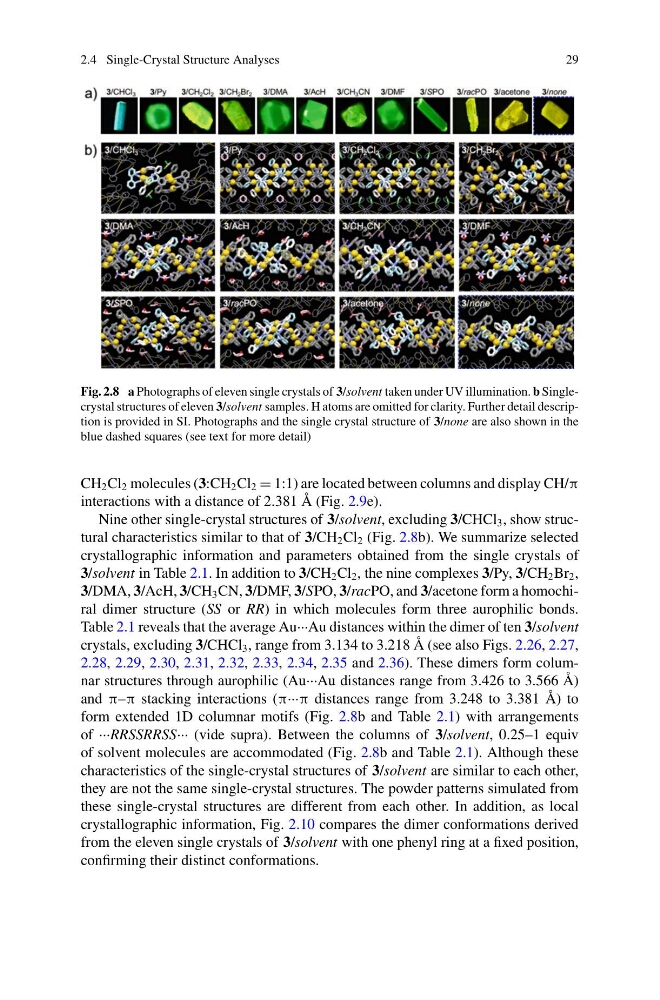
Fig. 2.8 a Photographs of eleven single crystals of 3/solvent taken under UV illumination. b Singlecrystal structures of eleven 3/solvent samples. H atoms are omitted for clarity. Further detail description is provided in SI. Photographs and the single crystal structure of 3/none are also shown in the
blue dashed squares (see text for more detail)
CH 2 Cl 2 molecules (3:CH 2 Cl 2 = 1:1) are located between columns and display CH/π
interactions with a distance of 2.381 Å (Fig. 2.9e).
Nine other single-crystal structures of 3/solvent, excluding 3/CHCl 3 , show structural characteristics similar to that of 3/CH 2 Cl 2 (Fig. 2.8b). We summarize selected
crystallographic information and parameters obtained from the single crystals of
3/solvent in Table 2.1. In addition to 3/CH 2 Cl 2 , the nine complexes 3/Py, 3/CH 2 Br 2 ,
3/DMA, 3/AcH, 3/CH 3 CN, 3/DMF, 3/SPO, 3/racPO, and 3/acetone form a homochiral dimer structure (SS or RR) in which molecules form three aurophilic bonds.
Table 2.1 reveals that the average Au···Au distances within the dimer of ten 3/solvent
crystals, excluding 3/CHCl 3 , range from 3.134 to 3.218 Å (see also Figs. 2.26, 2.27,
2.28, 2.29, 2.30, 2.31, 2.32, 2.33, 2.34, 2.35 and 2.36). These dimers form columnar structures through aurophilic (Au···Au distances range from 3.426 to 3.566 Å)
and π–π stacking interactions (π···π distances range from 3.248 to 3.381 Å) to
form extended 1D columnar motifs (Fig. 2.8b and Table 2.1) with arrangements
of ···RRSSRRSS··· (vide supra). Between the columns of 3/solvent, 0.25–1 equiv
of solvent molecules are accommodated (Fig. 2.8b and Table 2.1). Although these
characteristics of the single-crystal structures of 3/solvent are similar to each other,
they are not the same single-crystal structures. The powder patterns simulated from
these single-crystal structures are different from each other. In addition, as local
crystallographic information, Fig. 2.10 compares the dimer conformations derived
from the eleven single crystals of 3/solvent with one phenyl ring at a fixed position,
confirming their distinct conformations.
29
Fig. 2.8 a Photographs of eleven single crystals of 3/solvent taken under UV illumination. b Singlecrystal structures of eleven 3/solvent samples. H atoms are omitted for clarity. Further detail description is provided in SI. Photographs and the single crystal structure of 3/none are also shown in the
blue dashed squares (see text for more detail)
CH 2 Cl 2 molecules (3:CH 2 Cl 2 = 1:1) are located between columns and display CH/π
interactions with a distance of 2.381 Å (Fig. 2.9e).
Nine other single-crystal structures of 3/solvent, excluding 3/CHCl 3 , show structural characteristics similar to that of 3/CH 2 Cl 2 (Fig. 2.8b). We summarize selected
crystallographic information and parameters obtained from the single crystals of
3/solvent in Table 2.1. In addition to 3/CH 2 Cl 2 , the nine complexes 3/Py, 3/CH 2 Br 2 ,
3/DMA, 3/AcH, 3/CH 3 CN, 3/DMF, 3/SPO, 3/racPO, and 3/acetone form a homochiral dimer structure (SS or RR) in which molecules form three aurophilic bonds.
Table 2.1 reveals that the average Au···Au distances within the dimer of ten 3/solvent
crystals, excluding 3/CHCl 3 , range from 3.134 to 3.218 Å (see also Figs. 2.26, 2.27,
2.28, 2.29, 2.30, 2.31, 2.32, 2.33, 2.34, 2.35 and 2.36). These dimers form columnar structures through aurophilic (Au···Au distances range from 3.426 to 3.566 Å)
and π–π stacking interactions (π···π distances range from 3.248 to 3.381 Å) to
form extended 1D columnar motifs (Fig. 2.8b and Table 2.1) with arrangements
of ···RRSSRRSS··· (vide supra). Between the columns of 3/solvent, 0.25–1 equiv
of solvent molecules are accommodated (Fig. 2.8b and Table 2.1). Although these
characteristics of the single-crystal structures of 3/solvent are similar to each other,
they are not the same single-crystal structures. The powder patterns simulated from
these single-crystal structures are different from each other. In addition, as local
crystallographic information, Fig. 2.10 compares the dimer conformations derived
from the eleven single crystals of 3/solvent with one phenyl ring at a fixed position,
confirming their distinct conformations.