

2.4 Single-Crystal Structure Analyses
31
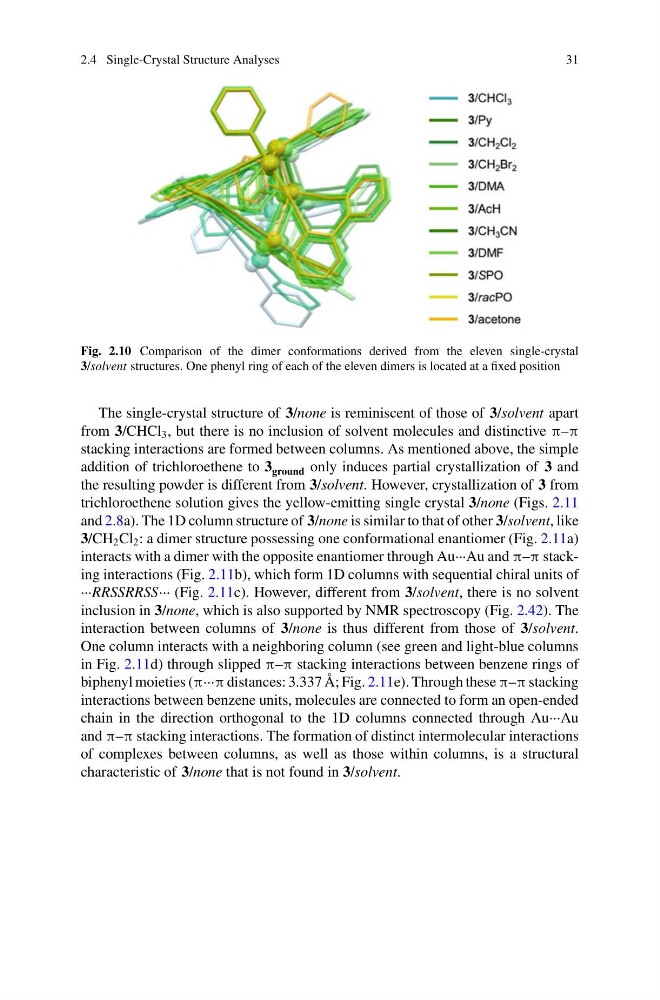
Fig. 2.10 Comparison of the dimer conformations derived from the eleven single-crystal
3/solvent structures. One phenyl ring of each of the eleven dimers is located at a fixed position
The single-crystal structure of 3/none is reminiscent of those of 3/solvent apart
from 3/CHCl 3 , but there is no inclusion of solvent molecules and distinctive π–π
stacking interactions are formed between columns. As mentioned above, the simple
addition of trichloroethene to 3 ground only induces partial crystallization of 3 and
the resulting powder is different from 3/solvent. However, crystallization of 3 from
trichloroethene solution gives the yellow-emitting single crystal 3/none (Figs. 2.11
and 2.8a). The 1D column structure of 3/none is similar to that of other 3/solvent, like
3/CH 2 Cl 2 : a dimer structure possessing one conformational enantiomer (Fig. 2.11a)
interacts with a dimer with the opposite enantiomer through Au···Au and π–π stacking interactions (Fig. 2.11b), which form 1D columns with sequential chiral units of
···RRSSRRSS··· (Fig. 2.11c). However, different from 3/solvent, there is no solvent
inclusion in 3/none, which is also supported by NMR spectroscopy (Fig. 2.42). The
interaction between columns of 3/none is thus different from those of 3/solvent.
One column interacts with a neighboring column (see green and light-blue columns
in Fig. 2.11d) through slipped π–π stacking interactions between benzene rings of
biphenyl moieties (π···π distances: 3.337 Å; Fig. 2.11e). Through these π–π stacking
interactions between benzene units, molecules are connected to form an open-ended
chain in the direction orthogonal to the 1D columns connected through Au···Au
and π–π stacking interactions. The formation of distinct intermolecular interactions
of complexes between columns, as well as those within columns, is a structural
characteristic of 3/none that is not found in 3/solvent.
31
Fig. 2.10 Comparison of the dimer conformations derived from the eleven single-crystal
3/solvent structures. One phenyl ring of each of the eleven dimers is located at a fixed position
The single-crystal structure of 3/none is reminiscent of those of 3/solvent apart
from 3/CHCl 3 , but there is no inclusion of solvent molecules and distinctive π–π
stacking interactions are formed between columns. As mentioned above, the simple
addition of trichloroethene to 3 ground only induces partial crystallization of 3 and
the resulting powder is different from 3/solvent. However, crystallization of 3 from
trichloroethene solution gives the yellow-emitting single crystal 3/none (Figs. 2.11
and 2.8a). The 1D column structure of 3/none is similar to that of other 3/solvent, like
3/CH 2 Cl 2 : a dimer structure possessing one conformational enantiomer (Fig. 2.11a)
interacts with a dimer with the opposite enantiomer through Au···Au and π–π stacking interactions (Fig. 2.11b), which form 1D columns with sequential chiral units of
···RRSSRRSS··· (Fig. 2.11c). However, different from 3/solvent, there is no solvent
inclusion in 3/none, which is also supported by NMR spectroscopy (Fig. 2.42). The
interaction between columns of 3/none is thus different from those of 3/solvent.
One column interacts with a neighboring column (see green and light-blue columns
in Fig. 2.11d) through slipped π–π stacking interactions between benzene rings of
biphenyl moieties (π···π distances: 3.337 Å; Fig. 2.11e). Through these π–π stacking
interactions between benzene units, molecules are connected to form an open-ended
chain in the direction orthogonal to the 1D columns connected through Au···Au
and π–π stacking interactions. The formation of distinct intermolecular interactions
of complexes between columns, as well as those within columns, is a structural
characteristic of 3/none that is not found in 3/solvent.