

2.3 Emission Color Changes Induced by Solvent Addition …
23
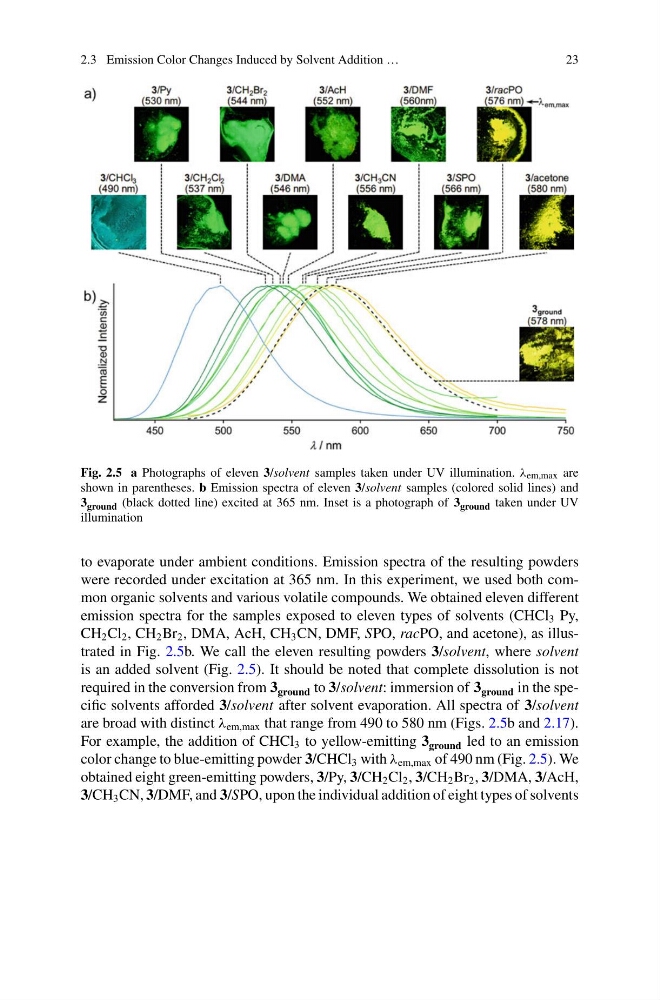
Fig. 2.5 a Photographs of eleven 3/solvent samples taken under UV illumination. λ em,max are
shown in parentheses. b Emission spectra of eleven 3/solvent samples (colored solid lines) and
3 ground (black dotted line) excited at 365 nm. Inset is a photograph of 3 ground taken under UV
illumination
to evaporate under ambient conditions. Emission spectra of the resulting powders
were recorded under excitation at 365 nm. In this experiment, we used both common organic solvents and various volatile compounds. We obtained eleven different
emission spectra for the samples exposed to eleven types of solvents (CHCl 3 Py,
CH 2 Cl 2 , CH 2 Br 2 , DMA, AcH, CH 3 CN, DMF, SPO, racPO, and acetone), as illustrated in Fig. 2.5b. We call the eleven resulting powders 3/solvent, where solvent
is an added solvent (Fig. 2.5). It should be noted that complete dissolution is not
required in the conversion from 3 ground to 3/solvent: immersion of 3 ground in the specific solvents afforded 3/solvent after solvent evaporation. All spectra of 3/solvent
are broad with distinct λ em,max that range from 490 to 580 nm (Figs. 2.5b and 2.17).
For example, the addition of CHCl 3 to yellow-emitting 3 ground led to an emission
color change to blue-emitting powder 3/CHCl 3 with λ em,max of 490 nm (Fig. 2.5). We
obtained eight green-emitting powders, 3/Py, 3/CH 2 Cl 2 , 3/CH 2 Br 2 , 3/DMA, 3/AcH,
3/CH 3 CN, 3/DMF, and 3/SPO, upon the individual addition of eight types of solvents
23
Fig. 2.5 a Photographs of eleven 3/solvent samples taken under UV illumination. λ em,max are
shown in parentheses. b Emission spectra of eleven 3/solvent samples (colored solid lines) and
3 ground (black dotted line) excited at 365 nm. Inset is a photograph of 3 ground taken under UV
illumination
to evaporate under ambient conditions. Emission spectra of the resulting powders
were recorded under excitation at 365 nm. In this experiment, we used both common organic solvents and various volatile compounds. We obtained eleven different
emission spectra for the samples exposed to eleven types of solvents (CHCl 3 Py,
CH 2 Cl 2 , CH 2 Br 2 , DMA, AcH, CH 3 CN, DMF, SPO, racPO, and acetone), as illustrated in Fig. 2.5b. We call the eleven resulting powders 3/solvent, where solvent
is an added solvent (Fig. 2.5). It should be noted that complete dissolution is not
required in the conversion from 3 ground to 3/solvent: immersion of 3 ground in the specific solvents afforded 3/solvent after solvent evaporation. All spectra of 3/solvent
are broad with distinct λ em,max that range from 490 to 580 nm (Figs. 2.5b and 2.17).
For example, the addition of CHCl 3 to yellow-emitting 3 ground led to an emission
color change to blue-emitting powder 3/CHCl 3 with λ em,max of 490 nm (Fig. 2.5). We
obtained eight green-emitting powders, 3/Py, 3/CH 2 Cl 2 , 3/CH 2 Br 2 , 3/DMA, 3/AcH,
3/CH 3 CN, 3/DMF, and 3/SPO, upon the individual addition of eight types of solvents