

22
2 Biphenyl Moiety for a Solvent Responsive Aryl Gold(I) …
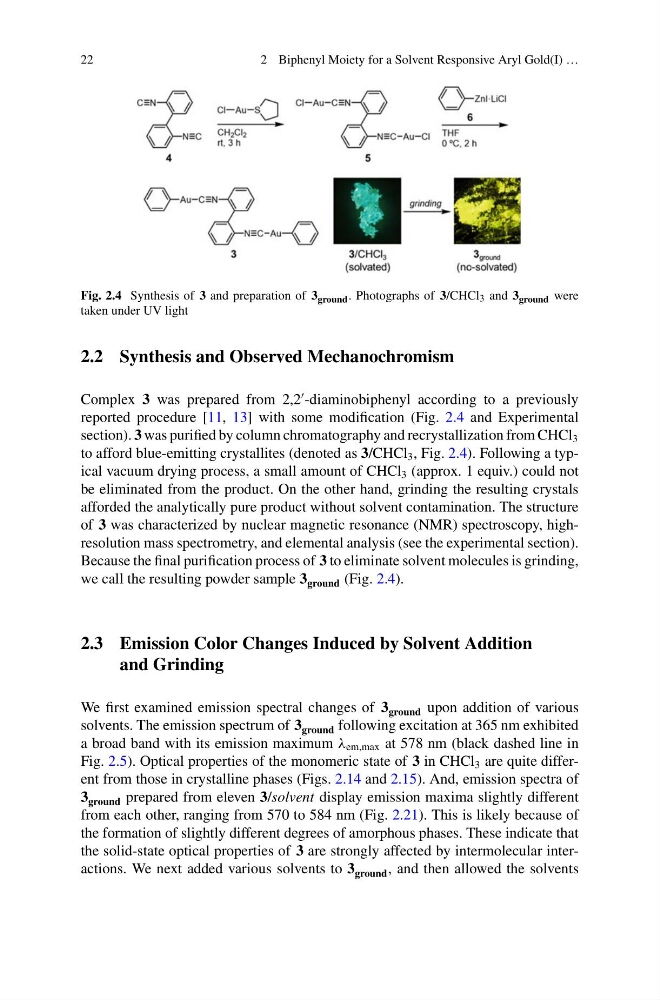
Fig. 2.4 Synthesis of 3 and preparation of 3 ground . Photographs of 3/CHCl 3 and 3 ground were
taken under UV light
2.2 Synthesis and Observed Mechanochromism
Complex 3 was prepared from 2,2
-diaminobiphenyl according to a previously
reported procedure [11, 13] with some modification (Fig. 2.4 and Experimental
section). 3 was purified by column chromatography and recrystallization from CHCl 3
to afford blue-emitting crystallites (denoted as 3/CHCl 3 , Fig. 2.4). Following a typical vacuum drying process, a small amount of CHCl 3 (approx. 1 equiv.) could not
be eliminated from the product. On the other hand, grinding the resulting crystals
afforded the analytically pure product without solvent contamination. The structure
of 3 was characterized by nuclear magnetic resonance (NMR) spectroscopy, highresolution mass spectrometry, and elemental analysis (see the experimental section).
Because the final purification process of 3 to eliminate solvent molecules is grinding,
we call the resulting powder sample 3 ground (Fig. 2.4).
2.3 Emission Color Changes Induced by Solvent Addition
and Grinding
We first examined emission spectral changes of 3 ground upon addition of various
solvents. The emission spectrum of 3 ground following excitation at 365 nm exhibited
a broad band with its emission maximum λ em,max at 578 nm (black dashed line in
Fig. 2.5). Optical properties of the monomeric state of 3 in CHCl 3 are quite different from those in crystalline phases (Figs. 2.14 and 2.15). And, emission spectra of
3 ground prepared from eleven 3/solvent display emission maxima slightly different
from each other, ranging from 570 to 584 nm (Fig. 2.21). This is likely because of
the formation of slightly different degrees of amorphous phases. These indicate that
the solid-state optical properties of 3 are strongly affected by intermolecular interactions. We next added various solvents to 3 ground , and then allowed the solvents
2 Biphenyl Moiety for a Solvent Responsive Aryl Gold(I) …
Fig. 2.4 Synthesis of 3 and preparation of 3 ground . Photographs of 3/CHCl 3 and 3 ground were
taken under UV light
2.2 Synthesis and Observed Mechanochromism
Complex 3 was prepared from 2,2
-diaminobiphenyl according to a previously
reported procedure [11, 13] with some modification (Fig. 2.4 and Experimental
section). 3 was purified by column chromatography and recrystallization from CHCl 3
to afford blue-emitting crystallites (denoted as 3/CHCl 3 , Fig. 2.4). Following a typical vacuum drying process, a small amount of CHCl 3 (approx. 1 equiv.) could not
be eliminated from the product. On the other hand, grinding the resulting crystals
afforded the analytically pure product without solvent contamination. The structure
of 3 was characterized by nuclear magnetic resonance (NMR) spectroscopy, highresolution mass spectrometry, and elemental analysis (see the experimental section).
Because the final purification process of 3 to eliminate solvent molecules is grinding,
we call the resulting powder sample 3 ground (Fig. 2.4).
2.3 Emission Color Changes Induced by Solvent Addition
and Grinding
We first examined emission spectral changes of 3 ground upon addition of various
solvents. The emission spectrum of 3 ground following excitation at 365 nm exhibited
a broad band with its emission maximum λ em,max at 578 nm (black dashed line in
Fig. 2.5). Optical properties of the monomeric state of 3 in CHCl 3 are quite different from those in crystalline phases (Figs. 2.14 and 2.15). And, emission spectra of
3 ground prepared from eleven 3/solvent display emission maxima slightly different
from each other, ranging from 570 to 584 nm (Fig. 2.21). This is likely because of
the formation of slightly different degrees of amorphous phases. These indicate that
the solid-state optical properties of 3 are strongly affected by intermolecular interactions. We next added various solvents to 3 ground , and then allowed the solvents