

24
2 Biphenyl Moiety for a Solvent Responsive Aryl Gold(I) …
(Fig. 2.5a). These green-emitting powders show different λ em,max that range from 530
to 566 nm (Fig. 2.5b). When racPO or acetone was added to 3 ground , only slight emission color changes were visually confirmed. The resulting yellow-emitting 3/racPO
and 3/acetone display yellow emission with λ em,max of 576 and 580, respectively
(Fig. 2.5b). One important characteristic of 3 is the different emission properties of
green-emitting 3/SPO and yellow-emitting 3/racPO with λ em,max of 566 and 576 nm,
respectively; these two samples are distinguishable from each other by observation
under UV light (Fig. 2.5a). This indicates that 3 can act as a solid-state indicator for
the stereochemical composition of propylene oxide.
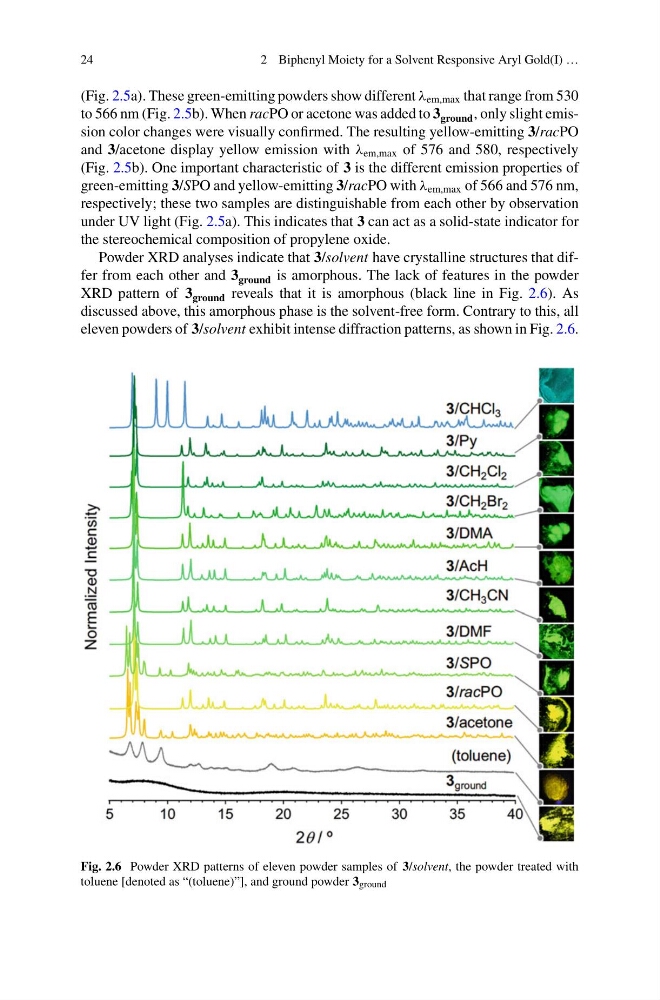
Powder XRD analyses indicate that 3/solvent have crystalline structures that differ from each other and 3 ground is amorphous. The lack of features in the powder
XRD pattern of 3 ground reveals that it is amorphous (black line in Fig. 2.6). As
discussed above, this amorphous phase is the solvent-free form. Contrary to this, all
eleven powders of 3/solvent exhibit intense diffraction patterns, as shown in Fig. 2.6.
Fig. 2.6 Powder XRD patterns of eleven powder samples of 3/solvent, the powder treated with
toluene [denoted as “(toluene)”], and ground powder 3 ground
2 Biphenyl Moiety for a Solvent Responsive Aryl Gold(I) …
(Fig. 2.5a). These green-emitting powders show different λ em,max that range from 530
to 566 nm (Fig. 2.5b). When racPO or acetone was added to 3 ground , only slight emission color changes were visually confirmed. The resulting yellow-emitting 3/racPO
and 3/acetone display yellow emission with λ em,max of 576 and 580, respectively
(Fig. 2.5b). One important characteristic of 3 is the different emission properties of
green-emitting 3/SPO and yellow-emitting 3/racPO with λ em,max of 566 and 576 nm,
respectively; these two samples are distinguishable from each other by observation
under UV light (Fig. 2.5a). This indicates that 3 can act as a solid-state indicator for
the stereochemical composition of propylene oxide.
Powder XRD analyses indicate that 3/solvent have crystalline structures that differ from each other and 3 ground is amorphous. The lack of features in the powder
XRD pattern of 3 ground reveals that it is amorphous (black line in Fig. 2.6). As
discussed above, this amorphous phase is the solvent-free form. Contrary to this, all
eleven powders of 3/solvent exhibit intense diffraction patterns, as shown in Fig. 2.6.
Fig. 2.6 Powder XRD patterns of eleven powder samples of 3/solvent, the powder treated with
toluene [denoted as “(toluene)”], and ground powder 3 ground