

10
1 General Introduction
XRD analysis give no direct information for molecular dynamics in the crystal. Thus,
coupling of complementary techniques that span much wider range of frequencies,
such as variable-temperature solid-state NMR (CP-MAS, wide-line analysis of
2 H
spin echo and T1 spin-lattice relaxation) can provide access to the amplitude and
frequency of motion, as well as the energy of activation of the dynamic process
within the crystal lattice [15].
For the construction of amphidynamic crystals, the components working as static
frames designed to support the dynamic portions of the system should be needed.
Highly mobile components, defined as rotator, may be isolated from each other,
and may have free volume around itself within the crystal lattice. The stator should
connect to the rotators through suitable axles that support their rotary motion, or
through pivots that support an oscillatory movement. Based on these idea, several
molecular or material designs for constructing the amphidynamic crystals have been
reported such as macroscopic gyroscopes, metal-organic frameworks (MOFs), mesoporous organosilicas, organic cages and porous aromatic framworks [15c]. Focusing
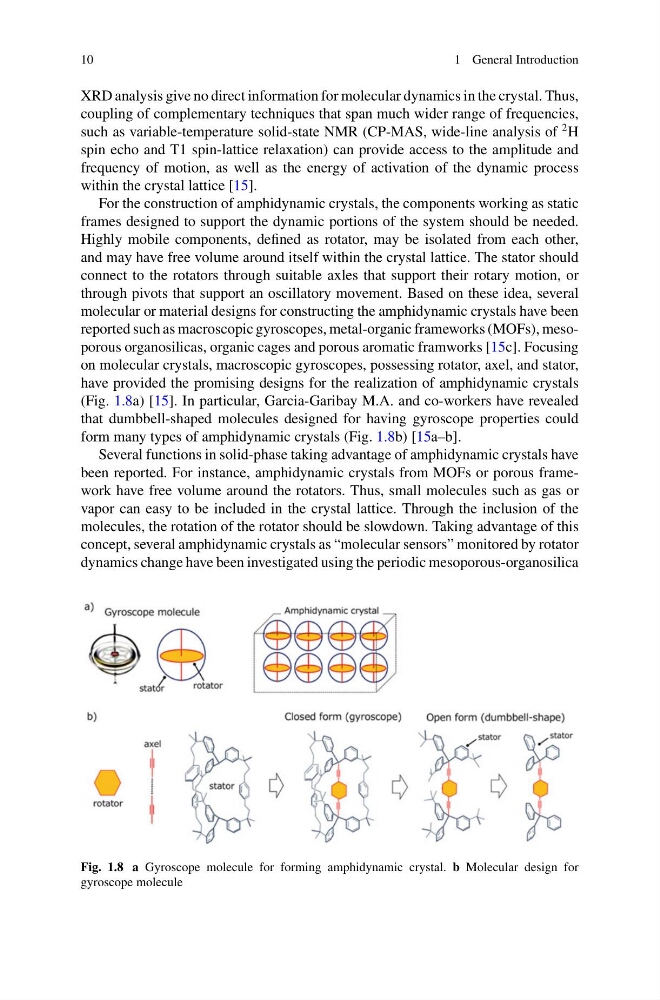
on molecular crystals, macroscopic gyroscopes, possessing rotator, axel, and stator,
have provided the promising designs for the realization of amphidynamic crystals
(Fig. 1.8a) [15]. In particular, Garcia-Garibay M.A. and co-workers have revealed
that dumbbell-shaped molecules designed for having gyroscope properties could
form many types of amphidynamic crystals (Fig. 1.8b) [15a–b].
Several functions in solid-phase taking advantage of amphidynamic crystals have
been reported. For instance, amphidynamic crystals from MOFs or porous framework have free volume around the rotators. Thus, small molecules such as gas or
vapor can easy to be included in the crystal lattice. Through the inclusion of the
molecules, the rotation of the rotator should be slowdown. Taking advantage of this
concept, several amphidynamic crystals as “molecular sensors” monitored by rotator
dynamics change have been investigated using the periodic mesoporous-organosilica
Fig. 1.8 a Gyroscope molecule for forming amphidynamic crystal. b Molecular design for
gyroscope molecule
1 General Introduction
XRD analysis give no direct information for molecular dynamics in the crystal. Thus,
coupling of complementary techniques that span much wider range of frequencies,
such as variable-temperature solid-state NMR (CP-MAS, wide-line analysis of
2 H
spin echo and T1 spin-lattice relaxation) can provide access to the amplitude and
frequency of motion, as well as the energy of activation of the dynamic process
within the crystal lattice [15].
For the construction of amphidynamic crystals, the components working as static
frames designed to support the dynamic portions of the system should be needed.
Highly mobile components, defined as rotator, may be isolated from each other,
and may have free volume around itself within the crystal lattice. The stator should
connect to the rotators through suitable axles that support their rotary motion, or
through pivots that support an oscillatory movement. Based on these idea, several
molecular or material designs for constructing the amphidynamic crystals have been
reported such as macroscopic gyroscopes, metal-organic frameworks (MOFs), mesoporous organosilicas, organic cages and porous aromatic framworks [15c]. Focusing
on molecular crystals, macroscopic gyroscopes, possessing rotator, axel, and stator,
have provided the promising designs for the realization of amphidynamic crystals
(Fig. 1.8a) [15]. In particular, Garcia-Garibay M.A. and co-workers have revealed
that dumbbell-shaped molecules designed for having gyroscope properties could
form many types of amphidynamic crystals (Fig. 1.8b) [15a–b].
Several functions in solid-phase taking advantage of amphidynamic crystals have
been reported. For instance, amphidynamic crystals from MOFs or porous framework have free volume around the rotators. Thus, small molecules such as gas or
vapor can easy to be included in the crystal lattice. Through the inclusion of the
molecules, the rotation of the rotator should be slowdown. Taking advantage of this
concept, several amphidynamic crystals as “molecular sensors” monitored by rotator
dynamics change have been investigated using the periodic mesoporous-organosilica
Fig. 1.8 a Gyroscope molecule for forming amphidynamic crystal. b Molecular design for
gyroscope molecule