

1.6 Amphidynamic Crystal
9
1.6 Amphidynamic Crystal
Molecular crystals are highly ordered three-dimensional assembly of molecules
aggregated together by relatively weak non-bonding interactions. Generally, molecular crystals are assembled into close packing arrangements that minimize the amount
of empty space, consequently, molecules are forced to decrease their individual
degrees of freedom in the crystals. In search of an insight into molecular freedom
in the assembled phase, the relationship between molecular motion and long-range
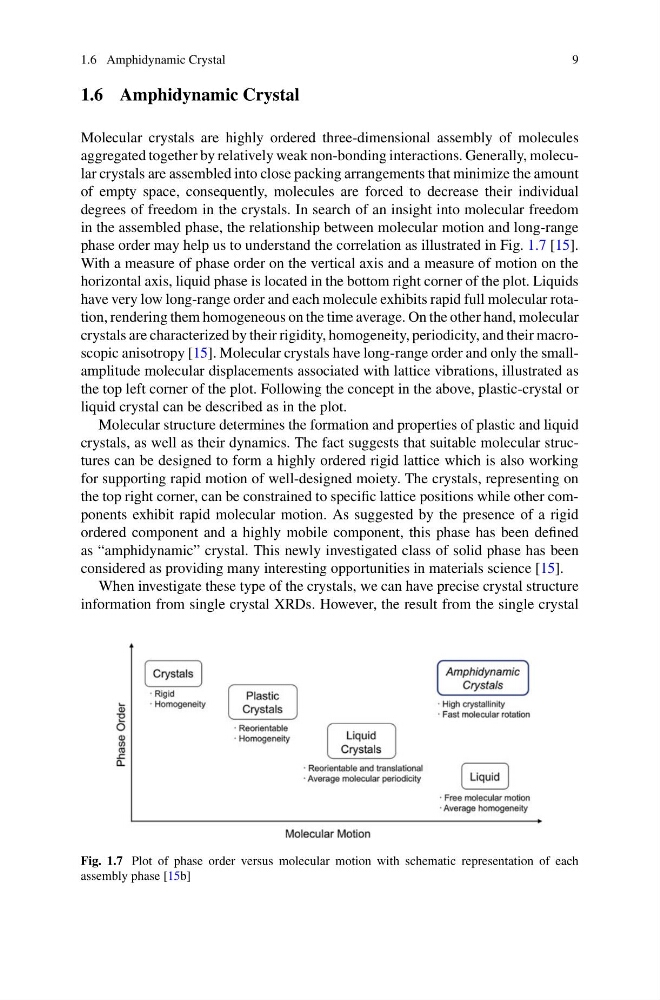
phase order may help us to understand the correlation as illustrated in Fig. 1.7 [15].
With a measure of phase order on the vertical axis and a measure of motion on the
horizontal axis, liquid phase is located in the bottom right corner of the plot. Liquids
have very low long-range order and each molecule exhibits rapid full molecular rotation, rendering them homogeneous on the time average. On the other hand, molecular
crystals are characterized by their rigidity, homogeneity, periodicity, and their macroscopic anisotropy [15]. Molecular crystals have long-range order and only the smallamplitude molecular displacements associated with lattice vibrations, illustrated as
the top left corner of the plot. Following the concept in the above, plastic-crystal or
liquid crystal can be described as in the plot.
Molecular structure determines the formation and properties of plastic and liquid
crystals, as well as their dynamics. The fact suggests that suitable molecular structures can be designed to form a highly ordered rigid lattice which is also working
for supporting rapid motion of well-designed moiety. The crystals, representing on
the top right corner, can be constrained to specific lattice positions while other components exhibit rapid molecular motion. As suggested by the presence of a rigid
ordered component and a highly mobile component, this phase has been defined
as “amphidynamic” crystal. This newly investigated class of solid phase has been
considered as providing many interesting opportunities in materials science [15].
When investigate these type of the crystals, we can have precise crystal structure
information from single crystal XRDs. However, the result from the single crystal
Fig. 1.7 Plot of phase order versus molecular motion with schematic representation of each
assembly phase [15b]
9
1.6 Amphidynamic Crystal
Molecular crystals are highly ordered three-dimensional assembly of molecules
aggregated together by relatively weak non-bonding interactions. Generally, molecular crystals are assembled into close packing arrangements that minimize the amount
of empty space, consequently, molecules are forced to decrease their individual
degrees of freedom in the crystals. In search of an insight into molecular freedom
in the assembled phase, the relationship between molecular motion and long-range
phase order may help us to understand the correlation as illustrated in Fig. 1.7 [15].
With a measure of phase order on the vertical axis and a measure of motion on the
horizontal axis, liquid phase is located in the bottom right corner of the plot. Liquids
have very low long-range order and each molecule exhibits rapid full molecular rotation, rendering them homogeneous on the time average. On the other hand, molecular
crystals are characterized by their rigidity, homogeneity, periodicity, and their macroscopic anisotropy [15]. Molecular crystals have long-range order and only the smallamplitude molecular displacements associated with lattice vibrations, illustrated as
the top left corner of the plot. Following the concept in the above, plastic-crystal or
liquid crystal can be described as in the plot.
Molecular structure determines the formation and properties of plastic and liquid
crystals, as well as their dynamics. The fact suggests that suitable molecular structures can be designed to form a highly ordered rigid lattice which is also working
for supporting rapid motion of well-designed moiety. The crystals, representing on
the top right corner, can be constrained to specific lattice positions while other components exhibit rapid molecular motion. As suggested by the presence of a rigid
ordered component and a highly mobile component, this phase has been defined
as “amphidynamic” crystal. This newly investigated class of solid phase has been
considered as providing many interesting opportunities in materials science [15].
When investigate these type of the crystals, we can have precise crystal structure
information from single crystal XRDs. However, the result from the single crystal
Fig. 1.7 Plot of phase order versus molecular motion with schematic representation of each
assembly phase [15b]