

8
1 General Introduction
Table 1.1 Restrictions on the formation of chiral and achiral crystal structures from chiral or achiral
molecules [13]
Achiral crystal structure Chiral crystal structure
Achiral molecules
Permitted
Permitted
Chiral molecules—enantiomerically pure Forbidden
Permitted
Chiral molecules—racemate
Permitted
Permitted
molecules could form achiral or chiral structures. However, enantiomerically pure
molecules which do not undergo racemate process are forbidden to form achiral
crystal structure because the homo-chiral molecular structure cannot allow to form
inversion or encounter symmetry in its crystal structure.
1.5.2 Wallach’s Rule
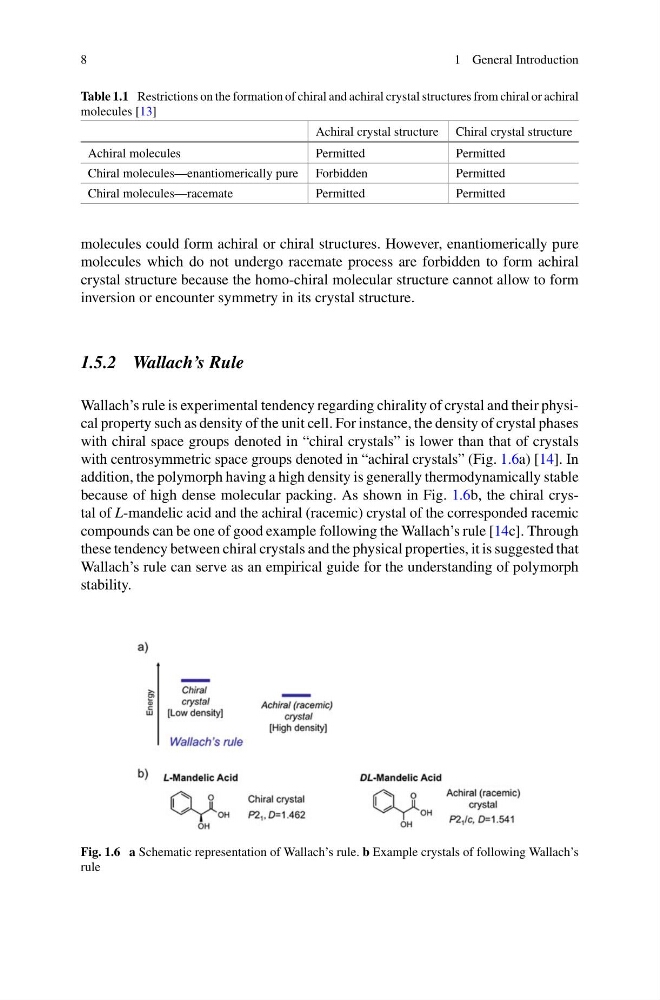
Wallach’s rule is experimental tendency regarding chirality of crystal and their physical property such as density of the unit cell. For instance, the density of crystal phases
with chiral space groups denoted in “chiral crystals” is lower than that of crystals
with centrosymmetric space groups denoted in “achiral crystals” (Fig. 1.6a) [14]. In
addition, the polymorph having a high density is generally thermodynamically stable
because of high dense molecular packing. As shown in Fig. 1.6b, the chiral crystal of L-mandelic acid and the achiral (racemic) crystal of the corresponded racemic
compounds can be one of good example following the Wallach’s rule [14c]. Through
these tendency between chiral crystals and the physical properties, it is suggested that
Wallach’s rule can serve as an empirical guide for the understanding of polymorph
stability.
Fig. 1.6 a Schematic representation of Wallach’s rule. b Example crystals of following Wallach’s
rule
1 General Introduction
Table 1.1 Restrictions on the formation of chiral and achiral crystal structures from chiral or achiral
molecules [13]
Achiral crystal structure Chiral crystal structure
Achiral molecules
Permitted
Permitted
Chiral molecules—enantiomerically pure Forbidden
Permitted
Chiral molecules—racemate
Permitted
Permitted
molecules could form achiral or chiral structures. However, enantiomerically pure
molecules which do not undergo racemate process are forbidden to form achiral
crystal structure because the homo-chiral molecular structure cannot allow to form
inversion or encounter symmetry in its crystal structure.
1.5.2 Wallach’s Rule
Wallach’s rule is experimental tendency regarding chirality of crystal and their physical property such as density of the unit cell. For instance, the density of crystal phases
with chiral space groups denoted in “chiral crystals” is lower than that of crystals
with centrosymmetric space groups denoted in “achiral crystals” (Fig. 1.6a) [14]. In
addition, the polymorph having a high density is generally thermodynamically stable
because of high dense molecular packing. As shown in Fig. 1.6b, the chiral crystal of L-mandelic acid and the achiral (racemic) crystal of the corresponded racemic
compounds can be one of good example following the Wallach’s rule [14c]. Through
these tendency between chiral crystals and the physical properties, it is suggested that
Wallach’s rule can serve as an empirical guide for the understanding of polymorph
stability.
Fig. 1.6 a Schematic representation of Wallach’s rule. b Example crystals of following Wallach’s
rule