

1.4 Features of Biaryl Group
7
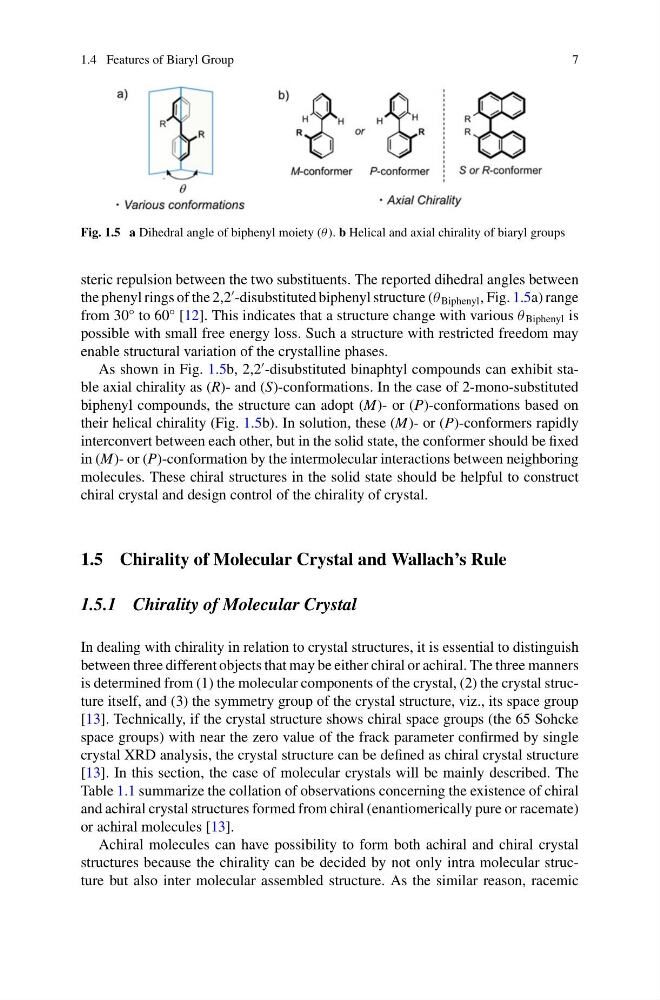
Fig. 1.5 a Dihedral angle of biphenyl moiety (θ). b Helical and axial chirality of biaryl groups
steric repulsion between the two substituents. The reported dihedral angles between
the phenyl rings of the 2,2
-disubstituted biphenyl structure (θ Biphenyl , Fig. 1.5a) range
from 30° to 60° [12]. This indicates that a structure change with various θ Biphenyl is
possible with small free energy loss. Such a structure with restricted freedom may
enable structural variation of the crystalline phases.
As shown in Fig. 1.5b, 2,2
-disubstituted binaphtyl compounds can exhibit stable axial chirality as (R)- and (S)-conformations. In the case of 2-mono-substituted
biphenyl compounds, the structure can adopt (M)- or (P)-conformations based on
their helical chirality (Fig. 1.5b). In solution, these (M)- or (P)-conformers rapidly
interconvert between each other, but in the solid state, the conformer should be fixed
in (M)- or (P)-conformation by the intermolecular interactions between neighboring
molecules. These chiral structures in the solid state should be helpful to construct
chiral crystal and design control of the chirality of crystal.
1.5 Chirality of Molecular Crystal and Wallach’s Rule
1.5.1 Chirality of Molecular Crystal
In dealing with chirality in relation to crystal structures, it is essential to distinguish
between three different objects that may be either chiral or achiral. The three manners
is determined from (1) the molecular components of the crystal, (2) the crystal structure itself, and (3) the symmetry group of the crystal structure, viz., its space group
[13]. Technically, if the crystal structure shows chiral space groups (the 65 Sohcke
space groups) with near the zero value of the frack parameter confirmed by single
crystal XRD analysis, the crystal structure can be defined as chiral crystal structure
[13]. In this section, the case of molecular crystals will be mainly described. The
Table 1.1 summarize the collation of observations concerning the existence of chiral
and achiral crystal structures formed from chiral (enantiomerically pure or racemate)
or achiral molecules [13].
Achiral molecules can have possibility to form both achiral and chiral crystal
structures because the chirality can be decided by not only intra molecular structure but also inter molecular assembled structure. As the similar reason, racemic
7
Fig. 1.5 a Dihedral angle of biphenyl moiety (θ). b Helical and axial chirality of biaryl groups
steric repulsion between the two substituents. The reported dihedral angles between
the phenyl rings of the 2,2
-disubstituted biphenyl structure (θ Biphenyl , Fig. 1.5a) range
from 30° to 60° [12]. This indicates that a structure change with various θ Biphenyl is
possible with small free energy loss. Such a structure with restricted freedom may
enable structural variation of the crystalline phases.
As shown in Fig. 1.5b, 2,2
-disubstituted binaphtyl compounds can exhibit stable axial chirality as (R)- and (S)-conformations. In the case of 2-mono-substituted
biphenyl compounds, the structure can adopt (M)- or (P)-conformations based on
their helical chirality (Fig. 1.5b). In solution, these (M)- or (P)-conformers rapidly
interconvert between each other, but in the solid state, the conformer should be fixed
in (M)- or (P)-conformation by the intermolecular interactions between neighboring
molecules. These chiral structures in the solid state should be helpful to construct
chiral crystal and design control of the chirality of crystal.
1.5 Chirality of Molecular Crystal and Wallach’s Rule
1.5.1 Chirality of Molecular Crystal
In dealing with chirality in relation to crystal structures, it is essential to distinguish
between three different objects that may be either chiral or achiral. The three manners
is determined from (1) the molecular components of the crystal, (2) the crystal structure itself, and (3) the symmetry group of the crystal structure, viz., its space group
[13]. Technically, if the crystal structure shows chiral space groups (the 65 Sohcke
space groups) with near the zero value of the frack parameter confirmed by single
crystal XRD analysis, the crystal structure can be defined as chiral crystal structure
[13]. In this section, the case of molecular crystals will be mainly described. The
Table 1.1 summarize the collation of observations concerning the existence of chiral
and achiral crystal structures formed from chiral (enantiomerically pure or racemate)
or achiral molecules [13].
Achiral molecules can have possibility to form both achiral and chiral crystal
structures because the chirality can be decided by not only intra molecular structure but also inter molecular assembled structure. As the similar reason, racemic