

6.5 Variable Temperature Solid State NMR Studies of 1-d 4 and 2
167
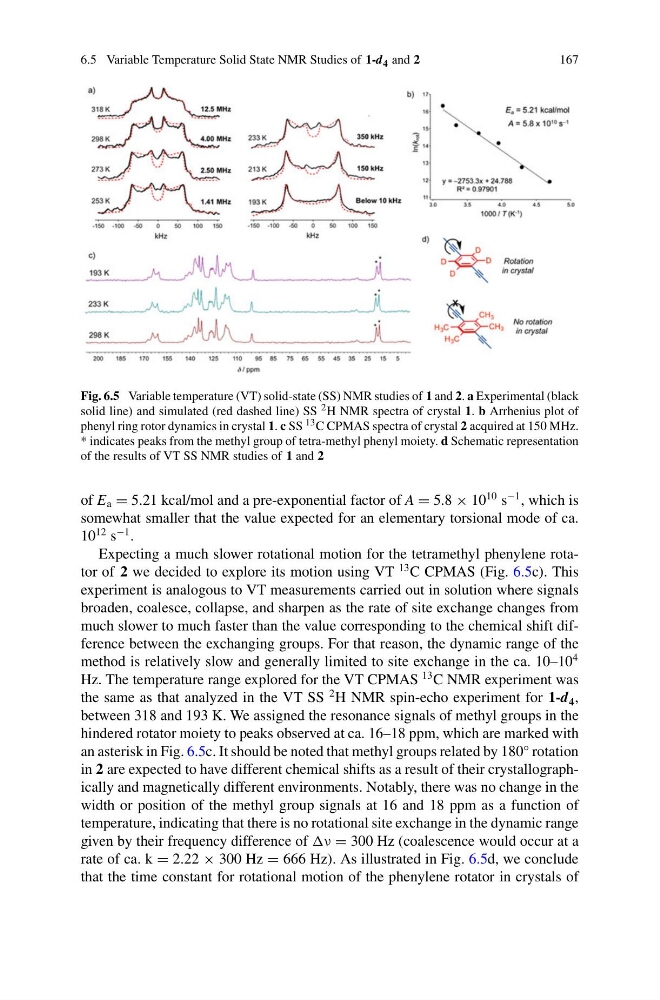
Fig. 6.5 Variable temperature (VT) solid-state (SS) NMR studies of 1 and 2. a Experimental (black
solid line) and simulated (red dashed line) SS 2 H NMR spectra of crystal 1. b Arrhenius plot of
phenyl ring rotor dynamics in crystal 1. c SS 13 C CPMAS spectra of crystal 2 acquired at 150 MHz.
* indicates peaks from the methyl group of tetra-methyl phenyl moiety. d Schematic representation
of the results of VT SS NMR studies of 1 and 2
of E a = 5.21 kcal/mol and a pre-exponential factor of A = 5.8 × 10
10 s
−1 , which is
somewhat smaller that the value expected for an elementary torsional mode of ca.
10
12 s
−1 .
Expecting a much slower rotational motion for the tetramethyl phenylene rotator of 2 we decided to explore its motion using VT
13 C CPMAS (Fig. 6.5c). This
experiment is analogous to VT measurements carried out in solution where signals
broaden, coalesce, collapse, and sharpen as the rate of site exchange changes from
much slower to much faster than the value corresponding to the chemical shift difference between the exchanging groups. For that reason, the dynamic range of the
method is relatively slow and generally limited to site exchange in the ca. 10–10
4
Hz. The temperature range explored for the VT CPMAS
13 C NMR experiment was
the same as that analyzed in the VT SS
2 H NMR spin-echo experiment for 1-d 4 ,
between 318 and 193 K. We assigned the resonance signals of methyl groups in the
hindered rotator moiety to peaks observed at ca. 16–18 ppm, which are marked with
an asterisk in Fig. 6.5c. It should be noted that methyl groups related by 180° rotation
in 2 are expected to have different chemical shifts as a result of their crystallographically and magnetically different environments. Notably, there was no change in the
width or position of the methyl group signals at 16 and 18 ppm as a function of
temperature, indicating that there is no rotational site exchange in the dynamic range
given by their frequency difference of ν = 300 Hz (coalescence would occur at a
rate of ca. k = 2.22 × 300 Hz = 666 Hz). As illustrated in Fig. 6.5d, we conclude
that the time constant for rotational motion of the phenylene rotator in crystals of
167
Fig. 6.5 Variable temperature (VT) solid-state (SS) NMR studies of 1 and 2. a Experimental (black
solid line) and simulated (red dashed line) SS 2 H NMR spectra of crystal 1. b Arrhenius plot of
phenyl ring rotor dynamics in crystal 1. c SS 13 C CPMAS spectra of crystal 2 acquired at 150 MHz.
* indicates peaks from the methyl group of tetra-methyl phenyl moiety. d Schematic representation
of the results of VT SS NMR studies of 1 and 2
of E a = 5.21 kcal/mol and a pre-exponential factor of A = 5.8 × 10
10 s
−1 , which is
somewhat smaller that the value expected for an elementary torsional mode of ca.
10
12 s
−1 .
Expecting a much slower rotational motion for the tetramethyl phenylene rotator of 2 we decided to explore its motion using VT
13 C CPMAS (Fig. 6.5c). This
experiment is analogous to VT measurements carried out in solution where signals
broaden, coalesce, collapse, and sharpen as the rate of site exchange changes from
much slower to much faster than the value corresponding to the chemical shift difference between the exchanging groups. For that reason, the dynamic range of the
method is relatively slow and generally limited to site exchange in the ca. 10–10
4
Hz. The temperature range explored for the VT CPMAS
13 C NMR experiment was
the same as that analyzed in the VT SS
2 H NMR spin-echo experiment for 1-d 4 ,
between 318 and 193 K. We assigned the resonance signals of methyl groups in the
hindered rotator moiety to peaks observed at ca. 16–18 ppm, which are marked with
an asterisk in Fig. 6.5c. It should be noted that methyl groups related by 180° rotation
in 2 are expected to have different chemical shifts as a result of their crystallographically and magnetically different environments. Notably, there was no change in the
width or position of the methyl group signals at 16 and 18 ppm as a function of
temperature, indicating that there is no rotational site exchange in the dynamic range
given by their frequency difference of ν = 300 Hz (coalescence would occur at a
rate of ca. k = 2.22 × 300 Hz = 666 Hz). As illustrated in Fig. 6.5d, we conclude
that the time constant for rotational motion of the phenylene rotator in crystals of