

166
6 Thermo-Responsive Phosphorescence Control Mediated …
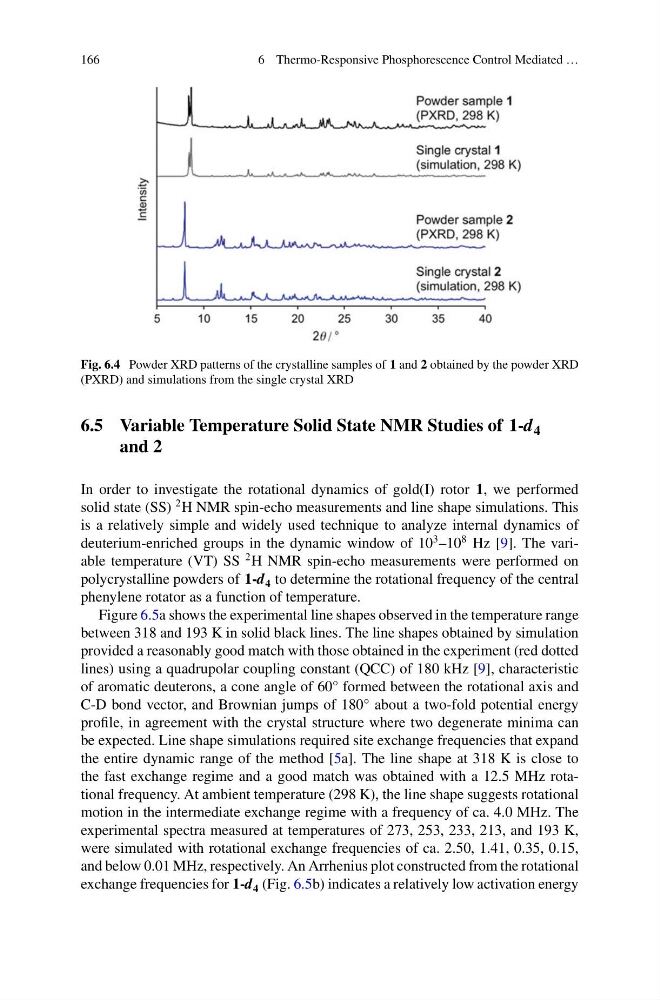
Fig. 6.4 Powder XRD patterns of the crystalline samples of 1 and 2 obtained by the powder XRD
(PXRD) and simulations from the single crystal XRD
6.5 Variable Temperature Solid State NMR Studies of 1-d 4
and 2
In order to investigate the rotational dynamics of gold(I) rotor 1, we performed
solid state (SS)
2 H NMR spin-echo measurements and line shape simulations. This
is a relatively simple and widely used technique to analyze internal dynamics of
deuterium-enriched groups in the dynamic window of 10
3 –10
8 Hz [9]. The variable temperature (VT) SS
2 H NMR spin-echo measurements were performed on
polycrystalline powders of 1-d 4 to determine the rotational frequency of the central
phenylene rotator as a function of temperature.
Figure 6.5a shows the experimental line shapes observed in the temperature range
between 318 and 193 K in solid black lines. The line shapes obtained by simulation
provided a reasonably good match with those obtained in the experiment (red dotted
lines) using a quadrupolar coupling constant (QCC) of 180 kHz [9], characteristic
of aromatic deuterons, a cone angle of 60° formed between the rotational axis and
C-D bond vector, and Brownian jumps of 180° about a two-fold potential energy
profile, in agreement with the crystal structure where two degenerate minima can
be expected. Line shape simulations required site exchange frequencies that expand
the entire dynamic range of the method [5a]. The line shape at 318 K is close to
the fast exchange regime and a good match was obtained with a 12.5 MHz rotational frequency. At ambient temperature (298 K), the line shape suggests rotational
motion in the intermediate exchange regime with a frequency of ca. 4.0 MHz. The
experimental spectra measured at temperatures of 273, 253, 233, 213, and 193 K,
were simulated with rotational exchange frequencies of ca. 2.50, 1.41, 0.35, 0.15,
and below 0.01 MHz, respectively. An Arrhenius plot constructed from the rotational
exchange frequencies for 1-d 4 (Fig. 6.5b) indicates a relatively low activation energy
6 Thermo-Responsive Phosphorescence Control Mediated …
Fig. 6.4 Powder XRD patterns of the crystalline samples of 1 and 2 obtained by the powder XRD
(PXRD) and simulations from the single crystal XRD
6.5 Variable Temperature Solid State NMR Studies of 1-d 4
and 2
In order to investigate the rotational dynamics of gold(I) rotor 1, we performed
solid state (SS)
2 H NMR spin-echo measurements and line shape simulations. This
is a relatively simple and widely used technique to analyze internal dynamics of
deuterium-enriched groups in the dynamic window of 10
3 –10
8 Hz [9]. The variable temperature (VT) SS
2 H NMR spin-echo measurements were performed on
polycrystalline powders of 1-d 4 to determine the rotational frequency of the central
phenylene rotator as a function of temperature.
Figure 6.5a shows the experimental line shapes observed in the temperature range
between 318 and 193 K in solid black lines. The line shapes obtained by simulation
provided a reasonably good match with those obtained in the experiment (red dotted
lines) using a quadrupolar coupling constant (QCC) of 180 kHz [9], characteristic
of aromatic deuterons, a cone angle of 60° formed between the rotational axis and
C-D bond vector, and Brownian jumps of 180° about a two-fold potential energy
profile, in agreement with the crystal structure where two degenerate minima can
be expected. Line shape simulations required site exchange frequencies that expand
the entire dynamic range of the method [5a]. The line shape at 318 K is close to
the fast exchange regime and a good match was obtained with a 12.5 MHz rotational frequency. At ambient temperature (298 K), the line shape suggests rotational
motion in the intermediate exchange regime with a frequency of ca. 4.0 MHz. The
experimental spectra measured at temperatures of 273, 253, 233, 213, and 193 K,
were simulated with rotational exchange frequencies of ca. 2.50, 1.41, 0.35, 0.15,
and below 0.01 MHz, respectively. An Arrhenius plot constructed from the rotational
exchange frequencies for 1-d 4 (Fig. 6.5b) indicates a relatively low activation energy