

168
6 Thermo-Responsive Phosphorescence Control Mediated …
1 at ambient temperature (ca. 0.25 μs) should be in reasonable proximity to the
time constants which are typical in the phosphorescence time window (see below).
By contrast, the tetramethyl phenylene rotator of 2 is essentially static, even at the
highest temperatures analyzed.
6.6 Emission Properties of 1 and 2
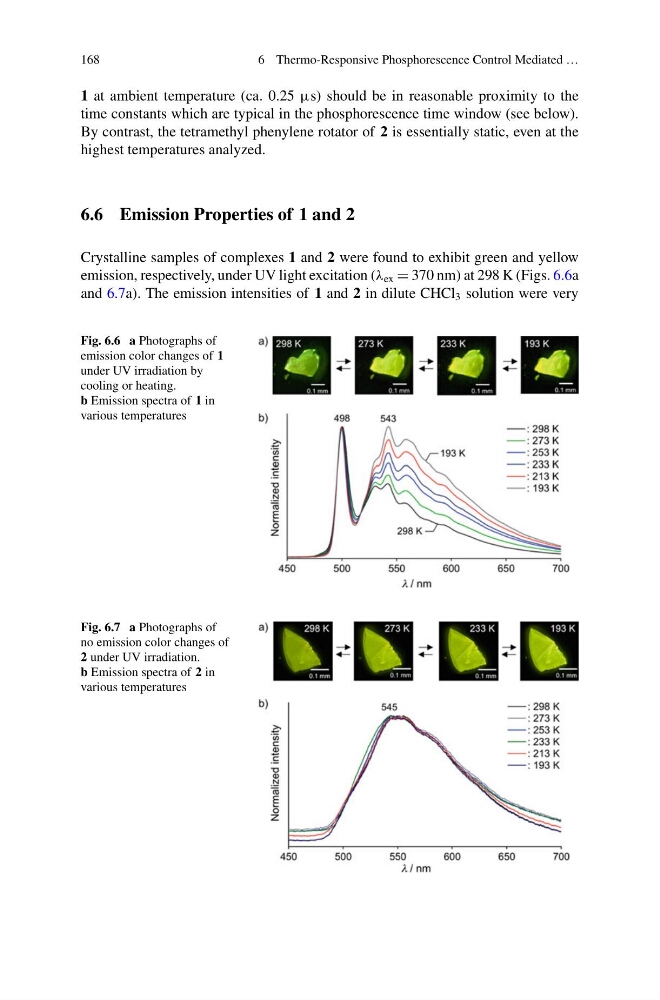
Crystalline samples of complexes 1 and 2 were found to exhibit green and yellow
emission, respectively, under UV light excitation (λ ex = 370 nm) at 298 K (Figs. 6.6a
and 6.7a). The emission intensities of 1 and 2 in dilute CHCl 3 solution were very
Fig. 6.6 a Photographs of
emission color changes of 1
under UV irradiation by
cooling or heating.
b Emission spectra of 1 in
various temperatures
Fig. 6.7 a Photographs of
no emission color changes of
2 under UV irradiation.
b Emission spectra of 2 in
various temperatures
6 Thermo-Responsive Phosphorescence Control Mediated …
1 at ambient temperature (ca. 0.25 μs) should be in reasonable proximity to the
time constants which are typical in the phosphorescence time window (see below).
By contrast, the tetramethyl phenylene rotator of 2 is essentially static, even at the
highest temperatures analyzed.
6.6 Emission Properties of 1 and 2
Crystalline samples of complexes 1 and 2 were found to exhibit green and yellow
emission, respectively, under UV light excitation (λ ex = 370 nm) at 298 K (Figs. 6.6a
and 6.7a). The emission intensities of 1 and 2 in dilute CHCl 3 solution were very
Fig. 6.6 a Photographs of
emission color changes of 1
under UV irradiation by
cooling or heating.
b Emission spectra of 1 in
various temperatures
Fig. 6.7 a Photographs of
no emission color changes of
2 under UV irradiation.
b Emission spectra of 2 in
various temperatures