

6.1 Introduction
159
P
P
Au
Au
F
F
F
F
F
F
R
R
R
R
THF (2 ml)
78°C, 2h
n-BuLi (2.0 equiv.)
Cl Au P
F
3
(2.0 equiv.)
0°C, 2h
R
R
R
R
1 (R = H)
1-d 4 (R = D)
2 (R = CH 3 )
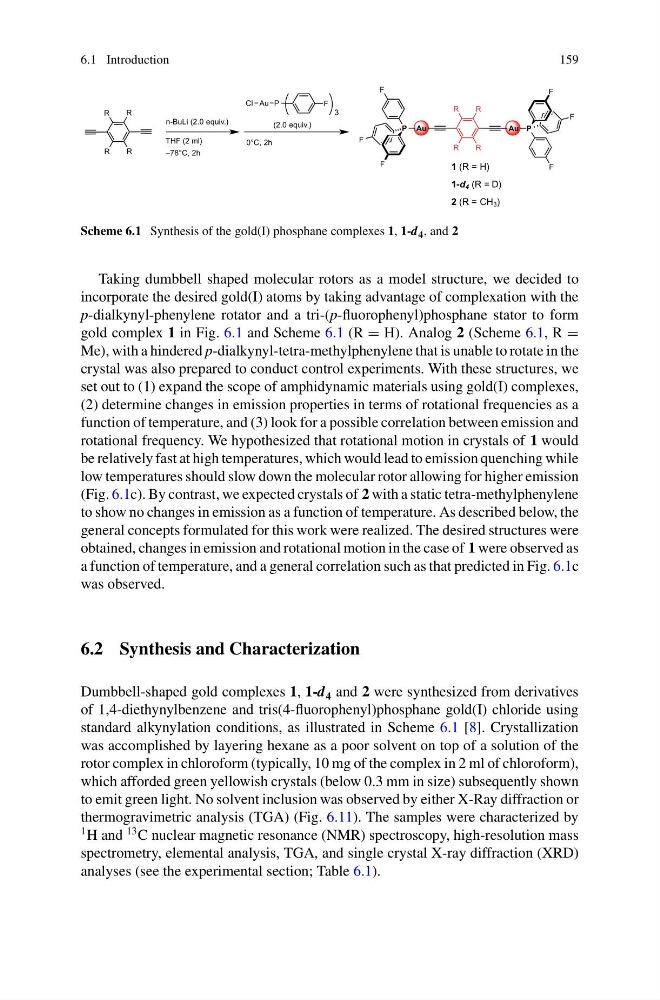
Scheme 6.1 Synthesis of the gold(I) phosphane complexes 1, 1-d 4 , and 2
Taking dumbbell shaped molecular rotors as a model structure, we decided to
incorporate the desired gold(I) atoms by taking advantage of complexation with the
p-dialkynyl-phenylene rotator and a tri-(p-fluorophenyl)phosphane stator to form
gold complex 1 in Fig. 6.1 and Scheme 6.1 (R = H). Analog 2 (Scheme 6.1, R =
Me), with a hindered p-dialkynyl-tetra-methylphenylene that is unable to rotate in the
crystal was also prepared to conduct control experiments. With these structures, we
set out to (1) expand the scope of amphidynamic materials using gold(I) complexes,
(2) determine changes in emission properties in terms of rotational frequencies as a
function of temperature, and (3) look for a possible correlation between emission and
rotational frequency. We hypothesized that rotational motion in crystals of 1 would
be relatively fast at high temperatures, which would lead to emission quenching while
low temperatures should slow down the molecular rotor allowing for higher emission
(Fig. 6.1c). By contrast, we expected crystals of 2 with a static tetra-methylphenylene
to show no changes in emission as a function of temperature. As described below, the
general concepts formulated for this work were realized. The desired structures were
obtained, changes in emission and rotational motion in the case of 1 were observed as
a function of temperature, and a general correlation such as that predicted in Fig. 6.1c
was observed.
6.2 Synthesis and Characterization
Dumbbell-shaped gold complexes 1, 1-d 4 and 2 were synthesized from derivatives
of 1,4-diethynylbenzene and tris(4-fluorophenyl)phosphane gold(I) chloride using
standard alkynylation conditions, as illustrated in Scheme 6.1 [8]. Crystallization
was accomplished by layering hexane as a poor solvent on top of a solution of the
rotor complex in chloroform (typically, 10 mg of the complex in 2 ml of chloroform),
which afforded green yellowish crystals (below 0.3 mm in size) subsequently shown
to emit green light. No solvent inclusion was observed by either X-Ray diffraction or
thermogravimetric analysis (TGA) (Fig. 6.11). The samples were characterized by
1 H and
13 C nuclear magnetic resonance (NMR) spectroscopy, high-resolution mass
spectrometry, elemental analysis, TGA, and single crystal X-ray diffraction (XRD)
analyses (see the experimental section; Table 6.1).
159
P
P
Au
Au
F
F
F
F
F
F
R
R
R
R
THF (2 ml)
78°C, 2h
n-BuLi (2.0 equiv.)
Cl Au P
F
3
(2.0 equiv.)
0°C, 2h
R
R
R
R
1 (R = H)
1-d 4 (R = D)
2 (R = CH 3 )
Scheme 6.1 Synthesis of the gold(I) phosphane complexes 1, 1-d 4 , and 2
Taking dumbbell shaped molecular rotors as a model structure, we decided to
incorporate the desired gold(I) atoms by taking advantage of complexation with the
p-dialkynyl-phenylene rotator and a tri-(p-fluorophenyl)phosphane stator to form
gold complex 1 in Fig. 6.1 and Scheme 6.1 (R = H). Analog 2 (Scheme 6.1, R =
Me), with a hindered p-dialkynyl-tetra-methylphenylene that is unable to rotate in the
crystal was also prepared to conduct control experiments. With these structures, we
set out to (1) expand the scope of amphidynamic materials using gold(I) complexes,
(2) determine changes in emission properties in terms of rotational frequencies as a
function of temperature, and (3) look for a possible correlation between emission and
rotational frequency. We hypothesized that rotational motion in crystals of 1 would
be relatively fast at high temperatures, which would lead to emission quenching while
low temperatures should slow down the molecular rotor allowing for higher emission
(Fig. 6.1c). By contrast, we expected crystals of 2 with a static tetra-methylphenylene
to show no changes in emission as a function of temperature. As described below, the
general concepts formulated for this work were realized. The desired structures were
obtained, changes in emission and rotational motion in the case of 1 were observed as
a function of temperature, and a general correlation such as that predicted in Fig. 6.1c
was observed.
6.2 Synthesis and Characterization
Dumbbell-shaped gold complexes 1, 1-d 4 and 2 were synthesized from derivatives
of 1,4-diethynylbenzene and tris(4-fluorophenyl)phosphane gold(I) chloride using
standard alkynylation conditions, as illustrated in Scheme 6.1 [8]. Crystallization
was accomplished by layering hexane as a poor solvent on top of a solution of the
rotor complex in chloroform (typically, 10 mg of the complex in 2 ml of chloroform),
which afforded green yellowish crystals (below 0.3 mm in size) subsequently shown
to emit green light. No solvent inclusion was observed by either X-Ray diffraction or
thermogravimetric analysis (TGA) (Fig. 6.11). The samples were characterized by
1 H and
13 C nuclear magnetic resonance (NMR) spectroscopy, high-resolution mass
spectrometry, elemental analysis, TGA, and single crystal X-ray diffraction (XRD)
analyses (see the experimental section; Table 6.1).