

160
6 Thermo-Responsive Phosphorescence Control Mediated …
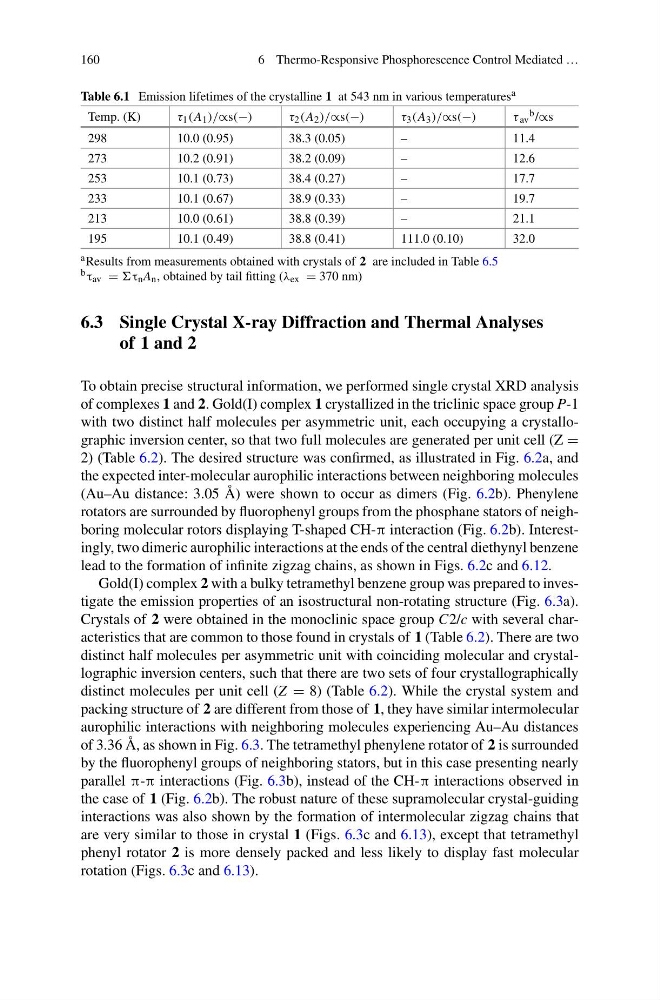
Table 6.1 Emission lifetimes of the crystalline 1 at 543 nm in various temperatures a
Temp. (K)
τ 1 (A 1 )/∝s(−)
τ 2 (A 2 )/∝s(−)
τ 3 (A 3 )/∝s(−)
τ av
b /∝s
298
10.0 (0.95)
38.3 (0.05)
–
11.4
273
10.2 (0.91)
38.2 (0.09)
–
12.6
253
10.1 (0.73)
38.4 (0.27)
–
17.7
233
10.1 (0.67)
38.9 (0.33)
–
19.7
213
10.0 (0.61)
38.8 (0.39)
–
21.1
195
10.1 (0.49)
38.8 (0.41)
111.0 (0.10)
32.0
a Results from measurements obtained with crystals of 2 are included in Table 6.5
b τ av = τ n A n , obtained by tail fitting (λ ex = 370 nm)
6.3 Single Crystal X-ray Diffraction and Thermal Analyses
of 1 and 2
To obtain precise structural information, we performed single crystal XRD analysis
of complexes 1 and 2. Gold(I) complex 1 crystallized in the triclinic space group P-1
with two distinct half molecules per asymmetric unit, each occupying a crystallographic inversion center, so that two full molecules are generated per unit cell (Z =
2) (Table 6.2). The desired structure was confirmed, as illustrated in Fig. 6.2a, and
the expected inter-molecular aurophilic interactions between neighboring molecules
(Au–Au distance: 3.05 Å) were shown to occur as dimers (Fig. 6.2b). Phenylene
rotators are surrounded by fluorophenyl groups from the phosphane stators of neighboring molecular rotors displaying T-shaped CH-π interaction (Fig. 6.2b). Interestingly, two dimeric aurophilic interactions at the ends of the central diethynyl benzene
lead to the formation of infinite zigzag chains, as shown in Figs. 6.2c and 6.12.
Gold(I) complex 2 with a bulky tetramethyl benzene group was prepared to investigate the emission properties of an isostructural non-rotating structure (Fig. 6.3a).
Crystals of 2 were obtained in the monoclinic space group C2/c with several characteristics that are common to those found in crystals of 1 (Table 6.2). There are two
distinct half molecules per asymmetric unit with coinciding molecular and crystallographic inversion centers, such that there are two sets of four crystallographically
distinct molecules per unit cell (Z = 8) (Table 6.2). While the crystal system and
packing structure of 2 are different from those of 1, they have similar intermolecular
aurophilic interactions with neighboring molecules experiencing Au–Au distances
of 3.36 Å, as shown in Fig. 6.3. The tetramethyl phenylene rotator of 2 is surrounded
by the fluorophenyl groups of neighboring stators, but in this case presenting nearly
parallel π-π interactions (Fig. 6.3b), instead of the CH-π interactions observed in
the case of 1 (Fig. 6.2b). The robust nature of these supramolecular crystal-guiding
interactions was also shown by the formation of intermolecular zigzag chains that
are very similar to those in crystal 1 (Figs. 6.3c and 6.13), except that tetramethyl
phenyl rotator 2 is more densely packed and less likely to display fast molecular
rotation (Figs. 6.3c and 6.13).
6 Thermo-Responsive Phosphorescence Control Mediated …
Table 6.1 Emission lifetimes of the crystalline 1 at 543 nm in various temperatures a
Temp. (K)
τ 1 (A 1 )/∝s(−)
τ 2 (A 2 )/∝s(−)
τ 3 (A 3 )/∝s(−)
τ av
b /∝s
298
10.0 (0.95)
38.3 (0.05)
–
11.4
273
10.2 (0.91)
38.2 (0.09)
–
12.6
253
10.1 (0.73)
38.4 (0.27)
–
17.7
233
10.1 (0.67)
38.9 (0.33)
–
19.7
213
10.0 (0.61)
38.8 (0.39)
–
21.1
195
10.1 (0.49)
38.8 (0.41)
111.0 (0.10)
32.0
a Results from measurements obtained with crystals of 2 are included in Table 6.5
b τ av = τ n A n , obtained by tail fitting (λ ex = 370 nm)
6.3 Single Crystal X-ray Diffraction and Thermal Analyses
of 1 and 2
To obtain precise structural information, we performed single crystal XRD analysis
of complexes 1 and 2. Gold(I) complex 1 crystallized in the triclinic space group P-1
with two distinct half molecules per asymmetric unit, each occupying a crystallographic inversion center, so that two full molecules are generated per unit cell (Z =
2) (Table 6.2). The desired structure was confirmed, as illustrated in Fig. 6.2a, and
the expected inter-molecular aurophilic interactions between neighboring molecules
(Au–Au distance: 3.05 Å) were shown to occur as dimers (Fig. 6.2b). Phenylene
rotators are surrounded by fluorophenyl groups from the phosphane stators of neighboring molecular rotors displaying T-shaped CH-π interaction (Fig. 6.2b). Interestingly, two dimeric aurophilic interactions at the ends of the central diethynyl benzene
lead to the formation of infinite zigzag chains, as shown in Figs. 6.2c and 6.12.
Gold(I) complex 2 with a bulky tetramethyl benzene group was prepared to investigate the emission properties of an isostructural non-rotating structure (Fig. 6.3a).
Crystals of 2 were obtained in the monoclinic space group C2/c with several characteristics that are common to those found in crystals of 1 (Table 6.2). There are two
distinct half molecules per asymmetric unit with coinciding molecular and crystallographic inversion centers, such that there are two sets of four crystallographically
distinct molecules per unit cell (Z = 8) (Table 6.2). While the crystal system and
packing structure of 2 are different from those of 1, they have similar intermolecular
aurophilic interactions with neighboring molecules experiencing Au–Au distances
of 3.36 Å, as shown in Fig. 6.3. The tetramethyl phenylene rotator of 2 is surrounded
by the fluorophenyl groups of neighboring stators, but in this case presenting nearly
parallel π-π interactions (Fig. 6.3b), instead of the CH-π interactions observed in
the case of 1 (Fig. 6.2b). The robust nature of these supramolecular crystal-guiding
interactions was also shown by the formation of intermolecular zigzag chains that
are very similar to those in crystal 1 (Figs. 6.3c and 6.13), except that tetramethyl
phenyl rotator 2 is more densely packed and less likely to display fast molecular
rotation (Figs. 6.3c and 6.13).