

158
6 Thermo-Responsive Phosphorescence Control Mediated …
In order to further develop the field of functional luminescent materials, in addition
to having binary systems with one state described by molecules that are free to rotate
in solution and another one where molecules are aggregated in the solid state, it would
be advantageous to control luminescence efficiency by affecting the rate of rotation in
the solid state [3]. To accomplish that, we propose the use of amphidynamic crystals
based on elements of molecular and crystal engineering to produce materials that
combine luminescence and rotational motion [4]. One of the most robust and general
architectures for the formation amphidynamic molecular crystals is based on the use
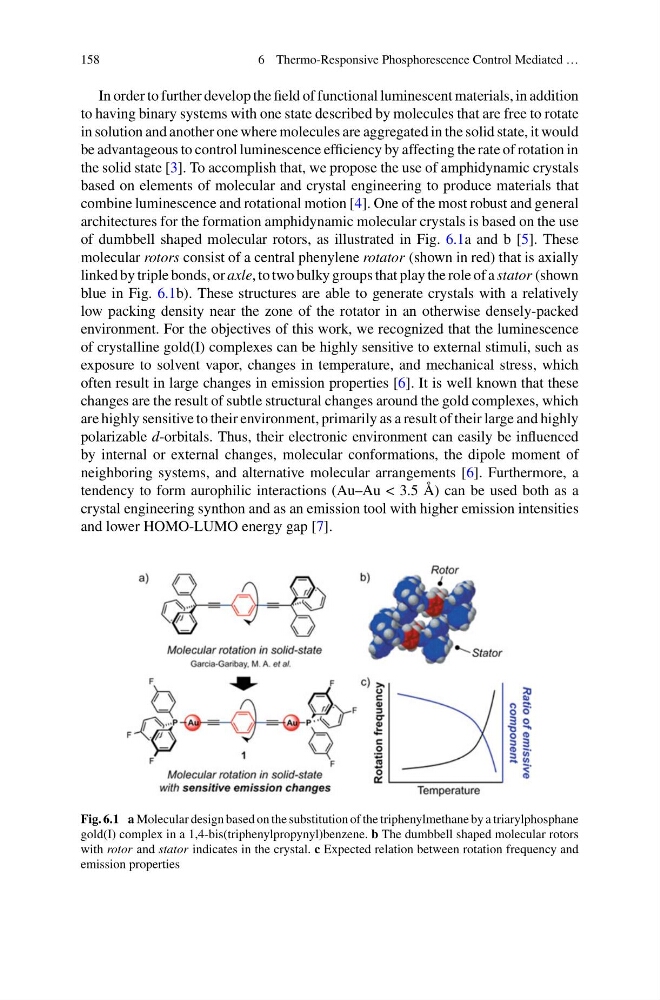
of dumbbell shaped molecular rotors, as illustrated in Fig. 6.1a and b [5]. These
molecular rotors consist of a central phenylene rotator (shown in red) that is axially
linked by triple bonds, or axle, to two bulky groups that play the role of a stator (shown
blue in Fig. 6.1b). These structures are able to generate crystals with a relatively
low packing density near the zone of the rotator in an otherwise densely-packed
environment. For the objectives of this work, we recognized that the luminescence
of crystalline gold(I) complexes can be highly sensitive to external stimuli, such as
exposure to solvent vapor, changes in temperature, and mechanical stress, which
often result in large changes in emission properties [6]. It is well known that these
changes are the result of subtle structural changes around the gold complexes, which
are highly sensitive to their environment, primarily as a result of their large and highly
polarizable d-orbitals. Thus, their electronic environment can easily be influenced
by internal or external changes, molecular conformations, the dipole moment of
neighboring systems, and alternative molecular arrangements [6]. Furthermore, a
tendency to form aurophilic interactions (Au–Au < 3.5 Å) can be used both as a
crystal engineering synthon and as an emission tool with higher emission intensities
and lower HOMO-LUMO energy gap [7].
Fig. 6.1 a Molecular design based on the substitution of the triphenylmethane by a triarylphosphane
gold(I) complex in a 1,4-bis(triphenylpropynyl)benzene. b The dumbbell shaped molecular rotors
with rotor and stator indicates in the crystal. c Expected relation between rotation frequency and
emission properties
6 Thermo-Responsive Phosphorescence Control Mediated …
In order to further develop the field of functional luminescent materials, in addition
to having binary systems with one state described by molecules that are free to rotate
in solution and another one where molecules are aggregated in the solid state, it would
be advantageous to control luminescence efficiency by affecting the rate of rotation in
the solid state [3]. To accomplish that, we propose the use of amphidynamic crystals
based on elements of molecular and crystal engineering to produce materials that
combine luminescence and rotational motion [4]. One of the most robust and general
architectures for the formation amphidynamic molecular crystals is based on the use
of dumbbell shaped molecular rotors, as illustrated in Fig. 6.1a and b [5]. These
molecular rotors consist of a central phenylene rotator (shown in red) that is axially
linked by triple bonds, or axle, to two bulky groups that play the role of a stator (shown
blue in Fig. 6.1b). These structures are able to generate crystals with a relatively
low packing density near the zone of the rotator in an otherwise densely-packed
environment. For the objectives of this work, we recognized that the luminescence
of crystalline gold(I) complexes can be highly sensitive to external stimuli, such as
exposure to solvent vapor, changes in temperature, and mechanical stress, which
often result in large changes in emission properties [6]. It is well known that these
changes are the result of subtle structural changes around the gold complexes, which
are highly sensitive to their environment, primarily as a result of their large and highly
polarizable d-orbitals. Thus, their electronic environment can easily be influenced
by internal or external changes, molecular conformations, the dipole moment of
neighboring systems, and alternative molecular arrangements [6]. Furthermore, a
tendency to form aurophilic interactions (Au–Au < 3.5 Å) can be used both as a
crystal engineering synthon and as an emission tool with higher emission intensities
and lower HOMO-LUMO energy gap [7].
Fig. 6.1 a Molecular design based on the substitution of the triphenylmethane by a triarylphosphane
gold(I) complex in a 1,4-bis(triphenylpropynyl)benzene. b The dumbbell shaped molecular rotors
with rotor and stator indicates in the crystal. c Expected relation between rotation frequency and
emission properties