

4
1 General Introduction
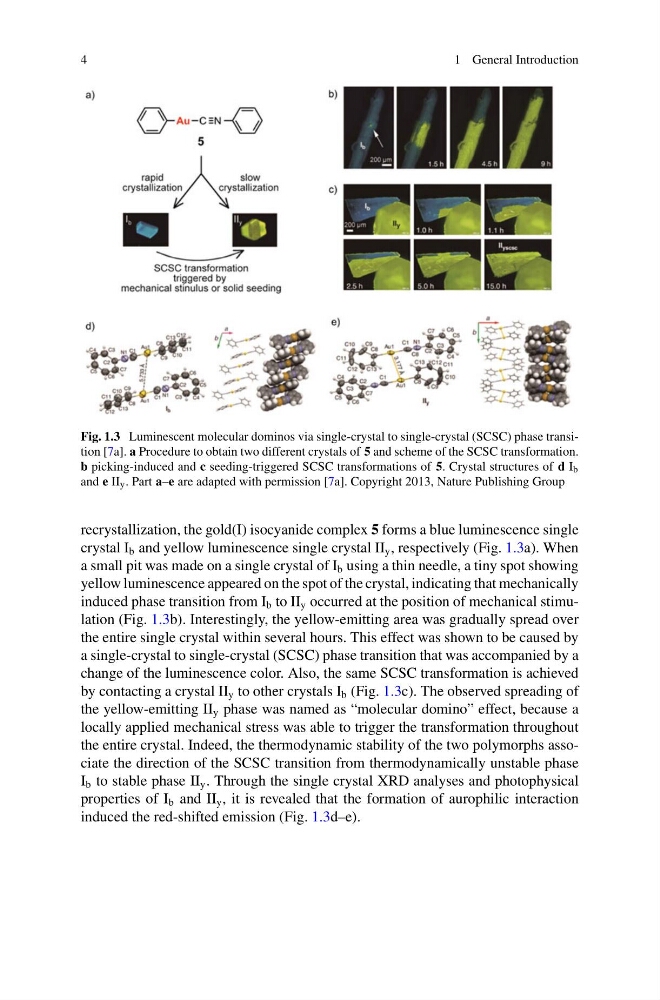
Fig. 1.3 Luminescent molecular dominos via single-crystal to single-crystal (SCSC) phase transition [7a]. a Procedure to obtain two different crystals of 5 and scheme of the SCSC transformation.
b picking-induced and c seeding-triggered SCSC transformations of 5. Crystal structures of d I b
and e II y . Part a–e are adapted with permission [7a]. Copyright 2013, Nature Publishing Group
recrystallization, the gold(I) isocyanide complex 5 forms a blue luminescence single
crystal I b and yellow luminescence single crystal II y , respectively (Fig. 1.3a). When
a small pit was made on a single crystal of I b using a thin needle, a tiny spot showing
yellow luminescence appeared on the spot of the crystal, indicating that mechanically
induced phase transition from I b to II y occurred at the position of mechanical stimulation (Fig. 1.3b). Interestingly, the yellow-emitting area was gradually spread over
the entire single crystal within several hours. This effect was shown to be caused by
a single-crystal to single-crystal (SCSC) phase transition that was accompanied by a
change of the luminescence color. Also, the same SCSC transformation is achieved
by contacting a crystal II y to other crystals I b (Fig. 1.3c). The observed spreading of
the yellow-emitting II y phase was named as “molecular domino” effect, because a
locally applied mechanical stress was able to trigger the transformation throughout
the entire crystal. Indeed, the thermodynamic stability of the two polymorphs associate the direction of the SCSC transition from thermodynamically unstable phase
I b to stable phase II y . Through the single crystal XRD analyses and photophysical
properties of I b and II y , it is revealed that the formation of aurophilic interaction
induced the red-shifted emission (Fig. 1.3d–e).
1 General Introduction
Fig. 1.3 Luminescent molecular dominos via single-crystal to single-crystal (SCSC) phase transition [7a]. a Procedure to obtain two different crystals of 5 and scheme of the SCSC transformation.
b picking-induced and c seeding-triggered SCSC transformations of 5. Crystal structures of d I b
and e II y . Part a–e are adapted with permission [7a]. Copyright 2013, Nature Publishing Group
recrystallization, the gold(I) isocyanide complex 5 forms a blue luminescence single
crystal I b and yellow luminescence single crystal II y , respectively (Fig. 1.3a). When
a small pit was made on a single crystal of I b using a thin needle, a tiny spot showing
yellow luminescence appeared on the spot of the crystal, indicating that mechanically
induced phase transition from I b to II y occurred at the position of mechanical stimulation (Fig. 1.3b). Interestingly, the yellow-emitting area was gradually spread over
the entire single crystal within several hours. This effect was shown to be caused by
a single-crystal to single-crystal (SCSC) phase transition that was accompanied by a
change of the luminescence color. Also, the same SCSC transformation is achieved
by contacting a crystal II y to other crystals I b (Fig. 1.3c). The observed spreading of
the yellow-emitting II y phase was named as “molecular domino” effect, because a
locally applied mechanical stress was able to trigger the transformation throughout
the entire crystal. Indeed, the thermodynamic stability of the two polymorphs associate the direction of the SCSC transition from thermodynamically unstable phase
I b to stable phase II y . Through the single crystal XRD analyses and photophysical
properties of I b and II y , it is revealed that the formation of aurophilic interaction
induced the red-shifted emission (Fig. 1.3d–e).