

1.2 Luminescence Properties of Gold(I) Complexes
5
1.2 Luminescence Properties of Gold(I) Complexes
Luminescence properties of gold(I) complexes can originate from ligands, especially their geometry around the gold atom, or from the presence of metal-metal
interaction so called aurophilic interaction [8]. In other word, it can be displayed by
transitions between orbital of metal center and orbitals of the ligands (usually among
p orbitals), or in transition involving both metal and ligands, where these can act as
donors or acceptors of electronic density (charge transfer transition) [9]. In general,
gold(I) complexes has formed the linear geometry around the gold(I) atom center.
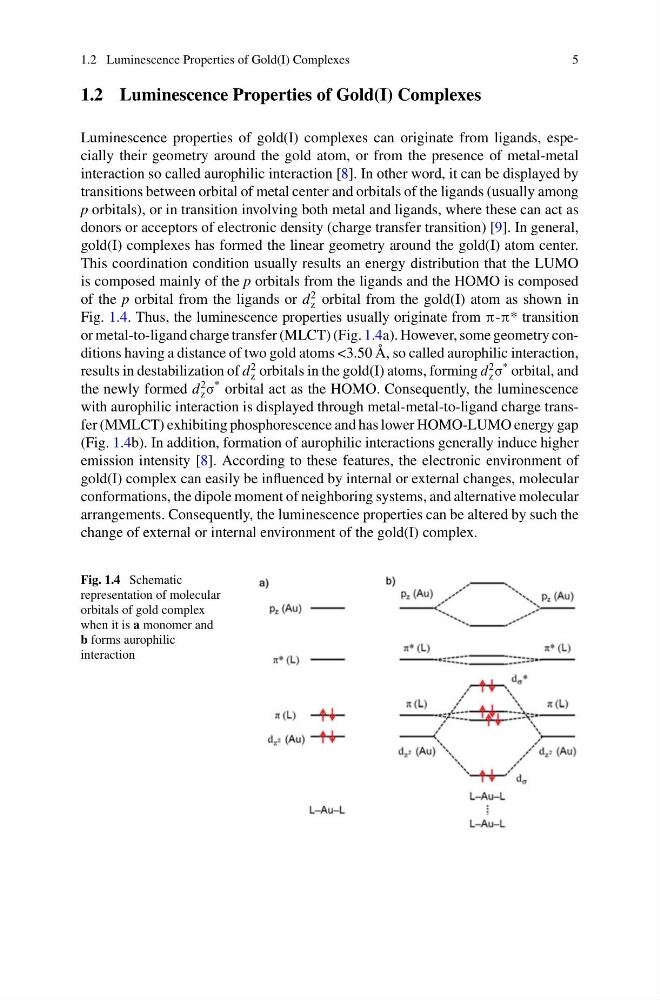
This coordination condition usually results an energy distribution that the LUMO
is composed mainly of the p orbitals from the ligands and the HOMO is composed
of the p orbital from the ligands or d
2
z orbital from the gold(I) atom as shown in
Fig. 1.4. Thus, the luminescence properties usually originate from π-π* transition
or metal-to-ligand charge transfer (MLCT) (Fig. 1.4a). However, some geometry conditions having a distance of two gold atoms <3.50 Å, so called aurophilic interaction,
results in destabilization of d
2
z orbitals in the gold(I) atoms, forming d
2
z σ
* orbital, and
the newly formed d
2
z σ
* orbital act as the HOMO. Consequently, the luminescence
with aurophilic interaction is displayed through metal-metal-to-ligand charge transfer (MMLCT) exhibiting phosphorescence and has lower HOMO-LUMO energy gap
(Fig. 1.4b). In addition, formation of aurophilic interactions generally induce higher
emission intensity [8]. According to these features, the electronic environment of
gold(I) complex can easily be influenced by internal or external changes, molecular
conformations, the dipole moment of neighboring systems, and alternative molecular
arrangements. Consequently, the luminescence properties can be altered by such the
change of external or internal environment of the gold(I) complex.
Fig. 1.4 Schematic
representation of molecular
orbitals of gold complex
when it is a monomer and
b forms aurophilic
interaction
5
1.2 Luminescence Properties of Gold(I) Complexes
Luminescence properties of gold(I) complexes can originate from ligands, especially their geometry around the gold atom, or from the presence of metal-metal
interaction so called aurophilic interaction [8]. In other word, it can be displayed by
transitions between orbital of metal center and orbitals of the ligands (usually among
p orbitals), or in transition involving both metal and ligands, where these can act as
donors or acceptors of electronic density (charge transfer transition) [9]. In general,
gold(I) complexes has formed the linear geometry around the gold(I) atom center.
This coordination condition usually results an energy distribution that the LUMO
is composed mainly of the p orbitals from the ligands and the HOMO is composed
of the p orbital from the ligands or d
2
z orbital from the gold(I) atom as shown in
Fig. 1.4. Thus, the luminescence properties usually originate from π-π* transition
or metal-to-ligand charge transfer (MLCT) (Fig. 1.4a). However, some geometry conditions having a distance of two gold atoms <3.50 Å, so called aurophilic interaction,
results in destabilization of d
2
z orbitals in the gold(I) atoms, forming d
2
z σ
* orbital, and
the newly formed d
2
z σ
* orbital act as the HOMO. Consequently, the luminescence
with aurophilic interaction is displayed through metal-metal-to-ligand charge transfer (MMLCT) exhibiting phosphorescence and has lower HOMO-LUMO energy gap
(Fig. 1.4b). In addition, formation of aurophilic interactions generally induce higher
emission intensity [8]. According to these features, the electronic environment of
gold(I) complex can easily be influenced by internal or external changes, molecular
conformations, the dipole moment of neighboring systems, and alternative molecular
arrangements. Consequently, the luminescence properties can be altered by such the
change of external or internal environment of the gold(I) complex.
Fig. 1.4 Schematic
representation of molecular
orbitals of gold complex
when it is a monomer and
b forms aurophilic
interaction