

1.1 External Stimuli Responsive Luminescence of Solid-State …
3
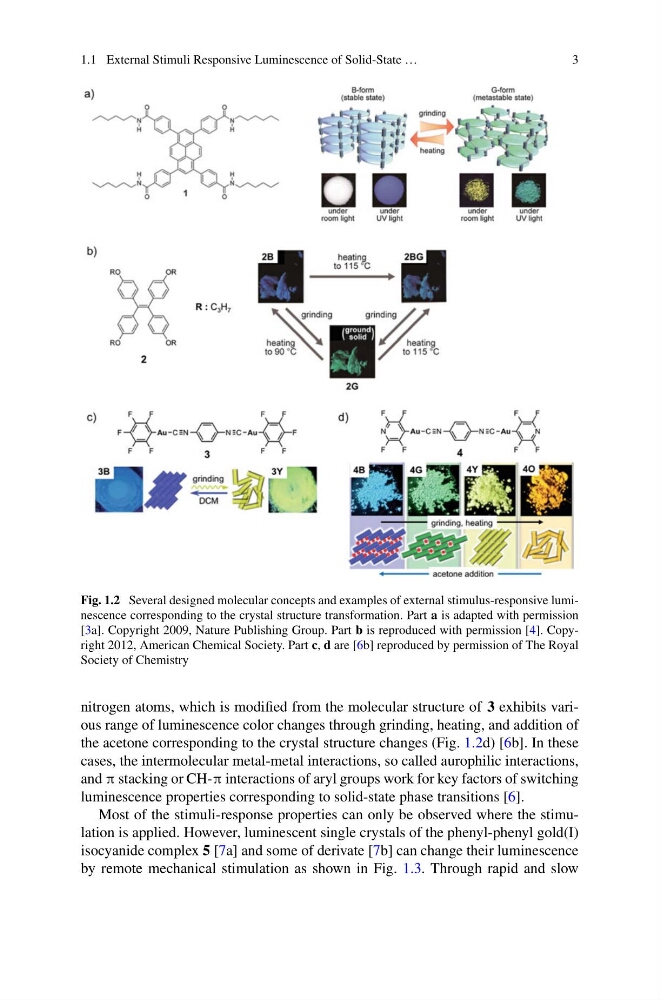
Fig. 1.2 Several designed molecular concepts and examples of external stimulus-responsive luminescence corresponding to the crystal structure transformation. Part a is adapted with permission
[3a]. Copyright 2009, Nature Publishing Group. Part b is reproduced with permission [4]. Copyright 2012, American Chemical Society. Part c, d are [6b] reproduced by permission of The Royal
Society of Chemistry
nitrogen atoms, which is modified from the molecular structure of 3 exhibits various range of luminescence color changes through grinding, heating, and addition of
the acetone corresponding to the crystal structure changes (Fig. 1.2d) [6b]. In these
cases, the intermolecular metal-metal interactions, so called aurophilic interactions,
and π stacking or CH-π interactions of aryl groups work for key factors of switching
luminescence properties corresponding to solid-state phase transitions [6].
Most of the stimuli-response properties can only be observed where the stimulation is applied. However, luminescent single crystals of the phenyl-phenyl gold(I)
isocyanide complex 5 [7a] and some of derivate [7b] can change their luminescence
by remote mechanical stimulation as shown in Fig. 1.3. Through rapid and slow
3
Fig. 1.2 Several designed molecular concepts and examples of external stimulus-responsive luminescence corresponding to the crystal structure transformation. Part a is adapted with permission
[3a]. Copyright 2009, Nature Publishing Group. Part b is reproduced with permission [4]. Copyright 2012, American Chemical Society. Part c, d are [6b] reproduced by permission of The Royal
Society of Chemistry
nitrogen atoms, which is modified from the molecular structure of 3 exhibits various range of luminescence color changes through grinding, heating, and addition of
the acetone corresponding to the crystal structure changes (Fig. 1.2d) [6b]. In these
cases, the intermolecular metal-metal interactions, so called aurophilic interactions,
and π stacking or CH-π interactions of aryl groups work for key factors of switching
luminescence properties corresponding to solid-state phase transitions [6].
Most of the stimuli-response properties can only be observed where the stimulation is applied. However, luminescent single crystals of the phenyl-phenyl gold(I)
isocyanide complex 5 [7a] and some of derivate [7b] can change their luminescence
by remote mechanical stimulation as shown in Fig. 1.3. Through rapid and slow