

3 Local Dielectric Constant Density Analysis of High-k Dielectric Nanomaterial
79
−5.0
0.0
5.0
[bohr]
−5.0
0.0
5.0
[bohr]
−0.1
0.0
0.1
4
0.1
Hf
O
O
(a)
−5.0
0.0
5.0
[bohr]
−5.0
0.0
5.0
[bohr]
−0.1
0.0
0.1
4
0.1
Hf
O
O
(b)
−5.0
0.0
5.0
[bohr]
−5.0
0.0
5.0
[bohr]
−0.1
0.0
0.1
4
0.1
Hf
O
O
(c)
−0.05
0
1/4
0.15
i [−]
i =1
i =2
i =3
Average
0.0
1.0
Hf
O
|sin|
(d)
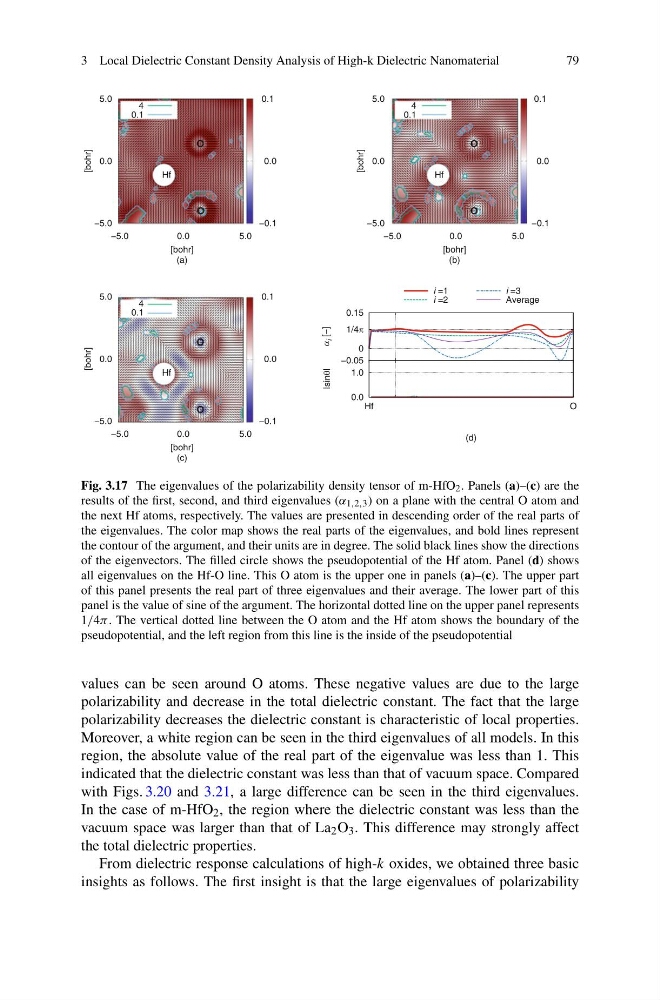
Fig. 3.17 The eigenvalues of the polarizability density tensor of m-HfO 2 . Panels (a)–(c) are the
results of the first, second, and third eigenvalues (α 1,2,3 ) on a plane with the central O atom and
the next Hf atoms, respectively. The values are presented in descending order of the real parts of
the eigenvalues. The color map shows the real parts of the eigenvalues, and bold lines represent
the contour of the argument, and their units are in degree. The solid black lines show the directions
of the eigenvectors. The filled circle shows the pseudopotential of the Hf atom. Panel (d) shows
all eigenvalues on the Hf-O line. This O atom is the upper one in panels (a)–(c). The upper part
of this panel presents the real part of three eigenvalues and their average. The lower part of this
panel is the value of sine of the argument. The horizontal dotted line on the upper panel represents
1/4π . The vertical dotted line between the O atom and the Hf atom shows the boundary of the
pseudopotential, and the left region from this line is the inside of the pseudopotential
values can be seen around O atoms. These negative values are due to the large
polarizability and decrease in the total dielectric constant. The fact that the large
polarizability decreases the dielectric constant is characteristic of local properties.
Moreover, a white region can be seen in the third eigenvalues of all models. In this
region, the absolute value of the real part of the eigenvalue was less than 1. This
indicated that the dielectric constant was less than that of vacuum space. Compared
with Figs. 3.20 and 3.21, a large difference can be seen in the third eigenvalues.
In the case of m-HfO 2 , the region where the dielectric constant was less than the
vacuum space was larger than that of La 2 O 3 . This difference may strongly affect
the total dielectric properties.
From dielectric response calculations of high-k oxides, we obtained three basic
insights as follows. The first insight is that the large eigenvalues of polarizability
79
−5.0
0.0
5.0
[bohr]
−5.0
0.0
5.0
[bohr]
−0.1
0.0
0.1
4
0.1
Hf
O
O
(a)
−5.0
0.0
5.0
[bohr]
−5.0
0.0
5.0
[bohr]
−0.1
0.0
0.1
4
0.1
Hf
O
O
(b)
−5.0
0.0
5.0
[bohr]
−5.0
0.0
5.0
[bohr]
−0.1
0.0
0.1
4
0.1
Hf
O
O
(c)
−0.05
0
1/4
0.15
i [−]
i =1
i =2
i =3
Average
0.0
1.0
Hf
O
|sin|
(d)
Fig. 3.17 The eigenvalues of the polarizability density tensor of m-HfO 2 . Panels (a)–(c) are the
results of the first, second, and third eigenvalues (α 1,2,3 ) on a plane with the central O atom and
the next Hf atoms, respectively. The values are presented in descending order of the real parts of
the eigenvalues. The color map shows the real parts of the eigenvalues, and bold lines represent
the contour of the argument, and their units are in degree. The solid black lines show the directions
of the eigenvectors. The filled circle shows the pseudopotential of the Hf atom. Panel (d) shows
all eigenvalues on the Hf-O line. This O atom is the upper one in panels (a)–(c). The upper part
of this panel presents the real part of three eigenvalues and their average. The lower part of this
panel is the value of sine of the argument. The horizontal dotted line on the upper panel represents
1/4π . The vertical dotted line between the O atom and the Hf atom shows the boundary of the
pseudopotential, and the left region from this line is the inside of the pseudopotential
values can be seen around O atoms. These negative values are due to the large
polarizability and decrease in the total dielectric constant. The fact that the large
polarizability decreases the dielectric constant is characteristic of local properties.
Moreover, a white region can be seen in the third eigenvalues of all models. In this
region, the absolute value of the real part of the eigenvalue was less than 1. This
indicated that the dielectric constant was less than that of vacuum space. Compared
with Figs. 3.20 and 3.21, a large difference can be seen in the third eigenvalues.
In the case of m-HfO 2 , the region where the dielectric constant was less than the
vacuum space was larger than that of La 2 O 3 . This difference may strongly affect
the total dielectric properties.
From dielectric response calculations of high-k oxides, we obtained three basic
insights as follows. The first insight is that the large eigenvalues of polarizability