

3 Local Dielectric Constant Density Analysis of High-k Dielectric Nanomaterial
75
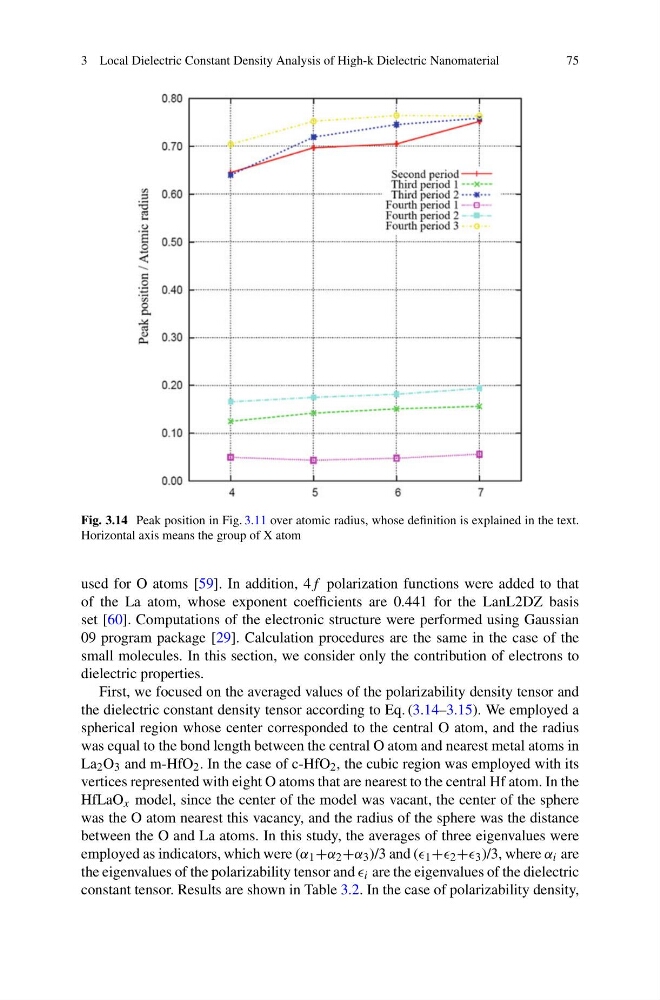
Fig. 3.14 Peak position in Fig. 3.11 over atomic radius, whose definition is explained in the text.
Horizontal axis means the group of X atom
used for O atoms [59]. In addition, 4f polarization functions were added to that
of the La atom, whose exponent coefficients are 0.441 for the LanL2DZ basis
set [60]. Computations of the electronic structure were performed using Gaussian
09 program package [29]. Calculation procedures are the same in the case of the
small molecules. In this section, we consider only the contribution of electrons to
dielectric properties.
First, we focused on the averaged values of the polarizability density tensor and
the dielectric constant density tensor according to Eq. (3.14–3.15). We employed a
spherical region whose center corresponded to the central O atom, and the radius
was equal to the bond length between the central O atom and nearest metal atoms in
La 2 O 3 and m-HfO 2 . In the case of c-HfO 2 , the cubic region was employed with its
vertices represented with eight O atoms that are nearest to the central Hf atom. In the
HfLaO x model, since the center of the model was vacant, the center of the sphere
was the O atom nearest this vacancy, and the radius of the sphere was the distance
between the O and La atoms. In this study, the averages of three eigenvalues were
employed as indicators, which were (α 1 +α 2 +α 3 )/3 and ( 1 + 2 + 3 )/3, where α i are
the eigenvalues of the polarizability tensor and i are the eigenvalues of the dielectric
constant tensor. Results are shown in Table 3.2. In the case of polarizability density,
75
Fig. 3.14 Peak position in Fig. 3.11 over atomic radius, whose definition is explained in the text.
Horizontal axis means the group of X atom
used for O atoms [59]. In addition, 4f polarization functions were added to that
of the La atom, whose exponent coefficients are 0.441 for the LanL2DZ basis
set [60]. Computations of the electronic structure were performed using Gaussian
09 program package [29]. Calculation procedures are the same in the case of the
small molecules. In this section, we consider only the contribution of electrons to
dielectric properties.
First, we focused on the averaged values of the polarizability density tensor and
the dielectric constant density tensor according to Eq. (3.14–3.15). We employed a
spherical region whose center corresponded to the central O atom, and the radius
was equal to the bond length between the central O atom and nearest metal atoms in
La 2 O 3 and m-HfO 2 . In the case of c-HfO 2 , the cubic region was employed with its
vertices represented with eight O atoms that are nearest to the central Hf atom. In the
HfLaO x model, since the center of the model was vacant, the center of the sphere
was the O atom nearest this vacancy, and the radius of the sphere was the distance
between the O and La atoms. In this study, the averages of three eigenvalues were
employed as indicators, which were (α 1 +α 2 +α 3 )/3 and ( 1 + 2 + 3 )/3, where α i are
the eigenvalues of the polarizability tensor and i are the eigenvalues of the dielectric
constant tensor. Results are shown in Table 3.2. In the case of polarizability density,