

74
M. Senami and A. Fukushima
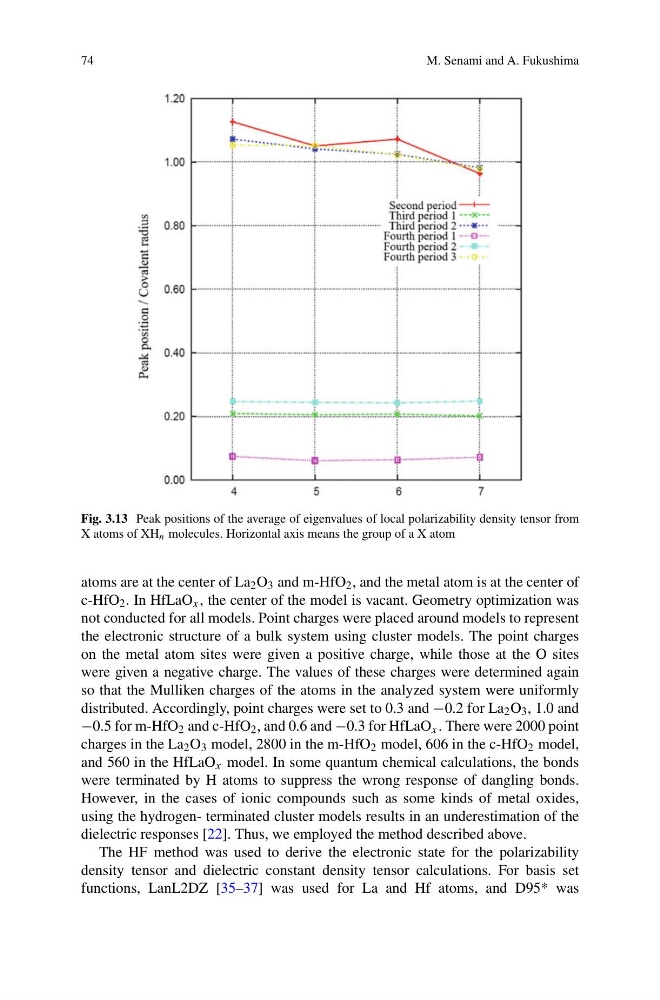
Fig. 3.13 Peak positions of the average of eigenvalues of local polarizability density tensor from
X atoms of XH n molecules. Horizontal axis means the group of a X atom
atoms are at the center of La 2 O 3 and m-HfO 2 , and the metal atom is at the center of
c-HfO 2 . In HfLaO x , the center of the model is vacant. Geometry optimization was
not conducted for all models. Point charges were placed around models to represent
the electronic structure of a bulk system using cluster models. The point charges
on the metal atom sites were given a positive charge, while those at the O sites
were given a negative charge. The values of these charges were determined again
so that the Mulliken charges of the atoms in the analyzed system were uniformly
distributed. Accordingly, point charges were set to 0.3 and −0.2 for La 2 O 3 , 1.0 and
−0.5 for m-HfO 2 and c-HfO 2 , and 0.6 and −0.3 for HfLaO x . There were 2000 point
charges in the La 2 O 3 model, 2800 in the m-HfO 2 model, 606 in the c-HfO 2 model,
and 560 in the HfLaO x model. In some quantum chemical calculations, the bonds
were terminated by H atoms to suppress the wrong response of dangling bonds.
However, in the cases of ionic compounds such as some kinds of metal oxides,
using the hydrogen- terminated cluster models results in an underestimation of the
dielectric responses [22]. Thus, we employed the method described above.
The HF method was used to derive the electronic state for the polarizability
density tensor and dielectric constant density tensor calculations. For basis set
functions, LanL2DZ [35–37] was used for La and Hf atoms, and D95* was
M. Senami and A. Fukushima
Fig. 3.13 Peak positions of the average of eigenvalues of local polarizability density tensor from
X atoms of XH n molecules. Horizontal axis means the group of a X atom
atoms are at the center of La 2 O 3 and m-HfO 2 , and the metal atom is at the center of
c-HfO 2 . In HfLaO x , the center of the model is vacant. Geometry optimization was
not conducted for all models. Point charges were placed around models to represent
the electronic structure of a bulk system using cluster models. The point charges
on the metal atom sites were given a positive charge, while those at the O sites
were given a negative charge. The values of these charges were determined again
so that the Mulliken charges of the atoms in the analyzed system were uniformly
distributed. Accordingly, point charges were set to 0.3 and −0.2 for La 2 O 3 , 1.0 and
−0.5 for m-HfO 2 and c-HfO 2 , and 0.6 and −0.3 for HfLaO x . There were 2000 point
charges in the La 2 O 3 model, 2800 in the m-HfO 2 model, 606 in the c-HfO 2 model,
and 560 in the HfLaO x model. In some quantum chemical calculations, the bonds
were terminated by H atoms to suppress the wrong response of dangling bonds.
However, in the cases of ionic compounds such as some kinds of metal oxides,
using the hydrogen- terminated cluster models results in an underestimation of the
dielectric responses [22]. Thus, we employed the method described above.
The HF method was used to derive the electronic state for the polarizability
density tensor and dielectric constant density tensor calculations. For basis set
functions, LanL2DZ [35–37] was used for La and Hf atoms, and D95* was