

532
G. Hanna and A. Sergi
E m1 − E m0 , J , W , χ and M are taken from Table 1 in Ref. [73] and are given
by 1660 cm −1 , 7.8 cm −1 , 13 N/m, 62 pN and 87 m p , respectively.
The quantum subsystem of amide I modes and classical environment of H-bond
lattice displacements are uncorrelated initially, which yields the following factorized
initial density matrix:
ˆ
ρ (0) = ˆ
ρ q (0) ρ e (Q, P ) ,
(14.30)
where ˆ
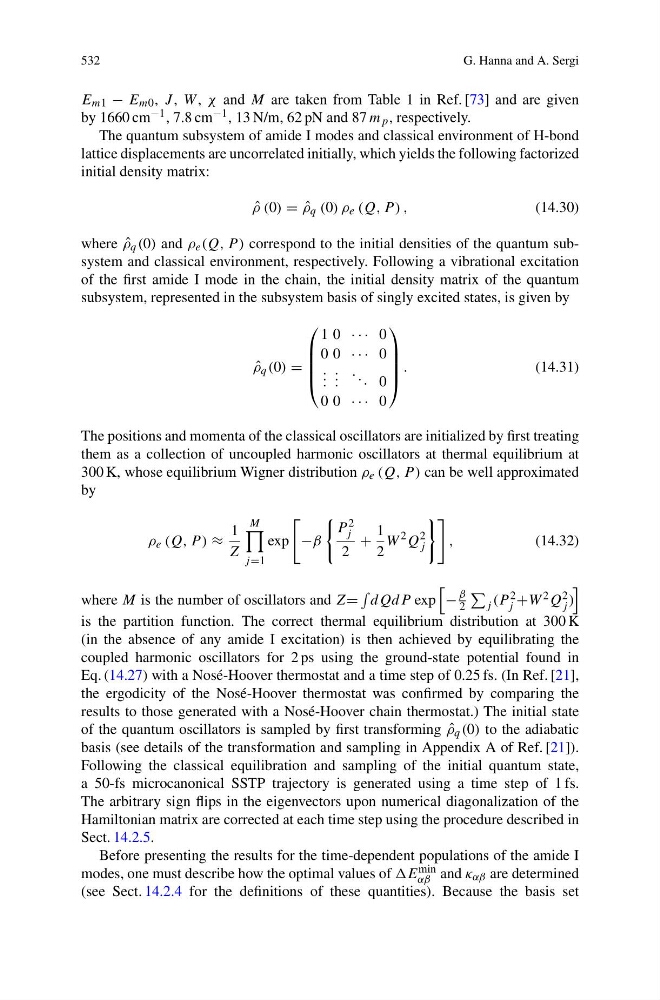
ρ q (0) and ρ e (Q, P ) correspond to the initial densities of the quantum subsystem and classical environment, respectively. Following a vibrational excitation
of the first amide I mode in the chain, the initial density matrix of the quantum
subsystem, represented in the subsystem basis of singly excited states, is given by
ˆ
ρ q (0) =
⎛
⎜
⎜
⎜
⎝
1 0 · · · 0
0 0 · · · 0
. . .
. . .
. . . 0
0 0 · · · 0
⎞
⎟
⎟
⎟
⎠
.
(14.31)
The positions and momenta of the classical oscillators are initialized by first treating
them as a collection of uncoupled harmonic oscillators at thermal equilibrium at
300 K, whose equilibrium Wigner distribution ρ e (Q, P ) can be well approximated
by
ρ e (Q, P ) ≈
1
Z
M
j =1
exp
−β
P 2
j
2
+
1
2
W
2 Q
2
j
,
(14.32)
where M is the number of oscillators and Z=
dQdP exp
−
β
2
j (P 2
j +W 2 Q 2
j )
is the partition function. The correct thermal equilibrium distribution at 300 K
(in the absence of any amide I excitation) is then achieved by equilibrating the
coupled harmonic oscillators for 2 ps using the ground-state potential found in
Eq. (14.27) with a Nosé-Hoover thermostat and a time step of 0.25 fs. (In Ref. [21],
the ergodicity of the Nosé-Hoover thermostat was confirmed by comparing the
results to those generated with a Nosé-Hoover chain thermostat.) The initial state
of the quantum oscillators is sampled by first transforming ˆ
ρ q (0) to the adiabatic
basis (see details of the transformation and sampling in Appendix A of Ref. [21]).
Following the classical equilibration and sampling of the initial quantum state,
a 50-fs microcanonical SSTP trajectory is generated using a time step of 1 fs.
The arbitrary sign flips in the eigenvectors upon numerical diagonalization of the
Hamiltonian matrix are corrected at each time step using the procedure described in
Sect. 14.2.5.
Before presenting the results for the time-dependent populations of the amide I
modes, one must describe how the optimal values of E min
αβ and κ αβ are determined
(see Sect. 14.2.4 for the definitions of these quantities). Because the basis set
G. Hanna and A. Sergi
E m1 − E m0 , J , W , χ and M are taken from Table 1 in Ref. [73] and are given
by 1660 cm −1 , 7.8 cm −1 , 13 N/m, 62 pN and 87 m p , respectively.
The quantum subsystem of amide I modes and classical environment of H-bond
lattice displacements are uncorrelated initially, which yields the following factorized
initial density matrix:
ˆ
ρ (0) = ˆ
ρ q (0) ρ e (Q, P ) ,
(14.30)
where ˆ
ρ q (0) and ρ e (Q, P ) correspond to the initial densities of the quantum subsystem and classical environment, respectively. Following a vibrational excitation
of the first amide I mode in the chain, the initial density matrix of the quantum
subsystem, represented in the subsystem basis of singly excited states, is given by
ˆ
ρ q (0) =
⎛
⎜
⎜
⎜
⎝
1 0 · · · 0
0 0 · · · 0
. . .
. . .
. . . 0
0 0 · · · 0
⎞
⎟
⎟
⎟
⎠
.
(14.31)
The positions and momenta of the classical oscillators are initialized by first treating
them as a collection of uncoupled harmonic oscillators at thermal equilibrium at
300 K, whose equilibrium Wigner distribution ρ e (Q, P ) can be well approximated
by
ρ e (Q, P ) ≈
1
Z
M
j =1
exp
−β
P 2
j
2
+
1
2
W
2 Q
2
j
,
(14.32)
where M is the number of oscillators and Z=
dQdP exp
−
β
2
j (P 2
j +W 2 Q 2
j )
is the partition function. The correct thermal equilibrium distribution at 300 K
(in the absence of any amide I excitation) is then achieved by equilibrating the
coupled harmonic oscillators for 2 ps using the ground-state potential found in
Eq. (14.27) with a Nosé-Hoover thermostat and a time step of 0.25 fs. (In Ref. [21],
the ergodicity of the Nosé-Hoover thermostat was confirmed by comparing the
results to those generated with a Nosé-Hoover chain thermostat.) The initial state
of the quantum oscillators is sampled by first transforming ˆ
ρ q (0) to the adiabatic
basis (see details of the transformation and sampling in Appendix A of Ref. [21]).
Following the classical equilibration and sampling of the initial quantum state,
a 50-fs microcanonical SSTP trajectory is generated using a time step of 1 fs.
The arbitrary sign flips in the eigenvectors upon numerical diagonalization of the
Hamiltonian matrix are corrected at each time step using the procedure described in
Sect. 14.2.5.
Before presenting the results for the time-dependent populations of the amide I
modes, one must describe how the optimal values of E min
αβ and κ αβ are determined
(see Sect. 14.2.4 for the definitions of these quantities). Because the basis set