

506
N. C. Bacalis
Here c
n,,
k are the usual associated Laguerre polynomial coefficients, z n, , b n, , q n,
are variational parameters, and g
n,,
k
are factors determined by orthogonalization
to desired, only, orbitals, i.e., by solving (for g
n,,
k ) the relations n i , , m| n j , ,
m = δ i, j , so that not all orbitals are mutually orthogonal. Therefore the general
formalism is non-orthogonal, which allows spin unrestricted as well as open shell
computation.
Thus, for an atom with nuclear charge Z nuc and N electrons, with space and spin
coordinates r 1 s 1 , ..., r N s N , and for a given symmetry type and electron occupancy,
the desired N − electron normalized wave function, of the n th excited state,
consisting of N conf (predetermined) configurations, out of N det SDs, is written as
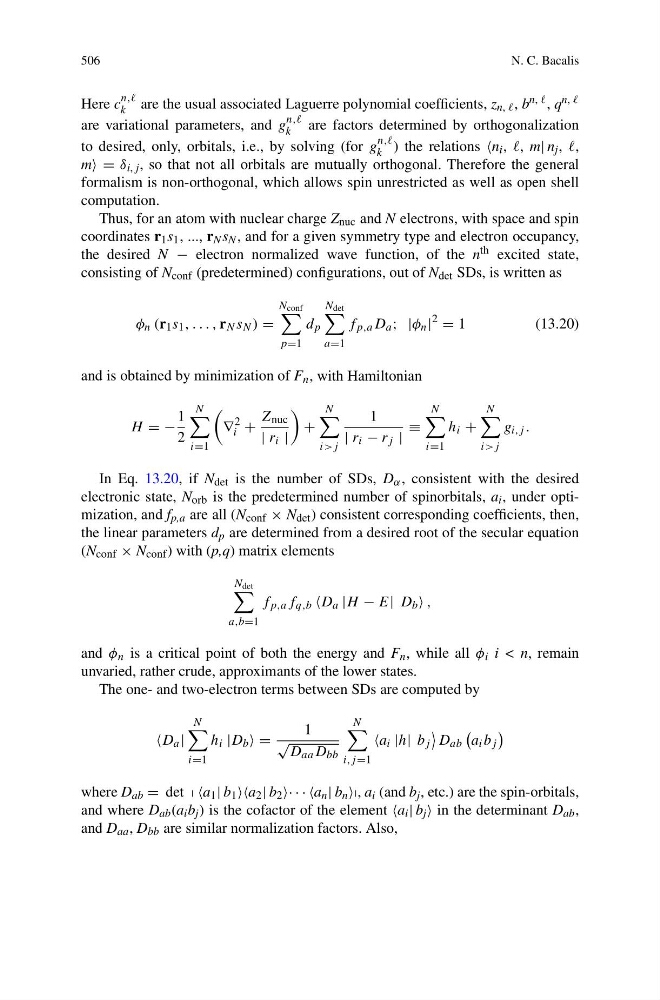
φ n (r 1 s 1 , . . . , r N s N ) =
N conf
p=1
d p
N det
a=1
f p,a D a ; |φ n |
2
= 1
(13.20)
and is obtained by minimization of F n , with Hamiltonian
H = −
1
2
N
i=1
∇
2
i +
Z nuc
| r i |
+
N
i>j
1
| r i − r j |
≡
N
i=1
h i +
N
i>j
g i,j .
In Eq. 13.20, if N det is the number of SDs, D α , consistent with the desired
electronic state, N orb is the predetermined number of spinorbitals, a i , under optimization, and f p,a are all (N conf × N det ) consistent corresponding coefficients, then,
the linear parameters d p are determined from a desired root of the secular equation
(N conf × N conf ) with (p,q) matrix elements
N det
a,b=1
f p,a f q,b D a |H − E| D b ,
and φ n is a critical point of both the energy and F n , while all φ i i < n, remain
unvaried, rather crude, approximants of the lower states.
The one- and two-electron terms between SDs are computed by
D a |
N
i=1
h i |D b =
1
√
D aa D bb
N
i,j =1
a i |h| b j
D ab
a i b j
where D ab = det a 1 | b 1 a 2 | b 2 · · · ·a n | b n , a i (and b j , etc.) are the spin-orbitals,
and where D ab (a i b j ) is the cofactor of the element a i | b j in the determinant D ab ,
and D aa , D bb are similar normalization factors. Also,
N. C. Bacalis
Here c
n,,
k are the usual associated Laguerre polynomial coefficients, z n, , b n, , q n,
are variational parameters, and g
n,,
k
are factors determined by orthogonalization
to desired, only, orbitals, i.e., by solving (for g
n,,
k ) the relations n i , , m| n j , ,
m = δ i, j , so that not all orbitals are mutually orthogonal. Therefore the general
formalism is non-orthogonal, which allows spin unrestricted as well as open shell
computation.
Thus, for an atom with nuclear charge Z nuc and N electrons, with space and spin
coordinates r 1 s 1 , ..., r N s N , and for a given symmetry type and electron occupancy,
the desired N − electron normalized wave function, of the n th excited state,
consisting of N conf (predetermined) configurations, out of N det SDs, is written as
φ n (r 1 s 1 , . . . , r N s N ) =
N conf
p=1
d p
N det
a=1
f p,a D a ; |φ n |
2
= 1
(13.20)
and is obtained by minimization of F n , with Hamiltonian
H = −
1
2
N
i=1
∇
2
i +
Z nuc
| r i |
+
N
i>j
1
| r i − r j |
≡
N
i=1
h i +
N
i>j
g i,j .
In Eq. 13.20, if N det is the number of SDs, D α , consistent with the desired
electronic state, N orb is the predetermined number of spinorbitals, a i , under optimization, and f p,a are all (N conf × N det ) consistent corresponding coefficients, then,
the linear parameters d p are determined from a desired root of the secular equation
(N conf × N conf ) with (p,q) matrix elements
N det
a,b=1
f p,a f q,b D a |H − E| D b ,
and φ n is a critical point of both the energy and F n , while all φ i i < n, remain
unvaried, rather crude, approximants of the lower states.
The one- and two-electron terms between SDs are computed by
D a |
N
i=1
h i |D b =
1
√
D aa D bb
N
i,j =1
a i |h| b j
D ab
a i b j
where D ab = det a 1 | b 1 a 2 | b 2 · · · ·a n | b n , a i (and b j , etc.) are the spin-orbitals,
and where D ab (a i b j ) is the cofactor of the element a i | b j in the determinant D ab ,
and D aa , D bb are similar normalization factors. Also,