

13 If Truncated Wave Functions of Excited State Energy Saddle Points Are. . .
491
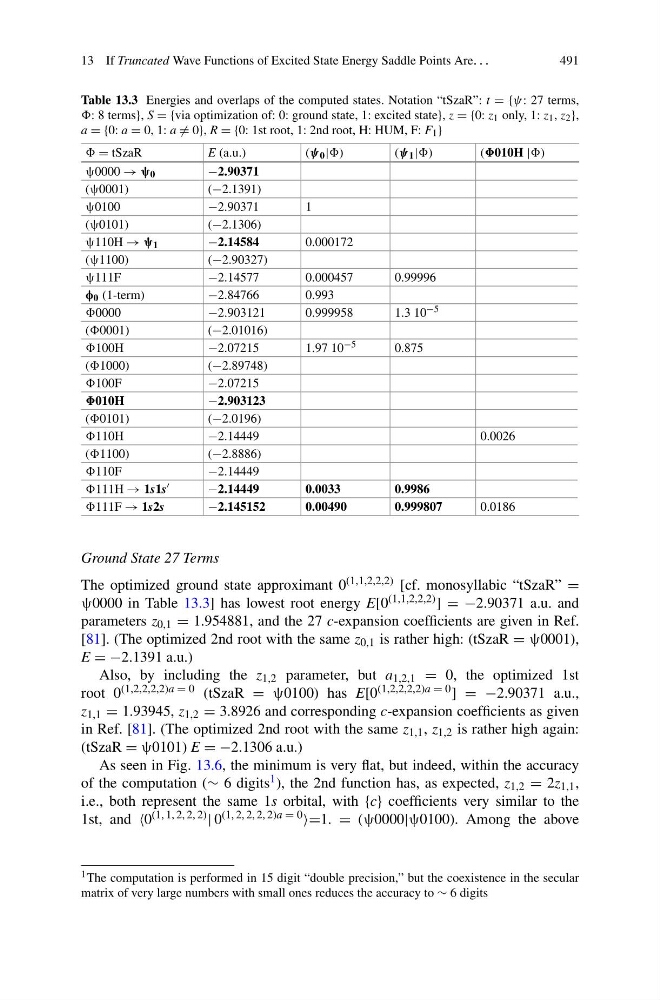
Table 13.3 Energies and overlaps of the computed states. Notation “tSzaR”: t = {ψ: 27 terms,
: 8 terms}, S = {via optimization of: 0: ground state, 1: excited state}, z = {0: z 1 only, 1: z 1 , z 2 },
a = {0: a = 0, 1: a = 0}, R = {0: 1st root, 1: 2nd root, H: HUM, F: F 1 }
= tSzaR
E (a.u.)
(ψ 0 |)
(ψ 1 |)
(010H |)
ψ0000 → ψ 0
−2.90371
(ψ0001)
(−2.1391)
ψ0100
−2.90371
1
(ψ0101)
(−2.1306)
ψ110H → ψ 1
−2.14584
0.000172
(ψ1100)
(−2.90327)
ψ111F
−2.14577
0.000457
0.99996
φ 0 (1-term)
−2.84766
0.993
0000
−2.903121
0.999958
1.3 10 −5
(0001)
(−2.01016)
100H
−2.07215
1.97 10 −5
0.875
(1000)
(−2.89748)
100F
−2.07215
010H
−2.903123
(0101)
(−2.0196)
110H
−2.14449
0.0026
(1100)
(−2.8886)
110F
−2.14449
111H → 1s1s
−2.14449
0.0033
0.9986
111F → 1s2s
−2.145152
0.00490
0.999807
0.0186
Ground State 27 Terms
The optimized ground state approximant 0 (1,1,2,2,2) [cf. monosyllabic “tSzaR” =
ψ0000 in Table 13.3] has lowest root energy E[0 (1,1,2,2,2) ] = −2.90371 a.u. and
parameters z 0,1 = 1.954881, and the 27 c-expansion coefficients are given in Ref.
[81]. (The optimized 2nd root with the same z 0,1 is rather high: (tSzaR = ψ0001),
E = −2.1391 a.u.)
Also, by including the z 1,2 parameter, but a 1,2,1 = 0, the optimized 1st
root 0 (1,2,2,2,2)a = 0 (tSzaR = ψ0100) has E[0 (1,2,2,2,2)a = 0 ] = −2.90371 a.u.,
z 1,1 = 1.93945, z 1,2 = 3.8926 and corresponding c-expansion coefficients as given
in Ref. [81]. (The optimized 2nd root with the same z 1,1 , z 1,2 is rather high again:
(tSzaR = ψ0101) E = −2.1306 a.u.)
As seen in Fig. 13.6, the minimum is very flat, but indeed, within the accuracy
of the computation (∼ 6 digits 1 ), the 2nd function has, as expected, z 1,2 = 2z 1,1 ,
i.e., both represent the same 1s orbital, with {c} coefficients very similar to the
1st, and 0 (1, 1, 2, 2, 2) | 0 (1, 2, 2, 2, 2)a = 0 =1. = (ψ0000|ψ0100). Among the above
1 The computation is performed in 15 digit “double precision,” but the coexistence in the secular
matrix of very large numbers with small ones reduces the accuracy to ∼ 6 digits
491
Table 13.3 Energies and overlaps of the computed states. Notation “tSzaR”: t = {ψ: 27 terms,
: 8 terms}, S = {via optimization of: 0: ground state, 1: excited state}, z = {0: z 1 only, 1: z 1 , z 2 },
a = {0: a = 0, 1: a = 0}, R = {0: 1st root, 1: 2nd root, H: HUM, F: F 1 }
= tSzaR
E (a.u.)
(ψ 0 |)
(ψ 1 |)
(010H |)
ψ0000 → ψ 0
−2.90371
(ψ0001)
(−2.1391)
ψ0100
−2.90371
1
(ψ0101)
(−2.1306)
ψ110H → ψ 1
−2.14584
0.000172
(ψ1100)
(−2.90327)
ψ111F
−2.14577
0.000457
0.99996
φ 0 (1-term)
−2.84766
0.993
0000
−2.903121
0.999958
1.3 10 −5
(0001)
(−2.01016)
100H
−2.07215
1.97 10 −5
0.875
(1000)
(−2.89748)
100F
−2.07215
010H
−2.903123
(0101)
(−2.0196)
110H
−2.14449
0.0026
(1100)
(−2.8886)
110F
−2.14449
111H → 1s1s
−2.14449
0.0033
0.9986
111F → 1s2s
−2.145152
0.00490
0.999807
0.0186
Ground State 27 Terms
The optimized ground state approximant 0 (1,1,2,2,2) [cf. monosyllabic “tSzaR” =
ψ0000 in Table 13.3] has lowest root energy E[0 (1,1,2,2,2) ] = −2.90371 a.u. and
parameters z 0,1 = 1.954881, and the 27 c-expansion coefficients are given in Ref.
[81]. (The optimized 2nd root with the same z 0,1 is rather high: (tSzaR = ψ0001),
E = −2.1391 a.u.)
Also, by including the z 1,2 parameter, but a 1,2,1 = 0, the optimized 1st
root 0 (1,2,2,2,2)a = 0 (tSzaR = ψ0100) has E[0 (1,2,2,2,2)a = 0 ] = −2.90371 a.u.,
z 1,1 = 1.93945, z 1,2 = 3.8926 and corresponding c-expansion coefficients as given
in Ref. [81]. (The optimized 2nd root with the same z 1,1 , z 1,2 is rather high again:
(tSzaR = ψ0101) E = −2.1306 a.u.)
As seen in Fig. 13.6, the minimum is very flat, but indeed, within the accuracy
of the computation (∼ 6 digits 1 ), the 2nd function has, as expected, z 1,2 = 2z 1,1 ,
i.e., both represent the same 1s orbital, with {c} coefficients very similar to the
1st, and 0 (1, 1, 2, 2, 2) | 0 (1, 2, 2, 2, 2)a = 0 =1. = (ψ0000|ψ0100). Among the above
1 The computation is performed in 15 digit “double precision,” but the coexistence in the secular
matrix of very large numbers with small ones reduces the accuracy to ∼ 6 digits