

13 If Truncated Wave Functions of Excited State Energy Saddle Points Are. . .
487
(ii) by binomial expanding r k
1,2 ∼ (s ± t)
k ,
(iii) by using
s 2 − t 2
ϕ =
1
p=0
(−1)
p s 2(1−p) t 2p ϕ, and,
(iv) by writing the required derivatives as
d
dx
x n e −zx =
1
b=0
[n (1 − b) − zb]
x n−1+b e −zx ,
all terms can be reduced to monomial sums, so that the total symmetric two-electron
function be written as
φ
− → r 1 , − → r 2
=
n 1 ,n 2 ,n s ,n t ,n u
(s, t, u) =
1
π
n 1 − 1
!n 1 !
n 2 − 1
!n 2 !
1 −
1
2 δ n 1 ,n 2
n s
i s =0
n t
i t =0
n u
i u =0
n 2 −1
k 2 =0
n 1 −1
k 1 =0
1
q =0
k 2
j 2 =0
k 1
j 1 =0
(−1)
j 1 +k 1 +k 2
(2q − 1)
j 1 +j 2 n
−2−k 1
1
n
−2−k 2
2
z
3
2 +k 1
1
z
3
2 +k 2
2
e
−s
z ,n 1
2n 1
+
z ,n 2
2n 2
− t
1
2 − q
z ,n 1
n 1
−
z ,n 2
n 2
s
i s −j 1 −j 2 +k 1 +k 2 t
2i t +j 1
+ j 2 u
i u a ,n 1 ,k 1 a ,n 2 ,k 2 c s ,2i t ,i u
/
j 1 !j 2 !
k 1 +1
!
k 1 −j 1
!
k 2 +1
!
k 2 −j 2
!
n 1 −1−k 1
!
n 2 −1−k 2
!
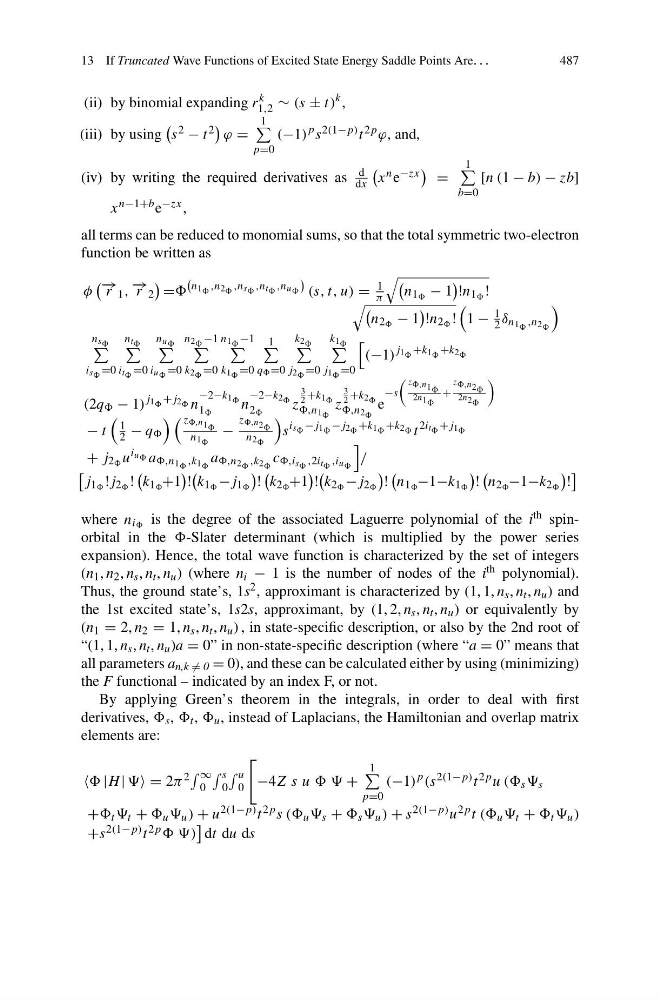
where n i is the degree of the associated Laguerre polynomial of the i th spinorbital in the -Slater determinant (which is multiplied by the power series
expansion). Hence, the total wave function is characterized by the set of integers
(n 1 , n 2 , n s , n t , n u ) (where n i − 1 is the number of nodes of the i th polynomial).
Thus, the ground state’s, 1s 2 , approximant is characterized by (1, 1, n s , n t , n u ) and
the 1st excited state’s, 1s2s, approximant, by (1, 2, n s , n t , n u ) or equivalently by
(n 1 = 2, n 2 = 1, n s , n t , n u ) , in state-specific description, or also by the 2nd root of
“(1, 1, n s , n t , n u )a = 0” in non-state-specific description (where “a = 0” means that
all parameters a n,k = 0 = 0), and these can be calculated either by using (minimizing)
the F functional – indicated by an index F, or not.
By applying Green’s theorem in the integrals, in order to deal with first
derivatives, s , t , u , instead of Laplacians, the Hamiltonian and overlap matrix
elements are:
|H | = 2π 2 ∞
0
s
0
u
0
−4Z s u u u +
1
p=0
(−1)
p (s 2(1−p) t 2p u ( s s
+ t t + u u ) + u 2(1−p) t 2p s ( u s + s u ) + s 2(1−p) u 2p t ( u t + t u )
+s 2(1−p) t 2p )
dt du ds
487
(ii) by binomial expanding r k
1,2 ∼ (s ± t)
k ,
(iii) by using
s 2 − t 2
ϕ =
1
p=0
(−1)
p s 2(1−p) t 2p ϕ, and,
(iv) by writing the required derivatives as
d
dx
x n e −zx =
1
b=0
[n (1 − b) − zb]
x n−1+b e −zx ,
all terms can be reduced to monomial sums, so that the total symmetric two-electron
function be written as
φ
− → r 1 , − → r 2
=
n 1 ,n 2 ,n s ,n t ,n u
(s, t, u) =
1
π
n 1 − 1
!n 1 !
n 2 − 1
!n 2 !
1 −
1
2 δ n 1 ,n 2
n s
i s =0
n t
i t =0
n u
i u =0
n 2 −1
k 2 =0
n 1 −1
k 1 =0
1
q =0
k 2
j 2 =0
k 1
j 1 =0
(−1)
j 1 +k 1 +k 2
(2q − 1)
j 1 +j 2 n
−2−k 1
1
n
−2−k 2
2
z
3
2 +k 1
1
z
3
2 +k 2
2
e
−s
z ,n 1
2n 1
+
z ,n 2
2n 2
− t
1
2 − q
z ,n 1
n 1
−
z ,n 2
n 2
s
i s −j 1 −j 2 +k 1 +k 2 t
2i t +j 1
+ j 2 u
i u a ,n 1 ,k 1 a ,n 2 ,k 2 c s ,2i t ,i u
/
j 1 !j 2 !
k 1 +1
!
k 1 −j 1
!
k 2 +1
!
k 2 −j 2
!
n 1 −1−k 1
!
n 2 −1−k 2
!
where n i is the degree of the associated Laguerre polynomial of the i th spinorbital in the -Slater determinant (which is multiplied by the power series
expansion). Hence, the total wave function is characterized by the set of integers
(n 1 , n 2 , n s , n t , n u ) (where n i − 1 is the number of nodes of the i th polynomial).
Thus, the ground state’s, 1s 2 , approximant is characterized by (1, 1, n s , n t , n u ) and
the 1st excited state’s, 1s2s, approximant, by (1, 2, n s , n t , n u ) or equivalently by
(n 1 = 2, n 2 = 1, n s , n t , n u ) , in state-specific description, or also by the 2nd root of
“(1, 1, n s , n t , n u )a = 0” in non-state-specific description (where “a = 0” means that
all parameters a n,k = 0 = 0), and these can be calculated either by using (minimizing)
the F functional – indicated by an index F, or not.
By applying Green’s theorem in the integrals, in order to deal with first
derivatives, s , t , u , instead of Laplacians, the Hamiltonian and overlap matrix
elements are:
|H | = 2π 2 ∞
0
s
0
u
0
−4Z s u u u +
1
p=0
(−1)
p (s 2(1−p) t 2p u ( s s
+ t t + u u ) + u 2(1−p) t 2p s ( u s + s u ) + s 2(1−p) u 2p t ( u t + t u )
+s 2(1−p) t 2p )
dt du ds