

482
N. C. Bacalis
13.5 Identifying a Flipped Root Around an Avoided Crossing
When atoms approach each other, then at a certain nuclear separation for each
pair of molecular electronic states (of the same symmetry), the Hamiltonian opens
their energy gap, and an avoided crossing may occur, changing their order: In
passing the crossing, the continuation of the ground state becomes excited, and the
continuation of the excited state becomes lowest. At a fixed nuclear separation, near
the crossing, the (avoided) exact and sought eigenstates ψ 0 and ψ 1 are distinct.
However, their approximants φ 0 and φ 1 are computed by varying their (truncated)
expansion parameters, and in the parameter space, also an avoided crossing occurs,
because, for any set of their parameters, the Hamiltonian opens their energy gap.
However, there is a significant difference between avoided crossing in the parameter
space and avoided crossing in the nuclear separation space. In the nuclear separation
space, the wave function in the united-atom limit is completely different than in the
separated-atom limit. However, in the parameter space, if φ 1 ≈ ψ 1 is, say 1s2s,
then, just beyond the crossing and away from the sought ψ 1 , φ 1 is still 1s2s, but
with slightly different values of the same parameters (i.e., of the exponents, of the
expansion coefficients, etc.). Thus, during optimization, the new (last suggested
by the optimization method) trial parameters do not provide any information as
to whether they are beyond or before the crossing. And if, toward convergence,
we consider as φ 1 the φ 0 (instead of φ 1 , erroneously), just because, with the
new (last suggested) trial parameters, φ 0 has flipped to be higher, i.e., beyond the
crossing, then the computation gets lost. We should feed φ 1 with the orbitals of
φ 1 at the new (last suggested) trial parameters beyond the crossing, despite their
flipping [9, 61, 64, 65, 67–78], i.e., in spite of the fact that at the new (last
suggested) trial parameters, φ 1 is lower than φ 0 . Root flipping may be avoided
by an appropriate representation of the excited state, [65] but this may not be known
in advance. If we do not know where the crossing is, we cannot identify the flipped
functions by looking at the values of their parameters, but we can, by checking
their (individually computed) F 1 using an unvaried (at least crude but reasonable)
lower approximant of ψ 0 , say 0 (presumably unambiguously known from nearby
nuclear separations): We shall see that: independently of whether φ 1 is, the 2nd
(correct) or the 1st (flipped) root, by computing the two functionals F 1 [ 0 ;φ 1 ] and
F 1 [ 0 ;φ 0 ], we will have
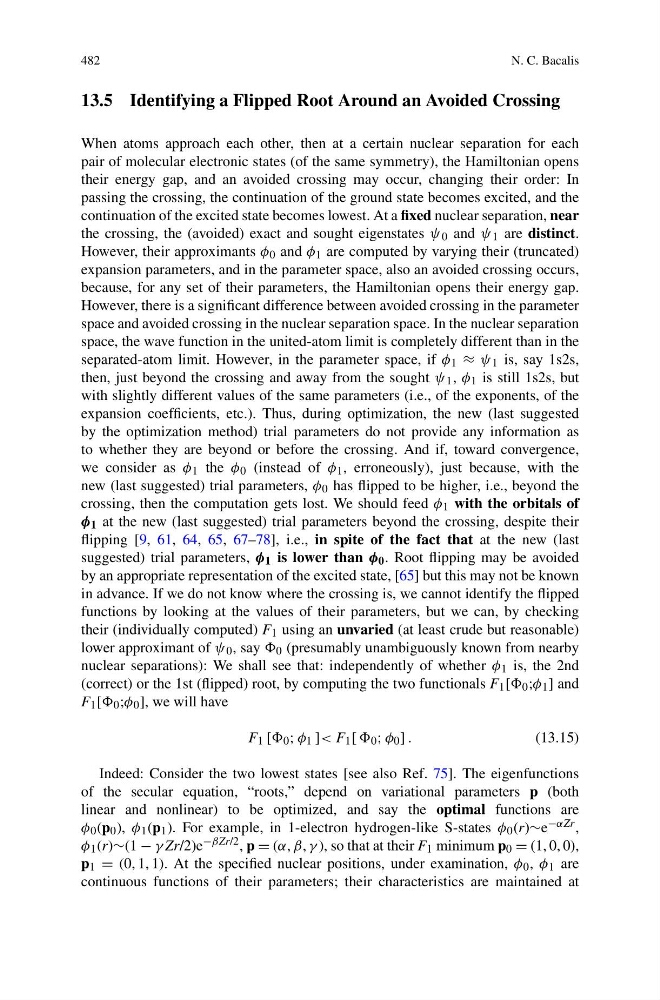
F 1 [ 0 ; φ 1 ]< F 1 [ 0 ; φ 0 ] .
(13.15)
Indeed: Consider the two lowest states [see also Ref. 75]. The eigenfunctions
of the secular equation, “roots,” depend on variational parameters p (both
linear and nonlinear) to be optimized, and say the optimal functions are
φ 0 (p 0 ), φ 1 (p 1 ). For example, in 1-electron hydrogen-like S-states φ 0 (r)∼e −αZr ,
φ 1 (r)∼(1 − γ Zr/2)e −βZr/2 , p = (α, β, γ ), so that at their F 1 minimum p 0 = (1, 0, 0),
p 1 = (0, 1, 1). At the specified nuclear positions, under examination, φ 0 , φ 1 are
continuous functions of their parameters; their characteristics are maintained at
N. C. Bacalis
13.5 Identifying a Flipped Root Around an Avoided Crossing
When atoms approach each other, then at a certain nuclear separation for each
pair of molecular electronic states (of the same symmetry), the Hamiltonian opens
their energy gap, and an avoided crossing may occur, changing their order: In
passing the crossing, the continuation of the ground state becomes excited, and the
continuation of the excited state becomes lowest. At a fixed nuclear separation, near
the crossing, the (avoided) exact and sought eigenstates ψ 0 and ψ 1 are distinct.
However, their approximants φ 0 and φ 1 are computed by varying their (truncated)
expansion parameters, and in the parameter space, also an avoided crossing occurs,
because, for any set of their parameters, the Hamiltonian opens their energy gap.
However, there is a significant difference between avoided crossing in the parameter
space and avoided crossing in the nuclear separation space. In the nuclear separation
space, the wave function in the united-atom limit is completely different than in the
separated-atom limit. However, in the parameter space, if φ 1 ≈ ψ 1 is, say 1s2s,
then, just beyond the crossing and away from the sought ψ 1 , φ 1 is still 1s2s, but
with slightly different values of the same parameters (i.e., of the exponents, of the
expansion coefficients, etc.). Thus, during optimization, the new (last suggested
by the optimization method) trial parameters do not provide any information as
to whether they are beyond or before the crossing. And if, toward convergence,
we consider as φ 1 the φ 0 (instead of φ 1 , erroneously), just because, with the
new (last suggested) trial parameters, φ 0 has flipped to be higher, i.e., beyond the
crossing, then the computation gets lost. We should feed φ 1 with the orbitals of
φ 1 at the new (last suggested) trial parameters beyond the crossing, despite their
flipping [9, 61, 64, 65, 67–78], i.e., in spite of the fact that at the new (last
suggested) trial parameters, φ 1 is lower than φ 0 . Root flipping may be avoided
by an appropriate representation of the excited state, [65] but this may not be known
in advance. If we do not know where the crossing is, we cannot identify the flipped
functions by looking at the values of their parameters, but we can, by checking
their (individually computed) F 1 using an unvaried (at least crude but reasonable)
lower approximant of ψ 0 , say 0 (presumably unambiguously known from nearby
nuclear separations): We shall see that: independently of whether φ 1 is, the 2nd
(correct) or the 1st (flipped) root, by computing the two functionals F 1 [ 0 ;φ 1 ] and
F 1 [ 0 ;φ 0 ], we will have
F 1 [ 0 ; φ 1 ]< F 1 [ 0 ; φ 0 ] .
(13.15)
Indeed: Consider the two lowest states [see also Ref. 75]. The eigenfunctions
of the secular equation, “roots,” depend on variational parameters p (both
linear and nonlinear) to be optimized, and say the optimal functions are
φ 0 (p 0 ), φ 1 (p 1 ). For example, in 1-electron hydrogen-like S-states φ 0 (r)∼e −αZr ,
φ 1 (r)∼(1 − γ Zr/2)e −βZr/2 , p = (α, β, γ ), so that at their F 1 minimum p 0 = (1, 0, 0),
p 1 = (0, 1, 1). At the specified nuclear positions, under examination, φ 0 , φ 1 are
continuous functions of their parameters; their characteristics are maintained at