

13 If Truncated Wave Functions of Excited State Energy Saddle Points Are. . .
473
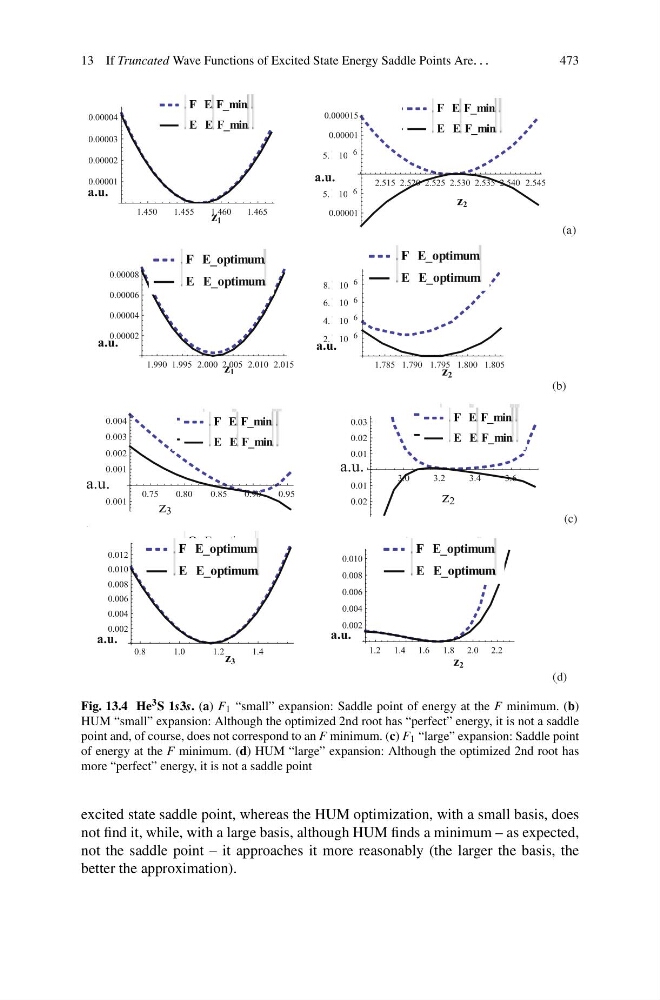
Fig. 13.4 He 3 S 1s3s. (a) F 1 “small” expansion: Saddle point of energy at the F minimum. (b)
HUM “small” expansion: Although the optimized 2nd root has “perfect” energy, it is not a saddle
point and, of course, does not correspond to an F minimum. (c) F 1 “large” expansion: Saddle point
of energy at the F minimum. (d) HUM “large” expansion: Although the optimized 2nd root has
more “perfect” energy, it is not a saddle point
excited state saddle point, whereas the HUM optimization, with a small basis, does
not find it, while, with a large basis, although HUM finds a minimum – as expected,
not the saddle point – it approaches it more reasonably (the larger the basis, the
better the approximation).
473
Fig. 13.4 He 3 S 1s3s. (a) F 1 “small” expansion: Saddle point of energy at the F minimum. (b)
HUM “small” expansion: Although the optimized 2nd root has “perfect” energy, it is not a saddle
point and, of course, does not correspond to an F minimum. (c) F 1 “large” expansion: Saddle point
of energy at the F minimum. (d) HUM “large” expansion: Although the optimized 2nd root has
more “perfect” energy, it is not a saddle point
excited state saddle point, whereas the HUM optimization, with a small basis, does
not find it, while, with a large basis, although HUM finds a minimum – as expected,
not the saddle point – it approaches it more reasonably (the larger the basis, the
better the approximation).