

472
N. C. Bacalis
(a) F “large”
(b) F “small”
(c) Correlation orbitals
(d) HUM “large”
(e) HUM “small”
(f) HUM deteriorated 1
st root
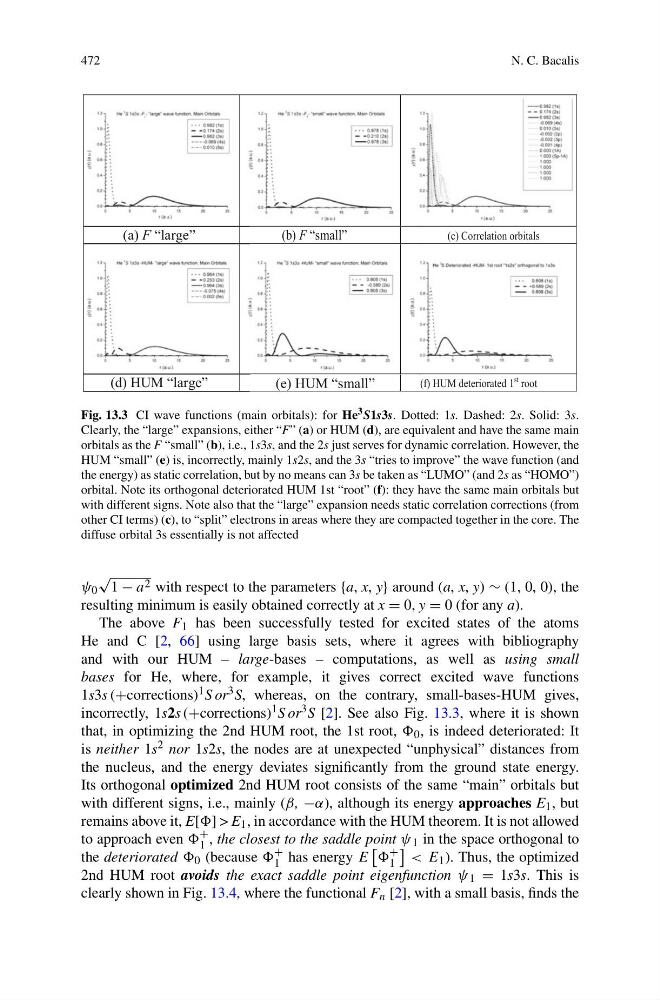
Fig. 13.3 CI wave functions (main orbitals): for He 3 S1s3s. Dotted: 1s. Dashed: 2s. Solid: 3s.
Clearly, the “large” expansions, either “F” (a) or HUM (d), are equivalent and have the same main
orbitals as the F “small” (b), i.e., 1s3s, and the 2s just serves for dynamic correlation. However, the
HUM “small” (e) is, incorrectly, mainly 1s2s, and the 3s “tries to improve” the wave function (and
the energy) as static correlation, but by no means can 3s be taken as “LUMO” (and 2s as “HOMO”)
orbital. Note its orthogonal deteriorated HUM 1st “root” (f): they have the same main orbitals but
with different signs. Note also that the “large” expansion needs static correlation corrections (from
other CI terms) (c), to “split” electrons in areas where they are compacted together in the core. The
diffuse orbital 3s essentially is not affected
ψ 0
√
1 − a 2 with respect to the parameters {a, x, y} around (a, x, y) ∼ (1, 0, 0), the
resulting minimum is easily obtained correctly at x = 0, y = 0 (for any a).
The above F 1 has been successfully tested for excited states of the atoms
He and C [2, 66] using large basis sets, where it agrees with bibliography
and with our HUM – large-bases – computations, as well as using small
bases for He, where, for example, it gives correct excited wave functions
1s3s (+corrections) 1 S or 3 S, whereas, on the contrary, small-bases-HUM gives,
incorrectly, 1s2s (+corrections) 1 S or 3 S [2]. See also Fig. 13.3, where it is shown
that, in optimizing the 2nd HUM root, the 1st root, 0 , is indeed deteriorated: It
is neither 1s 2 nor 1s2s, the nodes are at unexpected “unphysical” distances from
the nucleus, and the energy deviates significantly from the ground state energy.
Its orthogonal optimized 2nd HUM root consists of the same “main” orbitals but
with different signs, i.e., mainly (β, −α), although its energy approaches E 1 , but
remains above it, E[] > E 1 , in accordance with the HUM theorem. It is not allowed
to approach even
+
1 , the closest to the saddle point ψ 1 in the space orthogonal to
the deteriorated 0 (because
+
1 has energy E
+
1
< E 1 ). Thus, the optimized
2nd HUM root avoids the exact saddle point eigenfunction ψ 1 = 1s3s. This is
clearly shown in Fig. 13.4, where the functional F n [2], with a small basis, finds the
N. C. Bacalis
(a) F “large”
(b) F “small”
(c) Correlation orbitals
(d) HUM “large”
(e) HUM “small”
(f) HUM deteriorated 1
st root
Fig. 13.3 CI wave functions (main orbitals): for He 3 S1s3s. Dotted: 1s. Dashed: 2s. Solid: 3s.
Clearly, the “large” expansions, either “F” (a) or HUM (d), are equivalent and have the same main
orbitals as the F “small” (b), i.e., 1s3s, and the 2s just serves for dynamic correlation. However, the
HUM “small” (e) is, incorrectly, mainly 1s2s, and the 3s “tries to improve” the wave function (and
the energy) as static correlation, but by no means can 3s be taken as “LUMO” (and 2s as “HOMO”)
orbital. Note its orthogonal deteriorated HUM 1st “root” (f): they have the same main orbitals but
with different signs. Note also that the “large” expansion needs static correlation corrections (from
other CI terms) (c), to “split” electrons in areas where they are compacted together in the core. The
diffuse orbital 3s essentially is not affected
ψ 0
√
1 − a 2 with respect to the parameters {a, x, y} around (a, x, y) ∼ (1, 0, 0), the
resulting minimum is easily obtained correctly at x = 0, y = 0 (for any a).
The above F 1 has been successfully tested for excited states of the atoms
He and C [2, 66] using large basis sets, where it agrees with bibliography
and with our HUM – large-bases – computations, as well as using small
bases for He, where, for example, it gives correct excited wave functions
1s3s (+corrections) 1 S or 3 S, whereas, on the contrary, small-bases-HUM gives,
incorrectly, 1s2s (+corrections) 1 S or 3 S [2]. See also Fig. 13.3, where it is shown
that, in optimizing the 2nd HUM root, the 1st root, 0 , is indeed deteriorated: It
is neither 1s 2 nor 1s2s, the nodes are at unexpected “unphysical” distances from
the nucleus, and the energy deviates significantly from the ground state energy.
Its orthogonal optimized 2nd HUM root consists of the same “main” orbitals but
with different signs, i.e., mainly (β, −α), although its energy approaches E 1 , but
remains above it, E[] > E 1 , in accordance with the HUM theorem. It is not allowed
to approach even
+
1 , the closest to the saddle point ψ 1 in the space orthogonal to
the deteriorated 0 (because
+
1 has energy E
+
1
< E 1 ). Thus, the optimized
2nd HUM root avoids the exact saddle point eigenfunction ψ 1 = 1s3s. This is
clearly shown in Fig. 13.4, where the functional F n [2], with a small basis, finds the