

12 Inter-spin Interactions of Organic Radical Chains in Organic 1D. . .
457
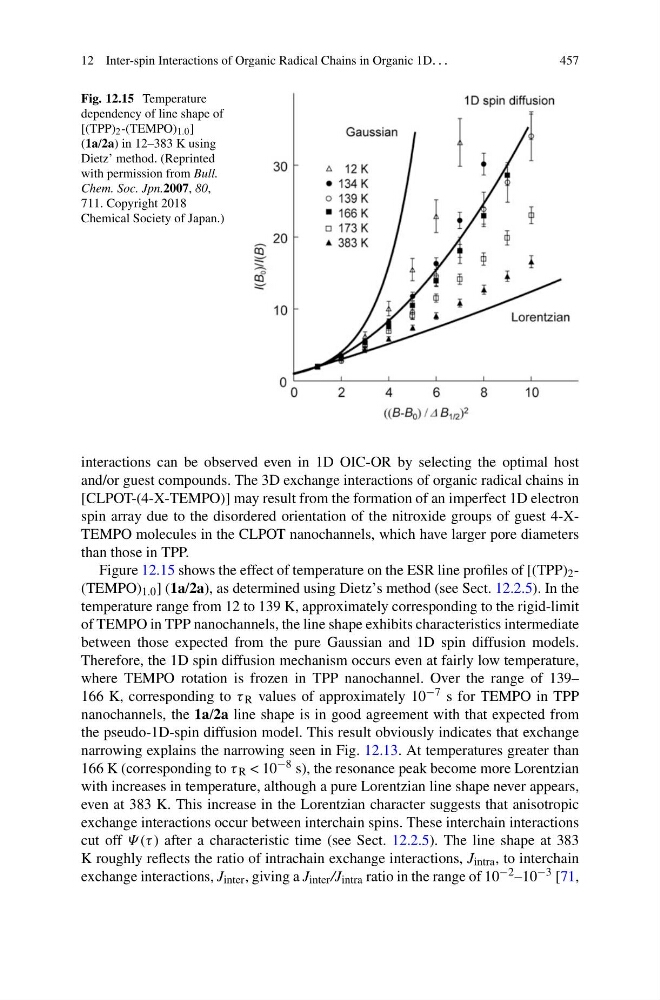
Fig. 12.15 Temperature
dependency of line shape of
[(TPP) 2 -(TEMPO) 1.0 ]
(1a/2a) in 12–383 K using
Dietz’ method. (Reprinted
with permission from Bull.
Chem. Soc. Jpn.2007, 80,
711. Copyright 2018
Chemical Society of Japan.)
interactions can be observed even in 1D OIC-OR by selecting the optimal host
and/or guest compounds. The 3D exchange interactions of organic radical chains in
[CLPOT-(4-X-TEMPO)] may result from the formation of an imperfect 1D electron
spin array due to the disordered orientation of the nitroxide groups of guest 4-XTEMPO molecules in the CLPOT nanochannels, which have larger pore diameters
than those in TPP.
Figure 12.15 shows the effect of temperature on the ESR line profiles of [(TPP) 2 -
(TEMPO) 1.0 ] (1a/2a), as determined using Dietz’s method (see Sect. 12.2.5). In the
temperature range from 12 to 139 K, approximately corresponding to the rigid-limit
of TEMPO in TPP nanochannels, the line shape exhibits characteristics intermediate
between those expected from the pure Gaussian and 1D spin diffusion models.
Therefore, the 1D spin diffusion mechanism occurs even at fairly low temperature,
where TEMPO rotation is frozen in TPP nanochannel. Over the range of 139–
166 K, corresponding to τ R values of approximately 10 −7 s for TEMPO in TPP
nanochannels, the 1a/2a line shape is in good agreement with that expected from
the pseudo-1D-spin diffusion model. This result obviously indicates that exchange
narrowing explains the narrowing seen in Fig. 12.13. At temperatures greater than
166 K (corresponding to τ R < 10 −8 s), the resonance peak become more Lorentzian
with increases in temperature, although a pure Lorentzian line shape never appears,
even at 383 K. This increase in the Lorentzian character suggests that anisotropic
exchange interactions occur between interchain spins. These interchain interactions
cut off Ψ (τ ) after a characteristic time (see Sect. 12.2.5). The line shape at 383
K roughly reflects the ratio of intrachain exchange interactions, J intra , to interchain
exchange interactions, J inter , giving a J inter /J intra ratio in the range of 10 −2 –10 −3 [71,
457
Fig. 12.15 Temperature
dependency of line shape of
[(TPP) 2 -(TEMPO) 1.0 ]
(1a/2a) in 12–383 K using
Dietz’ method. (Reprinted
with permission from Bull.
Chem. Soc. Jpn.2007, 80,
711. Copyright 2018
Chemical Society of Japan.)
interactions can be observed even in 1D OIC-OR by selecting the optimal host
and/or guest compounds. The 3D exchange interactions of organic radical chains in
[CLPOT-(4-X-TEMPO)] may result from the formation of an imperfect 1D electron
spin array due to the disordered orientation of the nitroxide groups of guest 4-XTEMPO molecules in the CLPOT nanochannels, which have larger pore diameters
than those in TPP.
Figure 12.15 shows the effect of temperature on the ESR line profiles of [(TPP) 2 -
(TEMPO) 1.0 ] (1a/2a), as determined using Dietz’s method (see Sect. 12.2.5). In the
temperature range from 12 to 139 K, approximately corresponding to the rigid-limit
of TEMPO in TPP nanochannels, the line shape exhibits characteristics intermediate
between those expected from the pure Gaussian and 1D spin diffusion models.
Therefore, the 1D spin diffusion mechanism occurs even at fairly low temperature,
where TEMPO rotation is frozen in TPP nanochannel. Over the range of 139–
166 K, corresponding to τ R values of approximately 10 −7 s for TEMPO in TPP
nanochannels, the 1a/2a line shape is in good agreement with that expected from
the pseudo-1D-spin diffusion model. This result obviously indicates that exchange
narrowing explains the narrowing seen in Fig. 12.13. At temperatures greater than
166 K (corresponding to τ R < 10 −8 s), the resonance peak become more Lorentzian
with increases in temperature, although a pure Lorentzian line shape never appears,
even at 383 K. This increase in the Lorentzian character suggests that anisotropic
exchange interactions occur between interchain spins. These interchain interactions
cut off Ψ (τ ) after a characteristic time (see Sect. 12.2.5). The line shape at 383
K roughly reflects the ratio of intrachain exchange interactions, J intra , to interchain
exchange interactions, J inter , giving a J inter /J intra ratio in the range of 10 −2 –10 −3 [71,