

2 Quantum Chemistry in Perovskite Fluoride and Hydride: Nanoscale. . .
33
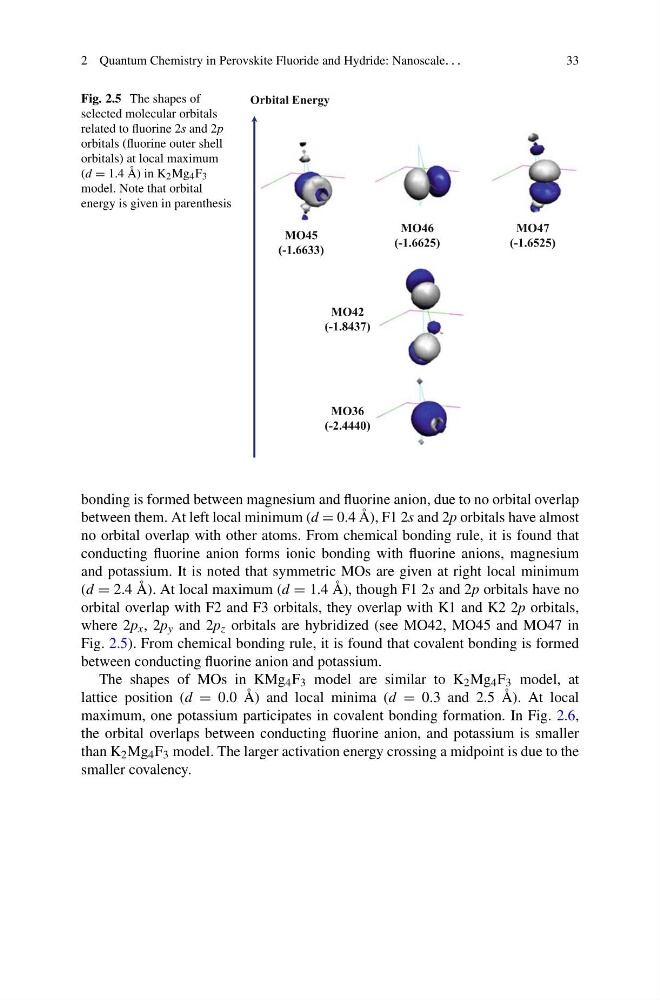
Fig. 2.5 The shapes of
selected molecular orbitals
related to fluorine 2s and 2p
orbitals (fluorine outer shell
orbitals) at local maximum
(d = 1.4 Å) in K 2 Mg 4 F 3
model. Note that orbital
energy is given in parenthesis
Orbital Energy
MO36
(-2.4440)
MO42
(-1.8437)
MO45
(-1.6633)
MO47
(-1.6525)
MO46
(-1.6625)
bonding is formed between magnesium and fluorine anion, due to no orbital overlap
between them. At left local minimum (d = 0.4 Å), F1 2s and 2p orbitals have almost
no orbital overlap with other atoms. From chemical bonding rule, it is found that
conducting fluorine anion forms ionic bonding with fluorine anions, magnesium
and potassium. It is noted that symmetric MOs are given at right local minimum
(d = 2.4 Å). At local maximum (d = 1.4 Å), though F1 2s and 2p orbitals have no
orbital overlap with F2 and F3 orbitals, they overlap with K1 and K2 2p orbitals,
where 2p x , 2p y and 2p z orbitals are hybridized (see MO42, MO45 and MO47 in
Fig. 2.5). From chemical bonding rule, it is found that covalent bonding is formed
between conducting fluorine anion and potassium.
The shapes of MOs in KMg 4 F 3 model are similar to K 2 Mg 4 F 3 model, at
lattice position (d = 0.0 Å) and local minima (d = 0.3 and 2.5 Å). At local
maximum, one potassium participates in covalent bonding formation. In Fig. 2.6,
the orbital overlaps between conducting fluorine anion, and potassium is smaller
than K 2 Mg 4 F 3 model. The larger activation energy crossing a midpoint is due to the
smaller covalency.
33
Fig. 2.5 The shapes of
selected molecular orbitals
related to fluorine 2s and 2p
orbitals (fluorine outer shell
orbitals) at local maximum
(d = 1.4 Å) in K 2 Mg 4 F 3
model. Note that orbital
energy is given in parenthesis
Orbital Energy
MO36
(-2.4440)
MO42
(-1.8437)
MO45
(-1.6633)
MO47
(-1.6525)
MO46
(-1.6625)
bonding is formed between magnesium and fluorine anion, due to no orbital overlap
between them. At left local minimum (d = 0.4 Å), F1 2s and 2p orbitals have almost
no orbital overlap with other atoms. From chemical bonding rule, it is found that
conducting fluorine anion forms ionic bonding with fluorine anions, magnesium
and potassium. It is noted that symmetric MOs are given at right local minimum
(d = 2.4 Å). At local maximum (d = 1.4 Å), though F1 2s and 2p orbitals have no
orbital overlap with F2 and F3 orbitals, they overlap with K1 and K2 2p orbitals,
where 2p x , 2p y and 2p z orbitals are hybridized (see MO42, MO45 and MO47 in
Fig. 2.5). From chemical bonding rule, it is found that covalent bonding is formed
between conducting fluorine anion and potassium.
The shapes of MOs in KMg 4 F 3 model are similar to K 2 Mg 4 F 3 model, at
lattice position (d = 0.0 Å) and local minima (d = 0.3 and 2.5 Å). At local
maximum, one potassium participates in covalent bonding formation. In Fig. 2.6,
the orbital overlaps between conducting fluorine anion, and potassium is smaller
than K 2 Mg 4 F 3 model. The larger activation energy crossing a midpoint is due to the
smaller covalency.