

12 Inter-spin Interactions of Organic Radical Chains in Organic 1D. . .
449
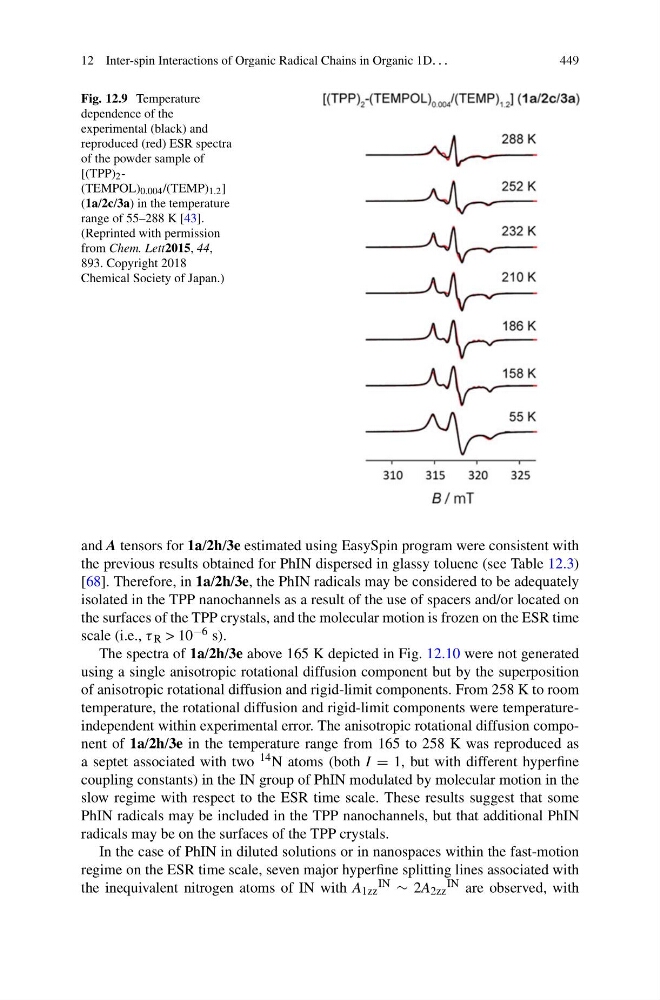
Fig. 12.9 Temperature
dependence of the
experimental (black) and
reproduced (red) ESR spectra
of the powder sample of
[(TPP) 2 -
(TEMPOL) 0.004 /(TEMP) 1.2 ]
(1a/2c/3a) in the temperature
range of 55–288 K [43].
(Reprinted with permission
from Chem. Lett2015, 44,
893. Copyright 2018
Chemical Society of Japan.)
and A tensors for 1a/2h/3e estimated using EasySpin program were consistent with
the previous results obtained for PhIN dispersed in glassy toluene (see Table 12.3)
[68]. Therefore, in 1a/2h/3e, the PhIN radicals may be considered to be adequately
isolated in the TPP nanochannels as a result of the use of spacers and/or located on
the surfaces of the TPP crystals, and the molecular motion is frozen on the ESR time
scale (i.e., τ R > 10 −6 s).
The spectra of 1a/2h/3e above 165 K depicted in Fig. 12.10 were not generated
using a single anisotropic rotational diffusion component but by the superposition
of anisotropic rotational diffusion and rigid-limit components. From 258 K to room
temperature, the rotational diffusion and rigid-limit components were temperatureindependent within experimental error. The anisotropic rotational diffusion component of 1a/2h/3e in the temperature range from 165 to 258 K was reproduced as
a septet associated with two 14 N atoms (both I = 1, but with different hyperfine
coupling constants) in the IN group of PhIN modulated by molecular motion in the
slow regime with respect to the ESR time scale. These results suggest that some
PhIN radicals may be included in the TPP nanochannels, but that additional PhIN
radicals may be on the surfaces of the TPP crystals.
In the case of PhIN in diluted solutions or in nanospaces within the fast-motion
regime on the ESR time scale, seven major hyperfine splitting lines associated with
the inequivalent nitrogen atoms of IN with A 1zz
IN ∼ 2A 2zz
IN are observed, with
449
Fig. 12.9 Temperature
dependence of the
experimental (black) and
reproduced (red) ESR spectra
of the powder sample of
[(TPP) 2 -
(TEMPOL) 0.004 /(TEMP) 1.2 ]
(1a/2c/3a) in the temperature
range of 55–288 K [43].
(Reprinted with permission
from Chem. Lett2015, 44,
893. Copyright 2018
Chemical Society of Japan.)
and A tensors for 1a/2h/3e estimated using EasySpin program were consistent with
the previous results obtained for PhIN dispersed in glassy toluene (see Table 12.3)
[68]. Therefore, in 1a/2h/3e, the PhIN radicals may be considered to be adequately
isolated in the TPP nanochannels as a result of the use of spacers and/or located on
the surfaces of the TPP crystals, and the molecular motion is frozen on the ESR time
scale (i.e., τ R > 10 −6 s).
The spectra of 1a/2h/3e above 165 K depicted in Fig. 12.10 were not generated
using a single anisotropic rotational diffusion component but by the superposition
of anisotropic rotational diffusion and rigid-limit components. From 258 K to room
temperature, the rotational diffusion and rigid-limit components were temperatureindependent within experimental error. The anisotropic rotational diffusion component of 1a/2h/3e in the temperature range from 165 to 258 K was reproduced as
a septet associated with two 14 N atoms (both I = 1, but with different hyperfine
coupling constants) in the IN group of PhIN modulated by molecular motion in the
slow regime with respect to the ESR time scale. These results suggest that some
PhIN radicals may be included in the TPP nanochannels, but that additional PhIN
radicals may be on the surfaces of the TPP crystals.
In the case of PhIN in diluted solutions or in nanospaces within the fast-motion
regime on the ESR time scale, seven major hyperfine splitting lines associated with
the inequivalent nitrogen atoms of IN with A 1zz
IN ∼ 2A 2zz
IN are observed, with