

12 Inter-spin Interactions of Organic Radical Chains in Organic 1D. . .
447
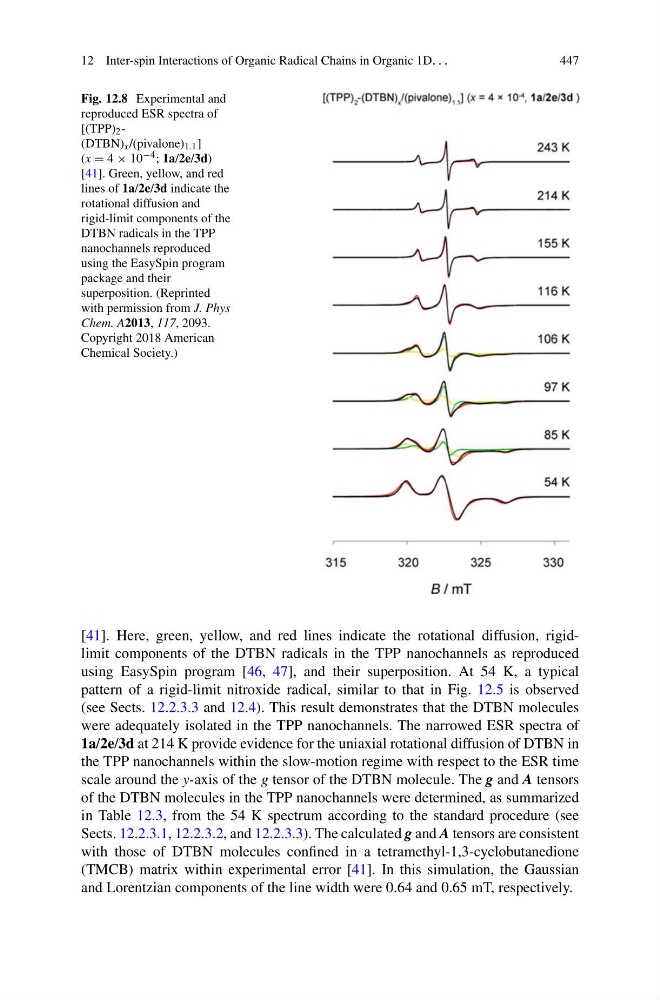
Fig. 12.8 Experimental and
reproduced ESR spectra of
[(TPP) 2 -
(DTBN) x /(pivalone) 1.1 ]
(x = 4 × 10 −4 ; 1a/2e/3d)
[41]. Green, yellow, and red
lines of 1a/2e/3d indicate the
rotational diffusion and
rigid-limit components of the
DTBN radicals in the TPP
nanochannels reproduced
using the EasySpin program
package and their
superposition. (Reprinted
with permission from J. Phys
Chem. A2013, 117, 2093.
Copyright 2018 American
Chemical Society.)
[41]. Here, green, yellow, and red lines indicate the rotational diffusion, rigidlimit components of the DTBN radicals in the TPP nanochannels as reproduced
using EasySpin program [46, 47], and their superposition. At 54 K, a typical
pattern of a rigid-limit nitroxide radical, similar to that in Fig. 12.5 is observed
(see Sects. 12.2.3.3 and 12.4). This result demonstrates that the DTBN molecules
were adequately isolated in the TPP nanochannels. The narrowed ESR spectra of
1a/2e/3d at 214 K provide evidence for the uniaxial rotational diffusion of DTBN in
the TPP nanochannels within the slow-motion regime with respect to the ESR time
scale around the y-axis of the g tensor of the DTBN molecule. The g and A tensors
of the DTBN molecules in the TPP nanochannels were determined, as summarized
in Table 12.3, from the 54 K spectrum according to the standard procedure (see
Sects. 12.2.3.1, 12.2.3.2, and 12.2.3.3). The calculated g and A tensors are consistent
with those of DTBN molecules confined in a tetramethyl-1,3-cyclobutanedione
(TMCB) matrix within experimental error [41]. In this simulation, the Gaussian
and Lorentzian components of the line width were 0.64 and 0.65 mT, respectively.
447
Fig. 12.8 Experimental and
reproduced ESR spectra of
[(TPP) 2 -
(DTBN) x /(pivalone) 1.1 ]
(x = 4 × 10 −4 ; 1a/2e/3d)
[41]. Green, yellow, and red
lines of 1a/2e/3d indicate the
rotational diffusion and
rigid-limit components of the
DTBN radicals in the TPP
nanochannels reproduced
using the EasySpin program
package and their
superposition. (Reprinted
with permission from J. Phys
Chem. A2013, 117, 2093.
Copyright 2018 American
Chemical Society.)
[41]. Here, green, yellow, and red lines indicate the rotational diffusion, rigidlimit components of the DTBN radicals in the TPP nanochannels as reproduced
using EasySpin program [46, 47], and their superposition. At 54 K, a typical
pattern of a rigid-limit nitroxide radical, similar to that in Fig. 12.5 is observed
(see Sects. 12.2.3.3 and 12.4). This result demonstrates that the DTBN molecules
were adequately isolated in the TPP nanochannels. The narrowed ESR spectra of
1a/2e/3d at 214 K provide evidence for the uniaxial rotational diffusion of DTBN in
the TPP nanochannels within the slow-motion regime with respect to the ESR time
scale around the y-axis of the g tensor of the DTBN molecule. The g and A tensors
of the DTBN molecules in the TPP nanochannels were determined, as summarized
in Table 12.3, from the 54 K spectrum according to the standard procedure (see
Sects. 12.2.3.1, 12.2.3.2, and 12.2.3.3). The calculated g and A tensors are consistent
with those of DTBN molecules confined in a tetramethyl-1,3-cyclobutanedione
(TMCB) matrix within experimental error [41]. In this simulation, the Gaussian
and Lorentzian components of the line width were 0.64 and 0.65 mT, respectively.