

446
H. Kobayashi
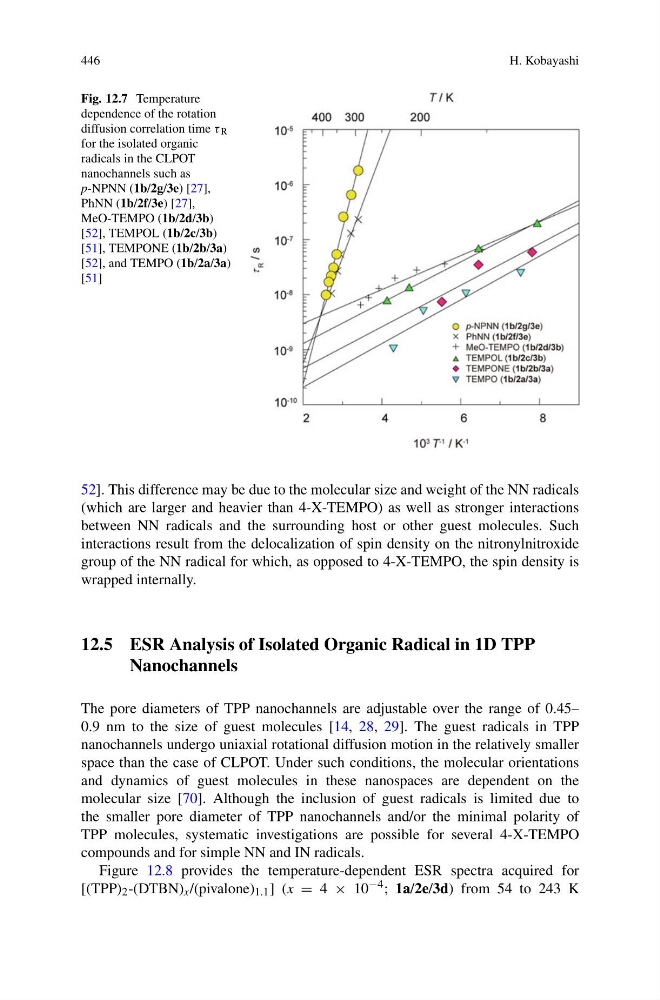
Fig. 12.7 Temperature
dependence of the rotation
diffusion correlation time τ R
for the isolated organic
radicals in the CLPOT
nanochannels such as
p-NPNN (1b/2g/3e) [27],
PhNN (1b/2f/3e) [27],
MeO-TEMPO (1b/2d/3b)
[52], TEMPOL (1b/2c/3b)
[51], TEMPONE (1b/2b/3a)
[52], and TEMPO (1b/2a/3a)
[51]
52]. This difference may be due to the molecular size and weight of the NN radicals
(which are larger and heavier than 4-X-TEMPO) as well as stronger interactions
between NN radicals and the surrounding host or other guest molecules. Such
interactions result from the delocalization of spin density on the nitronylnitroxide
group of the NN radical for which, as opposed to 4-X-TEMPO, the spin density is
wrapped internally.
12.5 ESR Analysis of Isolated Organic Radical in 1D TPP
Nanochannels
The pore diameters of TPP nanochannels are adjustable over the range of 0.45–
0.9 nm to the size of guest molecules [14, 28, 29]. The guest radicals in TPP
nanochannels undergo uniaxial rotational diffusion motion in the relatively smaller
space than the case of CLPOT. Under such conditions, the molecular orientations
and dynamics of guest molecules in these nanospaces are dependent on the
molecular size [70]. Although the inclusion of guest radicals is limited due to
the smaller pore diameter of TPP nanochannels and/or the minimal polarity of
TPP molecules, systematic investigations are possible for several 4-X-TEMPO
compounds and for simple NN and IN radicals.
Figure 12.8 provides the temperature-dependent ESR spectra acquired for
[(TPP) 2 -(DTBN) x /(pivalone) 1.1 ] (x = 4 × 10 −4 ; 1a/2e/3d) from 54 to 243 K
H. Kobayashi
Fig. 12.7 Temperature
dependence of the rotation
diffusion correlation time τ R
for the isolated organic
radicals in the CLPOT
nanochannels such as
p-NPNN (1b/2g/3e) [27],
PhNN (1b/2f/3e) [27],
MeO-TEMPO (1b/2d/3b)
[52], TEMPOL (1b/2c/3b)
[51], TEMPONE (1b/2b/3a)
[52], and TEMPO (1b/2a/3a)
[51]
52]. This difference may be due to the molecular size and weight of the NN radicals
(which are larger and heavier than 4-X-TEMPO) as well as stronger interactions
between NN radicals and the surrounding host or other guest molecules. Such
interactions result from the delocalization of spin density on the nitronylnitroxide
group of the NN radical for which, as opposed to 4-X-TEMPO, the spin density is
wrapped internally.
12.5 ESR Analysis of Isolated Organic Radical in 1D TPP
Nanochannels
The pore diameters of TPP nanochannels are adjustable over the range of 0.45–
0.9 nm to the size of guest molecules [14, 28, 29]. The guest radicals in TPP
nanochannels undergo uniaxial rotational diffusion motion in the relatively smaller
space than the case of CLPOT. Under such conditions, the molecular orientations
and dynamics of guest molecules in these nanospaces are dependent on the
molecular size [70]. Although the inclusion of guest radicals is limited due to
the smaller pore diameter of TPP nanochannels and/or the minimal polarity of
TPP molecules, systematic investigations are possible for several 4-X-TEMPO
compounds and for simple NN and IN radicals.
Figure 12.8 provides the temperature-dependent ESR spectra acquired for
[(TPP) 2 -(DTBN) x /(pivalone) 1.1 ] (x = 4 × 10 −4 ; 1a/2e/3d) from 54 to 243 K