

442
H. Kobayashi
vacancies between guest radicals, the molecular orientations and dynamics of the
guest radicals can be examined using ESR spectroscopy and spectral simulations.
The reader is referred to several papers that provide detailed experimental conditions
for ESR analyses [27, 39, 41, 44, 52].
CLPOT nanochannel can include many organic radicals due to its large pore
diameters (1.1–1.2 nm in the guest-free state) and minimal polarity. In this section,
the ESR spectra of 4-X-TEMPO and 4-XPNN are presented, and the process of
spectral reproduction is explained. The results are used to elucidate the molecular
orientations and dynamics of guest radicals in the CLPOT nanochannels.
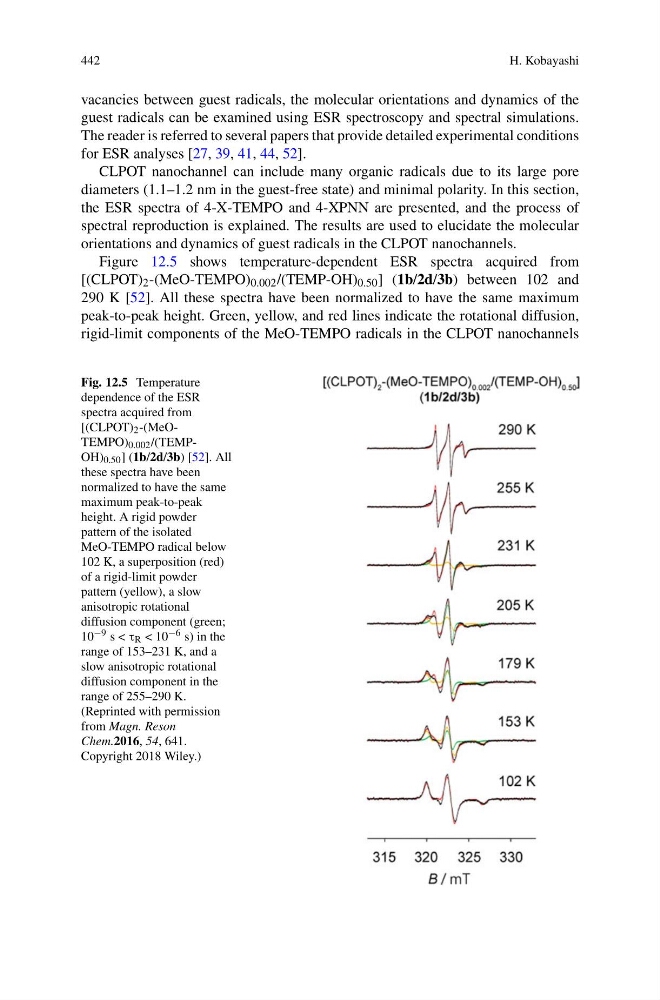
Figure 12.5 shows temperature-dependent ESR spectra acquired from
[(CLPOT) 2 -(MeO-TEMPO) 0.002 /(TEMP-OH) 0.50 ] (1b/2d/3b) between 102 and
290 K [52]. All these spectra have been normalized to have the same maximum
peak-to-peak height. Green, yellow, and red lines indicate the rotational diffusion,
rigid-limit components of the MeO-TEMPO radicals in the CLPOT nanochannels
Fig. 12.5 Temperature
dependence of the ESR
spectra acquired from
[(CLPOT) 2 -(MeOTEMPO) 0.002 /(TEMPOH) 0.50 ] (1b/2d/3b) [52]. All
these spectra have been
normalized to have the same
maximum peak-to-peak
height. A rigid powder
pattern of the isolated
MeO-TEMPO radical below
102 K, a superposition (red)
of a rigid-limit powder
pattern (yellow), a slow
anisotropic rotational
diffusion component (green;
10 −9 s < τ R < 10 −6 s) in the
range of 153–231 K, and a
slow anisotropic rotational
diffusion component in the
range of 255–290 K.
(Reprinted with permission
from Magn. Reson
Chem.2016, 54, 641.
Copyright 2018 Wiley.)
H. Kobayashi
vacancies between guest radicals, the molecular orientations and dynamics of the
guest radicals can be examined using ESR spectroscopy and spectral simulations.
The reader is referred to several papers that provide detailed experimental conditions
for ESR analyses [27, 39, 41, 44, 52].
CLPOT nanochannel can include many organic radicals due to its large pore
diameters (1.1–1.2 nm in the guest-free state) and minimal polarity. In this section,
the ESR spectra of 4-X-TEMPO and 4-XPNN are presented, and the process of
spectral reproduction is explained. The results are used to elucidate the molecular
orientations and dynamics of guest radicals in the CLPOT nanochannels.
Figure 12.5 shows temperature-dependent ESR spectra acquired from
[(CLPOT) 2 -(MeO-TEMPO) 0.002 /(TEMP-OH) 0.50 ] (1b/2d/3b) between 102 and
290 K [52]. All these spectra have been normalized to have the same maximum
peak-to-peak height. Green, yellow, and red lines indicate the rotational diffusion,
rigid-limit components of the MeO-TEMPO radicals in the CLPOT nanochannels
Fig. 12.5 Temperature
dependence of the ESR
spectra acquired from
[(CLPOT) 2 -(MeOTEMPO) 0.002 /(TEMPOH) 0.50 ] (1b/2d/3b) [52]. All
these spectra have been
normalized to have the same
maximum peak-to-peak
height. A rigid powder
pattern of the isolated
MeO-TEMPO radical below
102 K, a superposition (red)
of a rigid-limit powder
pattern (yellow), a slow
anisotropic rotational
diffusion component (green;
10 −9 s < τ R < 10 −6 s) in the
range of 153–231 K, and a
slow anisotropic rotational
diffusion component in the
range of 255–290 K.
(Reprinted with permission
from Magn. Reson
Chem.2016, 54, 641.
Copyright 2018 Wiley.)