

12 Inter-spin Interactions of Organic Radical Chains in Organic 1D. . .
441
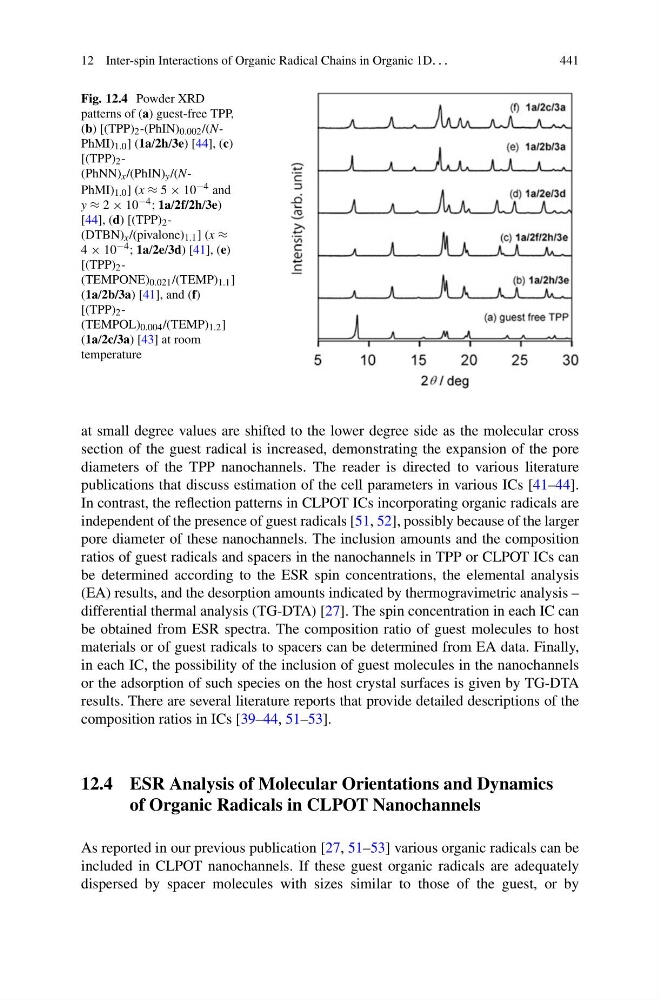
Fig. 12.4 Powder XRD
patterns of (a) guest-free TPP,
(b) [(TPP) 2 -(PhIN) 0.002 /(NPhMI) 1.0 ] (1a/2h/3e) [44], (c)
[(TPP) 2 -
(PhNN) x /(PhIN) y /(NPhMI) 1.0 ] (x ≈ 5 × 10 −4 and
y ≈ 2 × 10 −4 ; 1a/2f/2h/3e)
[44], (d) [(TPP) 2 -
(DTBN) x /(pivalone) 1.1 ] (x ≈
4 × 10 −4 ; 1a/2e/3d) [41], (e)
[(TPP) 2 -
(TEMPONE) 0.021 /(TEMP) 1.1 ]
(1a/2b/3a) [41], and (f)
[(TPP) 2 -
(TEMPOL) 0.004 /(TEMP) 1.2 ]
(1a/2c/3a) [43] at room
temperature
at small degree values are shifted to the lower degree side as the molecular cross
section of the guest radical is increased, demonstrating the expansion of the pore
diameters of the TPP nanochannels. The reader is directed to various literature
publications that discuss estimation of the cell parameters in various ICs [41–44].
In contrast, the reflection patterns in CLPOT ICs incorporating organic radicals are
independent of the presence of guest radicals [51, 52], possibly because of the larger
pore diameter of these nanochannels. The inclusion amounts and the composition
ratios of guest radicals and spacers in the nanochannels in TPP or CLPOT ICs can
be determined according to the ESR spin concentrations, the elemental analysis
(EA) results, and the desorption amounts indicated by thermogravimetric analysis –
differential thermal analysis (TG-DTA) [27]. The spin concentration in each IC can
be obtained from ESR spectra. The composition ratio of guest molecules to host
materials or of guest radicals to spacers can be determined from EA data. Finally,
in each IC, the possibility of the inclusion of guest molecules in the nanochannels
or the adsorption of such species on the host crystal surfaces is given by TG-DTA
results. There are several literature reports that provide detailed descriptions of the
composition ratios in ICs [39–44, 51–53].
12.4 ESR Analysis of Molecular Orientations and Dynamics
of Organic Radicals in CLPOT Nanochannels
As reported in our previous publication [27, 51–53] various organic radicals can be
included in CLPOT nanochannels. If these guest organic radicals are adequately
dispersed by spacer molecules with sizes similar to those of the guest, or by
441
Fig. 12.4 Powder XRD
patterns of (a) guest-free TPP,
(b) [(TPP) 2 -(PhIN) 0.002 /(NPhMI) 1.0 ] (1a/2h/3e) [44], (c)
[(TPP) 2 -
(PhNN) x /(PhIN) y /(NPhMI) 1.0 ] (x ≈ 5 × 10 −4 and
y ≈ 2 × 10 −4 ; 1a/2f/2h/3e)
[44], (d) [(TPP) 2 -
(DTBN) x /(pivalone) 1.1 ] (x ≈
4 × 10 −4 ; 1a/2e/3d) [41], (e)
[(TPP) 2 -
(TEMPONE) 0.021 /(TEMP) 1.1 ]
(1a/2b/3a) [41], and (f)
[(TPP) 2 -
(TEMPOL) 0.004 /(TEMP) 1.2 ]
(1a/2c/3a) [43] at room
temperature
at small degree values are shifted to the lower degree side as the molecular cross
section of the guest radical is increased, demonstrating the expansion of the pore
diameters of the TPP nanochannels. The reader is directed to various literature
publications that discuss estimation of the cell parameters in various ICs [41–44].
In contrast, the reflection patterns in CLPOT ICs incorporating organic radicals are
independent of the presence of guest radicals [51, 52], possibly because of the larger
pore diameter of these nanochannels. The inclusion amounts and the composition
ratios of guest radicals and spacers in the nanochannels in TPP or CLPOT ICs can
be determined according to the ESR spin concentrations, the elemental analysis
(EA) results, and the desorption amounts indicated by thermogravimetric analysis –
differential thermal analysis (TG-DTA) [27]. The spin concentration in each IC can
be obtained from ESR spectra. The composition ratio of guest molecules to host
materials or of guest radicals to spacers can be determined from EA data. Finally,
in each IC, the possibility of the inclusion of guest molecules in the nanochannels
or the adsorption of such species on the host crystal surfaces is given by TG-DTA
results. There are several literature reports that provide detailed descriptions of the
composition ratios in ICs [39–44, 51–53].
12.4 ESR Analysis of Molecular Orientations and Dynamics
of Organic Radicals in CLPOT Nanochannels
As reported in our previous publication [27, 51–53] various organic radicals can be
included in CLPOT nanochannels. If these guest organic radicals are adequately
dispersed by spacer molecules with sizes similar to those of the guest, or by