

12 Inter-spin Interactions of Organic Radical Chains in Organic 1D. . .
431
g =
⎛
⎝
g xx 0 0
0 g yy 0
0 0 g zz
⎞
⎠
(12.3)
A p =
⎛
⎝
A pxx 0
0
0 A pyy 0
0
0 A pzz
⎞
⎠
(12.4)
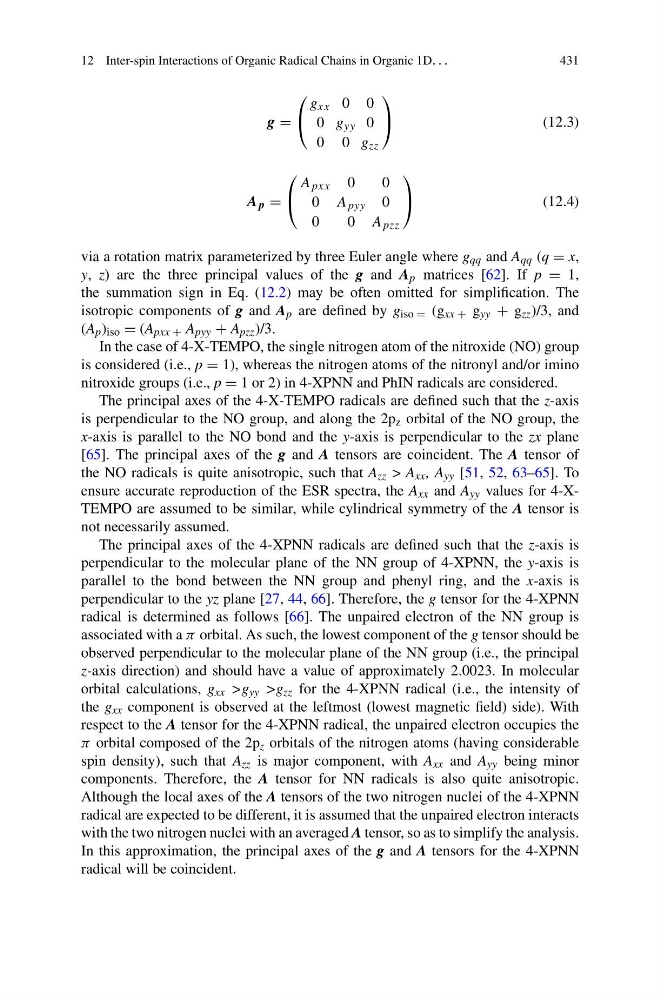
via a rotation matrix parameterized by three Euler angle where g qq and A qq (q = x,
y, z) are the three principal values of the g and A p matrices [62]. If p = 1,
the summation sign in Eq. (12.2) may be often omitted for simplification. The
isotropic components of g and A p are defined by g iso = (g xx + g yy + g zz )/3, and
(A p ) iso = (A pxx + A pyy + A pzz )/3.
In the case of 4-X-TEMPO, the single nitrogen atom of the nitroxide (NO) group
is considered (i.e., p = 1), whereas the nitrogen atoms of the nitronyl and/or imino
nitroxide groups (i.e., p = 1 or 2) in 4-XPNN and PhIN radicals are considered.
The principal axes of the 4-X-TEMPO radicals are defined such that the z-axis
is perpendicular to the NO group, and along the 2p z orbital of the NO group, the
x-axis is parallel to the NO bond and the y-axis is perpendicular to the zx plane
[65]. The principal axes of the g and A tensors are coincident. The A tensor of
the NO radicals is quite anisotropic, such that A zz > A xx , A yy [51, 52, 63–65]. To
ensure accurate reproduction of the ESR spectra, the A xx and A yy values for 4-XTEMPO are assumed to be similar, while cylindrical symmetry of the A tensor is
not necessarily assumed.
The principal axes of the 4-XPNN radicals are defined such that the z-axis is
perpendicular to the molecular plane of the NN group of 4-XPNN, the y-axis is
parallel to the bond between the NN group and phenyl ring, and the x-axis is
perpendicular to the yz plane [27, 44, 66]. Therefore, the g tensor for the 4-XPNN
radical is determined as follows [66]. The unpaired electron of the NN group is
associated with a π orbital. As such, the lowest component of the g tensor should be
observed perpendicular to the molecular plane of the NN group (i.e., the principal
z-axis direction) and should have a value of approximately 2.0023. In molecular
orbital calculations, g xx >g yy >g zz for the 4-XPNN radical (i.e., the intensity of
the g xx component is observed at the leftmost (lowest magnetic field) side). With
respect to the A tensor for the 4-XPNN radical, the unpaired electron occupies the
π orbital composed of the 2p z orbitals of the nitrogen atoms (having considerable
spin density), such that A zz is major component, with A xx and A yy being minor
components. Therefore, the A tensor for NN radicals is also quite anisotropic.
Although the local axes of the A tensors of the two nitrogen nuclei of the 4-XPNN
radical are expected to be different, it is assumed that the unpaired electron interacts
with the two nitrogen nuclei with an averaged A tensor, so as to simplify the analysis.
In this approximation, the principal axes of the g and A tensors for the 4-XPNN
radical will be coincident.
431
g =
⎛
⎝
g xx 0 0
0 g yy 0
0 0 g zz
⎞
⎠
(12.3)
A p =
⎛
⎝
A pxx 0
0
0 A pyy 0
0
0 A pzz
⎞
⎠
(12.4)
via a rotation matrix parameterized by three Euler angle where g qq and A qq (q = x,
y, z) are the three principal values of the g and A p matrices [62]. If p = 1,
the summation sign in Eq. (12.2) may be often omitted for simplification. The
isotropic components of g and A p are defined by g iso = (g xx + g yy + g zz )/3, and
(A p ) iso = (A pxx + A pyy + A pzz )/3.
In the case of 4-X-TEMPO, the single nitrogen atom of the nitroxide (NO) group
is considered (i.e., p = 1), whereas the nitrogen atoms of the nitronyl and/or imino
nitroxide groups (i.e., p = 1 or 2) in 4-XPNN and PhIN radicals are considered.
The principal axes of the 4-X-TEMPO radicals are defined such that the z-axis
is perpendicular to the NO group, and along the 2p z orbital of the NO group, the
x-axis is parallel to the NO bond and the y-axis is perpendicular to the zx plane
[65]. The principal axes of the g and A tensors are coincident. The A tensor of
the NO radicals is quite anisotropic, such that A zz > A xx , A yy [51, 52, 63–65]. To
ensure accurate reproduction of the ESR spectra, the A xx and A yy values for 4-XTEMPO are assumed to be similar, while cylindrical symmetry of the A tensor is
not necessarily assumed.
The principal axes of the 4-XPNN radicals are defined such that the z-axis is
perpendicular to the molecular plane of the NN group of 4-XPNN, the y-axis is
parallel to the bond between the NN group and phenyl ring, and the x-axis is
perpendicular to the yz plane [27, 44, 66]. Therefore, the g tensor for the 4-XPNN
radical is determined as follows [66]. The unpaired electron of the NN group is
associated with a π orbital. As such, the lowest component of the g tensor should be
observed perpendicular to the molecular plane of the NN group (i.e., the principal
z-axis direction) and should have a value of approximately 2.0023. In molecular
orbital calculations, g xx >g yy >g zz for the 4-XPNN radical (i.e., the intensity of
the g xx component is observed at the leftmost (lowest magnetic field) side). With
respect to the A tensor for the 4-XPNN radical, the unpaired electron occupies the
π orbital composed of the 2p z orbitals of the nitrogen atoms (having considerable
spin density), such that A zz is major component, with A xx and A yy being minor
components. Therefore, the A tensor for NN radicals is also quite anisotropic.
Although the local axes of the A tensors of the two nitrogen nuclei of the 4-XPNN
radical are expected to be different, it is assumed that the unpaired electron interacts
with the two nitrogen nuclei with an averaged A tensor, so as to simplify the analysis.
In this approximation, the principal axes of the g and A tensors for the 4-XPNN
radical will be coincident.