

430
H. Kobayashi
12.2.3 ESR Simulation
12.2.3.1 g Tensor and A Tensor
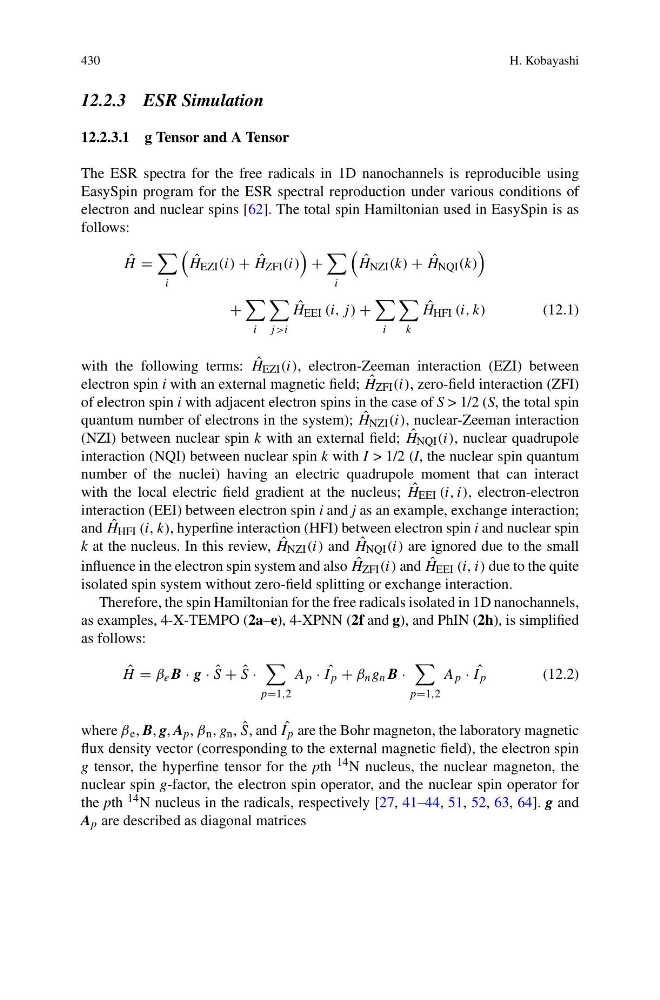
The ESR spectra for the free radicals in 1D nanochannels is reproducible using
EasySpin program for the ESR spectral reproduction under various conditions of
electron and nuclear spins [62]. The total spin Hamiltonian used in EasySpin is as
follows:
ˆ
H =
i
ˆ
H EZI (i) + ˆ
H ZFI (i)
+
i
ˆ
H NZI (k) + ˆ
H NQI (k)
+
i
j>i
ˆ
H EEI (i, j ) +
i
k
ˆ
H HFI (i, k)
(12.1)
with the following terms: ˆ
H EZI (i), electron-Zeeman interaction (EZI) between
electron spin i with an external magnetic field; ˆ
H ZFI (i), zero-field interaction (ZFI)
of electron spin i with adjacent electron spins in the case of S > 1/2 (S, the total spin
quantum number of electrons in the system); ˆ
H NZI (i), nuclear-Zeeman interaction
(NZI) between nuclear spin k with an external field; ˆ
H NQI (i), nuclear quadrupole
interaction (NQI) between nuclear spin k with I > 1/2 (I, the nuclear spin quantum
number of the nuclei) having an electric quadrupole moment that can interact
with the local electric field gradient at the nucleus; ˆ
H EEI (i, i), electron-electron
interaction (EEI) between electron spin i and j as an example, exchange interaction;
and ˆ
H HFI (i, k), hyperfine interaction (HFI) between electron spin i and nuclear spin
k at the nucleus. In this review, ˆ
H NZI (i) and ˆ
H NQI (i) are ignored due to the small
influence in the electron spin system and also ˆ
H ZFI (i) and ˆ
H EEI (i, i) due to the quite
isolated spin system without zero-field splitting or exchange interaction.
Therefore, the spin Hamiltonian for the free radicals isolated in 1D nanochannels,
as examples, 4-X-TEMPO (2a–e), 4-XPNN (2f and g), and PhIN (2h), is simplified
as follows:
ˆ
H = β e B · g · ˆ
S + ˆ
S ·
p=1,2
A p · ˆ
I p + β n g n B ·
p=1,2
A p · ˆ
I p
(12.2)
where β e , B, g, A p , β n , g n , ˆ
S, and ˆ
I p are the Bohr magneton, the laboratory magnetic
flux density vector (corresponding to the external magnetic field), the electron spin
g tensor, the hyperfine tensor for the pth 14 N nucleus, the nuclear magneton, the
nuclear spin g-factor, the electron spin operator, and the nuclear spin operator for
the pth 14 N nucleus in the radicals, respectively [27, 41–44, 51, 52, 63, 64]. g and
A p are described as diagonal matrices
H. Kobayashi
12.2.3 ESR Simulation
12.2.3.1 g Tensor and A Tensor
The ESR spectra for the free radicals in 1D nanochannels is reproducible using
EasySpin program for the ESR spectral reproduction under various conditions of
electron and nuclear spins [62]. The total spin Hamiltonian used in EasySpin is as
follows:
ˆ
H =
i
ˆ
H EZI (i) + ˆ
H ZFI (i)
+
i
ˆ
H NZI (k) + ˆ
H NQI (k)
+
i
j>i
ˆ
H EEI (i, j ) +
i
k
ˆ
H HFI (i, k)
(12.1)
with the following terms: ˆ
H EZI (i), electron-Zeeman interaction (EZI) between
electron spin i with an external magnetic field; ˆ
H ZFI (i), zero-field interaction (ZFI)
of electron spin i with adjacent electron spins in the case of S > 1/2 (S, the total spin
quantum number of electrons in the system); ˆ
H NZI (i), nuclear-Zeeman interaction
(NZI) between nuclear spin k with an external field; ˆ
H NQI (i), nuclear quadrupole
interaction (NQI) between nuclear spin k with I > 1/2 (I, the nuclear spin quantum
number of the nuclei) having an electric quadrupole moment that can interact
with the local electric field gradient at the nucleus; ˆ
H EEI (i, i), electron-electron
interaction (EEI) between electron spin i and j as an example, exchange interaction;
and ˆ
H HFI (i, k), hyperfine interaction (HFI) between electron spin i and nuclear spin
k at the nucleus. In this review, ˆ
H NZI (i) and ˆ
H NQI (i) are ignored due to the small
influence in the electron spin system and also ˆ
H ZFI (i) and ˆ
H EEI (i, i) due to the quite
isolated spin system without zero-field splitting or exchange interaction.
Therefore, the spin Hamiltonian for the free radicals isolated in 1D nanochannels,
as examples, 4-X-TEMPO (2a–e), 4-XPNN (2f and g), and PhIN (2h), is simplified
as follows:
ˆ
H = β e B · g · ˆ
S + ˆ
S ·
p=1,2
A p · ˆ
I p + β n g n B ·
p=1,2
A p · ˆ
I p
(12.2)
where β e , B, g, A p , β n , g n , ˆ
S, and ˆ
I p are the Bohr magneton, the laboratory magnetic
flux density vector (corresponding to the external magnetic field), the electron spin
g tensor, the hyperfine tensor for the pth 14 N nucleus, the nuclear magneton, the
nuclear spin g-factor, the electron spin operator, and the nuclear spin operator for
the pth 14 N nucleus in the radicals, respectively [27, 41–44, 51, 52, 63, 64]. g and
A p are described as diagonal matrices