

424
H. Kobayashi
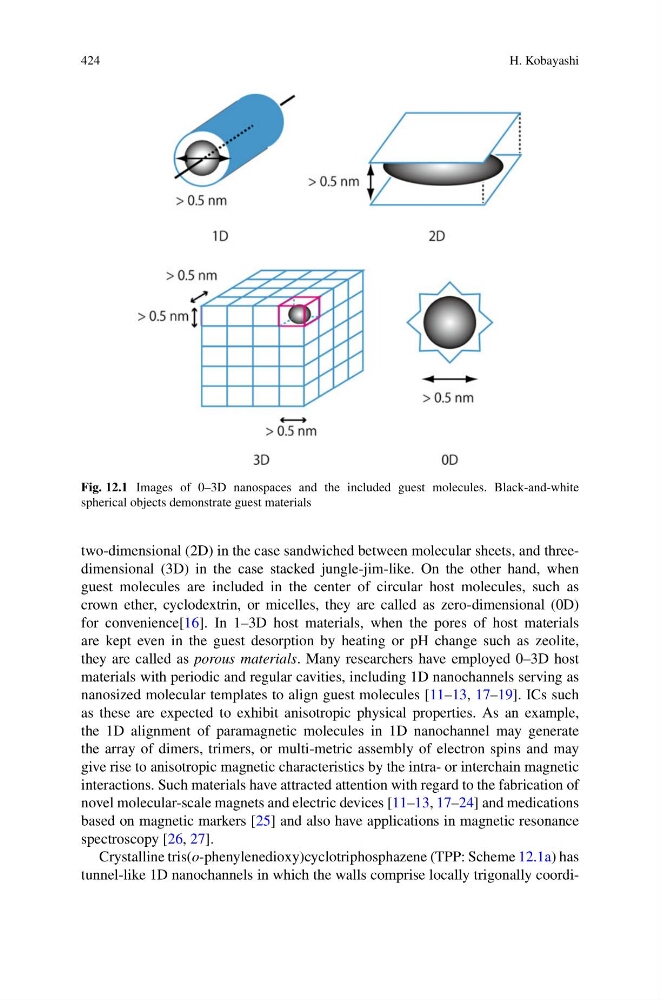
Fig. 12.1 Images of 0–3D nanospaces and the included guest molecules. Black-and-white
spherical objects demonstrate guest materials
two-dimensional (2D) in the case sandwiched between molecular sheets, and threedimensional (3D) in the case stacked jungle-jim-like. On the other hand, when
guest molecules are included in the center of circular host molecules, such as
crown ether, cyclodextrin, or micelles, they are called as zero-dimensional (0D)
for convenience[16]. In 1–3D host materials, when the pores of host materials
are kept even in the guest desorption by heating or pH change such as zeolite,
they are called as porous materials. Many researchers have employed 0–3D host
materials with periodic and regular cavities, including 1D nanochannels serving as
nanosized molecular templates to align guest molecules [11–13, 17–19]. ICs such
as these are expected to exhibit anisotropic physical properties. As an example,
the 1D alignment of paramagnetic molecules in 1D nanochannel may generate
the array of dimers, trimers, or multi-metric assembly of electron spins and may
give rise to anisotropic magnetic characteristics by the intra- or interchain magnetic
interactions. Such materials have attracted attention with regard to the fabrication of
novel molecular-scale magnets and electric devices [11–13, 17–24] and medications
based on magnetic markers [25] and also have applications in magnetic resonance
spectroscopy [26, 27].
Crystalline tris(o-phenylenedioxy)cyclotriphosphazene (TPP: Scheme 12.1a) has
tunnel-like 1D nanochannels in which the walls comprise locally trigonally coordi-
H. Kobayashi
Fig. 12.1 Images of 0–3D nanospaces and the included guest molecules. Black-and-white
spherical objects demonstrate guest materials
two-dimensional (2D) in the case sandwiched between molecular sheets, and threedimensional (3D) in the case stacked jungle-jim-like. On the other hand, when
guest molecules are included in the center of circular host molecules, such as
crown ether, cyclodextrin, or micelles, they are called as zero-dimensional (0D)
for convenience[16]. In 1–3D host materials, when the pores of host materials
are kept even in the guest desorption by heating or pH change such as zeolite,
they are called as porous materials. Many researchers have employed 0–3D host
materials with periodic and regular cavities, including 1D nanochannels serving as
nanosized molecular templates to align guest molecules [11–13, 17–19]. ICs such
as these are expected to exhibit anisotropic physical properties. As an example,
the 1D alignment of paramagnetic molecules in 1D nanochannel may generate
the array of dimers, trimers, or multi-metric assembly of electron spins and may
give rise to anisotropic magnetic characteristics by the intra- or interchain magnetic
interactions. Such materials have attracted attention with regard to the fabrication of
novel molecular-scale magnets and electric devices [11–13, 17–24] and medications
based on magnetic markers [25] and also have applications in magnetic resonance
spectroscopy [26, 27].
Crystalline tris(o-phenylenedioxy)cyclotriphosphazene (TPP: Scheme 12.1a) has
tunnel-like 1D nanochannels in which the walls comprise locally trigonally coordi-